Understanding Burners & Combustion Control Technologies
Burners & Combustion systems rely on two primary control architectures: relay-based control units and pressure switch monitoring devices. For HVAC contractors managing installations across diverse applications—from residential boiler systems to commercial industrial heating—understanding the functional differences between these technologies directly impacts system reliability, maintenance costs, and safety compliance.
With over 35 years of experience as a global industrial equipment distributor, 3G Electric has observed how contractor selection of these components influences long-term system performance. The choice between a control relay like the Kromschroder Relay BCU 570WC1F1U0K1-E and a dedicated pressure switch like the Kromschroder DG 50U/6 isn't simply about cost—it's about matching control architecture to your specific application demands, regulatory environment, and maintenance workflow.
Both technologies serve essential roles in Burners & Combustion safety and performance. Control relays orchestrate the complete ignition sequence, flame detection, and burner shutdown logic. Pressure switches monitor fuel and air conditions, providing critical safety interlocks. Many modern systems integrate both technologies, creating a layered safety approach that exceeds minimum compliance requirements.
Control Relay Units: The Logic Center of Burners & Combustion Systems
Control relays function as the "brain" of modern Burners & Combustion installations. The Kromschroder BCU 570WC1F1U0K1-E exemplifies how contemporary relay design handles multiple ignition strategies while maintaining EN 746-2 and EN 676 compliance across unlimited operating cycles.
Key operational advantages of relay-based control:
- Sequence management: Relays execute pre-purge cycles, ignition attempts, flame verification, and safe shutdown sequences automatically without manual intervention
- Multi-mode flexibility: Supporting direct ignition, intermittent pilot, and continuous pilot modes allows single relay deployment across diverse burner types and power ratings
- Flame monitoring integration: Built-in logic processes signals from UV, ionization, or flame rod sensors, making relay units inherently safer than standalone pressure switches
- Diagnostic capability: Modern relays provide troubleshooting outputs that help contractors identify issues faster during commissioning and maintenance
For HVAC contractors, relay-based Burners & Combustion control eliminates complex relay ladder logic. Instead of assembling multiple discrete relays and timers on-site, contractors deploy a single integrated unit. This accelerates installation timelines—critical when managing multiple projects—and reduces the potential for wiring errors that compromise safety.
The EN 746-2 standard compliance of the Kromschroder BCU 570WC1F1U0K1-E means contractors can confidently specify this relay across European Union markets, Middle Eastern applications, and jurisdictions adopting harmonized combustion safety standards. Real-world experience across our 35+ year distribution history shows that contractors specifying compliant relays from day one encounter fewer regulatory pushback issues during final inspections.
However, relay units typically cost 40-60% more than standalone pressure switches. Contractors managing price-sensitive retrofit projects may face client pressure to substitute pressure switches, which creates service risks covered in the next section.
Pressure Switches: Essential Safety Interlocks for Fuel and Air Conditions
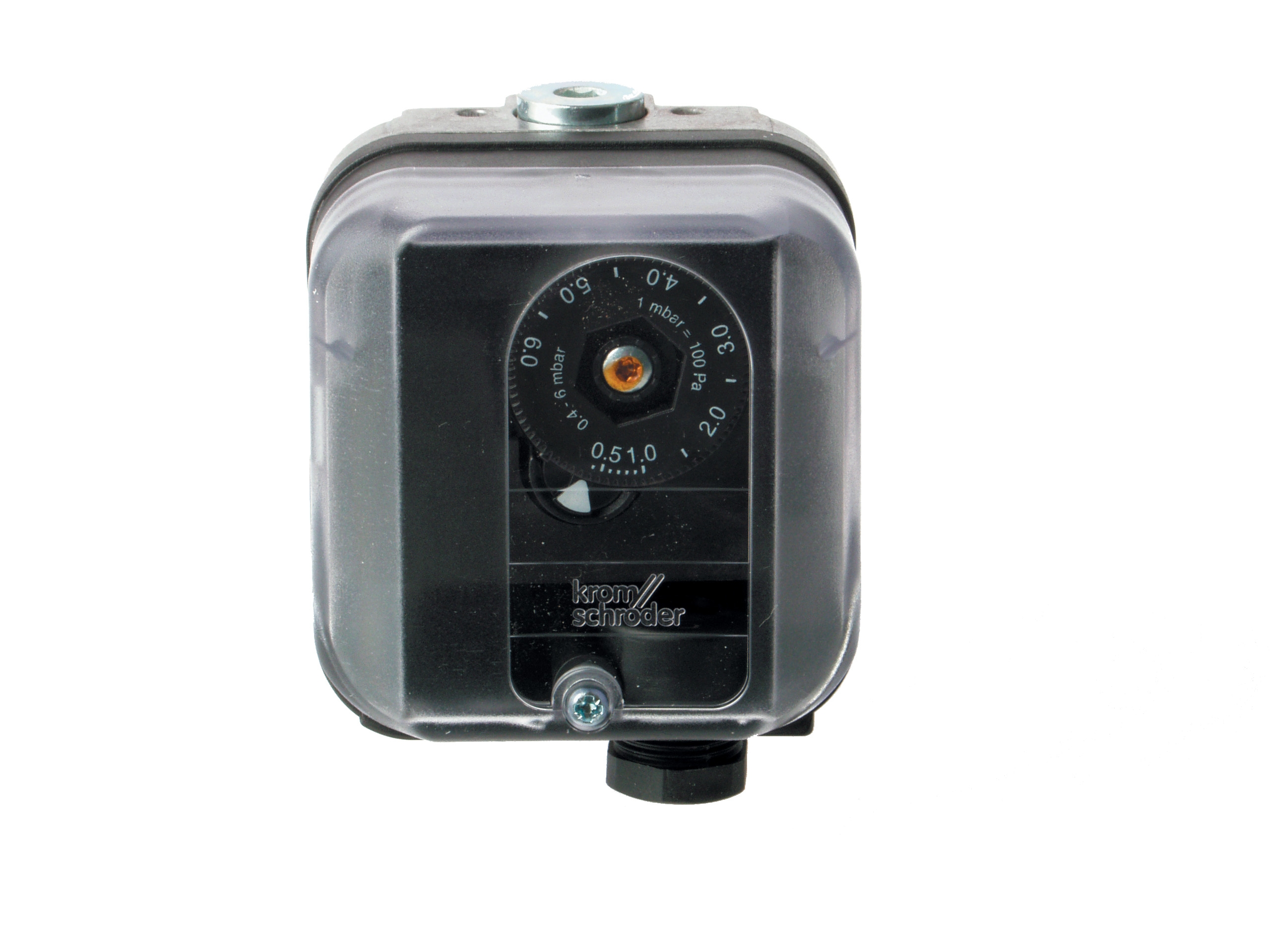
Pressure switches like the Kromschroder DG 50U/6 serve a fundamentally different function than control relays. Rather than orchestrating sequences, pressure switches verify that fuel delivery and combustion air supply meet safe operating parameters before permitting burner operation.
Critical monitoring functions of pressure switches in Burners & Combustion systems:
- Fuel pressure verification: Confirms fuel pump delivery meets minimum pressure thresholds before ignition attempts
- Air pressure interlock: Ensures combustion air fan operates and maintains proper fan pressure before burner energization
- Loss of signal protection: Automatically shuts down burners if fuel pressure drops or air pressure falls below safe minimums during operation
- SIL-rated safety response: The DG 50U/6's SIL 3 and Performance Level e rating means the switch itself meets functional safety standards for safety-critical applications
Multi-certification across EN 1854, FM, UL, AGA, and GOST-TR standards makes pressure switches like the Kromschroder DG 50U/6 suitable for global Burners & Combustion deployments. Contractors expanding operations into new geographic markets can specify this pressure switch with confidence across North American (FM/UL), European (EN/CE), and Russian/CIS (GOST-TR) jurisdictions.
From a maintenance perspective, pressure switches offer simplicity. They respond to physical pressure conditions without complex electronic logic. When a pressure switch fails, troubleshooting is straightforward: test inlet pressure, confirm outlet switch response, and replace if needed. HVAC service technicians with basic electrical skills can diagnose pressure switch issues without specialized training.
The operational cost advantage compounds over time. A single pressure switch costs $150-250 retail, versus $600-1200 for a control relay. For contractors managing fleets of customer installations, pressure switch replacement parts inventory costs remain manageable. Contractors can stock multiple DG 50U/6 units across service vans for emergency repairs without significant capital allocation.
Yet pressure switches alone cannot implement safe Burners & Combustion ignition sequences. They cannot distinguish between flame presence and flame absence. They cannot execute programmed purge cycles. They cannot enforce minimum ignition trial periods required by safety standards. This is why effective Burners & Combustion systems integrate pressure switches within relay-controlled logic.
Practical Integration: When to Specify Relays, Pressure Switches, or Both
The real-world decision facing HVAC contractors isn't "relay versus pressure switch"—it's understanding how both technologies collaborate within complete Burners & Combustion control architecture.
Scenario 1: New commercial boiler installations
Specify a control relay like the Kromschroder BCU 570WC1F1U0K1-E combined with a pressure switch like the Kromschroder DG 50U/6. The relay manages ignition sequence and flame verification; the pressure switch provides redundant fuel and air condition monitoring. This dual-layer approach exceeds EN 746-2 compliance margins and reduces nuisance shutdowns from momentary pressure fluctuations. Client trust increases when commissioning proceeds without false alarms.
Scenario 2: Industrial dual-fuel applications
Larger industrial burners like the FBR GAS XP 60/2 CE TC EVO or FBR KN 1300/M TL EL require sophisticated Burners & Combustion control that handles fuel changeover, modulation ramping, and air damper positioning. Standard control relays prove insufficient; these applications demand multi-function control units like the Siemens LFL 1.622, which combines relay logic with integral flame detection processing and damper control outputs. Pressure switches supplement by monitoring fuel line conditions between tank and burner inlet.
Scenario 3: Emergency retrofit on budget timeline
When replacing failed burner controls on existing residential heating systems, contractors often encounter space constraints and cost limitations. Specify a pressure switch if the original installation already included a basic relay logic assembly that functions correctly. The pressure switch adds safety redundancy without redesigning existing wiring. However, document this decision clearly for the building owner; the system lacks the enhanced safety margins of modern integrated relays.
Scenario 4: Planned system upgrades
When scheduling maintenance on older Burners & Combustion systems nearing component end-of-life, propose relay upgrades to the client. Modern relays like the Kromschroder BCU 570WC1F1U0K1-E incorporate diagnostic outputs that legacy pressure switches cannot provide. Upgrading eliminates repeated service calls from nuisance shutdowns and improves system efficiency through better air damper control. The higher initial investment pays dividends in reduced service costs over the system's remaining operational life.
Compliance and Certification Considerations for Global HVAC Operations
HVAC contractors operating internationally face complex regulatory landscapes for Burners & Combustion equipment. Component selection must account for regional compliance requirements that vary significantly.
European Union jurisdictions mandate EN 746-2 compliance for burner control equipment. The Kromschroder BCU 570WC1F1U0K1-E meets these requirements explicitly. North American FM and UL certifications take precedence in Canada and the United States. The Kromschroder DG 50U/6 carries both certifications, enabling single SKU inventory for North American contractors. Russian Federation and CIS markets increasingly require GOST-TR certification for imported equipment. The DG 50U/6's GOST-TR rating simplifies market entry for contractors expanding into former Soviet territories.
Contractors should avoid regional improvisation. Specifying European relays on North American installations without proper FM/UL documentation creates liability exposure and complicates insurance claims following system failures. 3G Electric's 35+ year distribution history demonstrates that contractors who maintain compliance rigor from project inception encounter fewer regulatory friction points and build stronger client relationships based on transparency.
Certification also influences spare parts availability. An FM-certified pressure switch can be sourced quickly through established North American distribution networks. Non-certified or regionally restricted components may require lengthy international shipping, leaving customer systems offline during critical heating seasons.
Making Your Selection: Technical Specifications That Matter
When comparing Burners & Combustion control options, focus on these practical specifications:
For Control Relays:
- Supported ignition modes (direct, intermittent pilot, continuous pilot)
- Maximum number of ignition trials and trial duration
- Flame signal input compatibility (UV, ionization, flame rod)
- Operating cycle limit (some older relays limit total cycles; modern units support unlimited operation)
- Integrated or external air damper control capability
- Pressure range and setpoint adjustability
- SIL rating and response time (critical for safety-rated applications)
- Port sizes and connection thread types (ensure mechanical compatibility with existing piping)
- Electrical contact rating (some pressure switches handle only pilot signals; others switch main fuel solenoids directly)
During equipment selection, verify that relay and pressure switch pressure ranges coordinate. If a fuel pump produces 3.5 bar output, both the pressure switch setpoint and relay fuel input threshold must accommodate this pressure. Mismatched specifications cause nuisance shutdowns or prevent ignition—both conditions increase service callbacks and damage contractor reputation.
Conclusion: Building Reliable Burners & Combustion Systems
The most reliable Burners & Combustion systems integrate control relays and pressure switches with complementary specifications and clear functional responsibility. Control relays orchestrate safe operating sequences; pressure switches monitor physical conditions and provide redundant shutdown logic. Together, these technologies create layered safety that exceeds regulatory minimums while reducing long-term maintenance costs.
As a global industrial equipment distributor for over 35 years, 3G Electric recognizes that HVAC contractors succeed by understanding these technical relationships and matching them to project-specific requirements. Selecting the Kromschroder BCU 570WC1F1U0K1-E for EU compliance, the Kromschroder DG 50U/6 for North American safety redundancy, or the Siemens LFL 1.622 for complex industrial modulation represents informed decision-making that your clients will appreciate through reliable, efficient heating system operation.
Contact 3G Electric's technical team to discuss Burners & Combustion control specifications for your next project. Our distribution expertise helps you navigate compliance requirements, optimize component selection, and maintain cost-effective inventory across your service region.