Understanding Pumps & Compressors Displacement vs. Real-World Demand
In Singapore's competitive manufacturing and marine sectors, oversized Pumps & Compressors systems consume 20-40% more energy than necessary, while undersized units create bottlenecks and accelerated wear. Displacement (measured in cc/rev or L/min) is the fundamental specification that determines whether your hydraulic system matches production reality.
Drawing on 35+ years of industrial equipment distribution experience, 3G Electric has observed that most scaling failures occur not in pump selection, but in capacity planning. A facility might specify a 100 hp pump because legacy documentation references it—without analyzing actual simultaneous load demands. Modern industrial operations in Singapore require data-driven sizing, especially as energy costs rise and carbon reporting intensifies.
The critical distinction is between peak demand and sustained demand. A punch press may draw 150 bar for 2 seconds per cycle, but run idle for 8 seconds. Over an 8-hour shift, the average power requirement is drastically lower. Pumps & Compressors sized for peak rather than average create waste heat, accelerate seal degradation, and inflate utility bills.
Compact Models for High-Pressure, Low-Volume Applications
Singapore's electronics manufacturing, precision tooling, and medical device sectors frequently require small-displacement, high-pressure Pumps & Compressors. These applications demand reliability in confined spaces with minimal maintenance access.
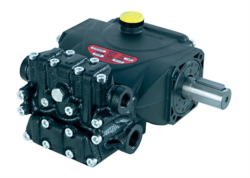
The Interpump PUMP E1D1808 L delivers 8 L/min at 180 bar with just 2.72 kW input power, weighing only 5 kg. This unit suits applications where space and weight constraints are critical—typical in automated assembly lines and robotic clamping systems. At 2,800 rpm, it operates efficiently without requiring heavy motor infrastructure.
For slightly higher displacement, the Interpump ET1C1612 SX*D20 provides 12 L/min at 160 bar with 3.68 kW power, operating at 1,750 rpm. The PTFE construction resists contamination in food processing and pharmaceutical environments—common in Jurong and Tuas industrial zones.
These compact units typically replace larger, obsolete systems during facility modernization. A Singapore semiconductor assembly plant might retire a 22 kW pump controlling secondary coolant circulation and consolidate with the ET1C1612 for pilot pressure lines, reducing annual energy spend by 18,000 kWh. The key calculation: multiply rated flow (L/min) by pressure (bar) and divide by 600 to determine approximate kW consumption, then compare against current utility metering.
Mid-Range Systems: Balancing Displacement and Affordability
Manufacturing operations requiring sustained 100-150 L/min flows at moderate-to-high pressure form the largest segment of Singapore's industrial base. Textile finishing, hydraulic press operations, and injection molding facilities operate in this displacement band.
The Pratissoli PUMP SS71153 delivers 122 L/min at 160 bar with a 37.5 kW motor at 800 rpm. This displacement level suits secondary circuit systems where response time is less critical than energy efficiency. At 800 rpm, wear rates are significantly lower than 2,800 rpm designs, translating to 8,000+ hours between seal replacement intervals.
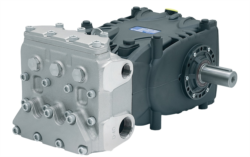
For operations requiring higher pressure or flow, the Pratissoli KF30 provides 106 L/min at 200 bar with 40 kW power. The KF Family's Italian engineering (Interpump Group heritage) ensures pressure stability across load ranges—critical in extrusion lines where material consistency directly impacts product quality. The 72 kg weight enables retrofit into existing manifold blocks without structural reinforcement.
When comparing these mid-range units, calculate the duty cycle percentage: if a punch press operates at full displacement 40% of shift time, the effective power is 40 kW × 0.4 = 16 kW sustained. This figure—not nameplate rating—should drive energy procurement conversations with your utility.
High-Displacement Systems for Integrated Multi-Axis Operations
Singapore's advanced manufacturing, including ship repair, aerospace component fabrication, and large-scale automation, frequently requires 200+ bar systems feeding multiple independent circuits. These integrated hydraulic "power stations" demand Pumps & Compressors capable of sustaining 200+ L/min without pressure ripple or cavitation.
The Pratissoli MW40 represents this high-displacement category: 211 L/min at 210 bar with 85 kW power, weighing 264 kg. A single MW40 can supply:
- Main press circuit (180 bar, 80 L/min)
- Pilot/control circuit (50 bar, 20 L/min)
- Cooling circuit (20 bar, 111 L/min)
The pressure flexibility of the MW40 accommodates cascade systems where secondary circuits operate at lower pressure, reducing throttling losses. In one Tuas marine equipment manufacturer's case, upgrading from two separate 50 kW pumps to a single MW40 reduced motor current by 12% while improving response time due to unified filtration and reduced line friction.
High-displacement systems also benefit from variable displacement control. While fixed-displacement units (all models mentioned) operate continuously at rated speed, many Singapore facilities pair them with load-sensing proportional valves. This approach maintains system pressure only when load is present, saving 6,000-9,000 kWh annually for a typical 80-hour-per-week facility.
Practical Scaling Framework for Singapore Operations
Industrial professionals should follow this diagnostic sequence when right-sizing Pumps & Compressors:
Step 1: Measure Actual Simultaneous Demand
Do not rely on equipment nameplates or historical specifications. Install pressure gauges and flow meters on active circuits for one production week. Record peak and average values separately.
Step 2: Calculate Total System Margin
Add 15% headroom to sustained average demand—not peak demand. This allows for pressure loss across hoses, fittings, and valves without undersizing. If actual measurement shows 85 L/min average, specify for 98 L/min (85 × 1.15).
Step 3: Match Displacement Band
Select a pump model whose rated displacement falls within 85-110% of calculated demand. The Interpump and Pratissoli portfolios distributed by 3G Electric offer consistent 5-10 L/min increments, enabling precise matching.
Step 4: Verify Pressure Class
Chose the lowest pressure rating that accommodates your peak pressure requirement. Operating at 160 bar instead of 210 bar reduces seal stress, doubles seal life, and decreases motor current by 8-12%.
Step 5: Assess Speed and Noise
For noise-sensitive environments (food processing, pharmaceutical clean rooms), favor 800 rpm models like the SS71153 over 2,800 rpm designs. The decibel reduction exceeds 6 dB—noticeable to workers and facilities managers.
Step 6: Calculate Total Cost of Ownership
Capital cost represents only 18-22% of five-year pump ownership expense. Motor electricity, seal replacement, and heat exchanger load dominate long-term cost. A kW saved continuously equals approximately SGD 1,500 annual utility savings in Singapore's industrial tariff structure.
Common Scaling Pitfalls and Solutions
Pitfall 1: Specifying for Peak Demand
A facility experiences 200 bar pressure for 15 seconds per cycle on a 90-second cycle time = 17% duty cycle. Sizing for 200 bar continuous wastes energy 83% of the time. Solution: Use load-sensing valves with fixed-displacement pumps, or specify variable-displacement units for primarily intermittent loads.
Pitfall 2: Ignoring Thermal Load
Under-sized Pumps & Compressors operating at high pressure generate excessive heat. A 40 kW pump at 200 bar continuous may generate 8-12 kW heat requiring expensive cooling infrastructure. Solution: Verify heat rejection capacity in equipment datasheets; budget for auxiliary coolers in tropical Singapore climates.
Pitfall 3: Consolidation Without Analysis
When replacing dual 30 kW systems with a single 60 kW pump, many facilities assume 50% energy savings. In reality, consolidated systems may require higher pressure to reach remote circuits, negating efficiency gains. Solution: Calculate pressure drop across extended hose runs before consolidating systems.
Pitfall 4: Over-Specifying Pressure
Specifying 250 bar capability when peak demand is 160 bar adds 15-18% to pump cost and increases seal replacement frequency by 40%. Solution: Review pressure requirements circuit-by-circuit; use proportional valves to limit secondary circuits to minimum necessary pressure.
Conclusion: Informed Scaling Drives Operational Excellence
Right-sizing Pumps & Compressors systems represents one of the highest ROI investments in Singapore industrial facilities. A 30 kW pump operating 2,000 hours annually consumes 60,000 kWh; oversizing by 25% means 15,000 kWh wasted annually—equivalent to SGD 2,250 in electricity costs plus environmental impact.
3G Electric's 35+ years distributing industrial equipment across Southeast Asia demonstrates consistent patterns: facilities that invest in proper demand measurement and capacity planning recover their analysis costs within 18 months through energy savings and reduced maintenance intervals. The Pratissoli KF30, MW40, and Interpump E-Series models referenced above represent proven solutions—but only when matched to accurately measured system requirements.
Your next scaling decision should begin with data, not tradition. Contact 3G Electric's technical team to review your facility's actual hydraulic demand and specification recommendations based on 3,000+ installations across Singapore's manufacturing sectors.