Understanding Pumps & Compressors: Core Functional Differences
Pumps and compressors are both positive displacement devices, yet their operational principles and application scopes differ fundamentally. A pump moves incompressible fluids (typically liquids) by converting mechanical energy into flow energy, maintaining relatively constant volume delivery regardless of pressure fluctuations. In contrast, a compressor reduces the volume of compressible gases, increasing pressure and density for storage, transfer, or pneumatic actuation.
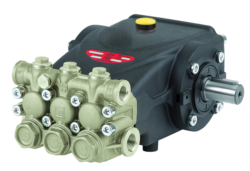
For procurement engineers evaluating equipment specifications, this distinction is critical. Pumps operate within defined pressure ranges—typically 100 to 400 bar for industrial hydraulic systems—while compressors scale from low-pressure applications (5-10 bar for pneumatic tools) to high-pressure systems exceeding 250 bar for specialized industrial processes. The Interpump PUMP E3B2515I R exemplifies precision pump engineering, delivering consistent displacement across varying load conditions, whereas compressor selection requires assessment of compression ratio, inlet air temperature, and moisture management.
With 35+ years of experience as a global industrial equipment distributor, 3G Electric recognizes that procurement teams must understand these fundamental differences to prevent specification mismatches, costly equipment downtimes, and integration failures. The choice between pump and compressor—or the decision to deploy both within an integrated system—determines upstream component selection, downstream application capability, and total cost of ownership across the equipment lifecycle.
Specification Comparison: Displacement, Pressure, and Flow Characteristics
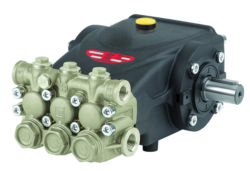
Displacement represents the volume of fluid moved per revolution (measured in cc/rev or cm³/rev) for pumps, and compression efficiency depends on displacement matched to target pressure differentials. The Interpump PUMP E3B2515 L and Interpump PUMP E3C1515 L both operate at different displacement values, allowing procurement teams to model system configurations where dual-pump arrangements handle varying flow demands without pressure penalty.
Pump Specification Hierarchy:
- Displacement Range: 5-150 cc/rev for industrial hydraulic applications; determines base flow rate at rated RPM
- Pressure Rating: System pressure capacity (100-400 bar standard); exceeding rated pressure causes seal degradation and catastrophic failure
- Volumetric Efficiency: 90-98% for modern gear and vane pumps; directly impacts system power consumption and thermal load
- Rotational Speed Tolerance: Narrow RPM windows (typically ±5%) ensure displacement accuracy; over-speed causes cavitation
- Displacement (Swept Volume): 20-500 cm³/rev; determines flow capacity at atmospheric inlet conditions
- Compression Ratio: Final pressure divided by inlet pressure; higher ratios reduce volumetric efficiency, requiring cooling stages
- Isothermal vs. Adiabatic Efficiency: Real-world systems operate between theoretical boundaries; moisture condensation demands separator specification
- Intake Air Quality: Particulate contamination and humidity directly degrade compressor lifespan; filtration becomes procurement specification requirement
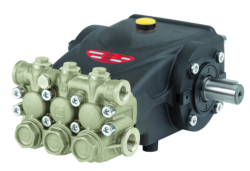
The Interpump PUMP E3B1515 DX with Valve and Gearbox RS500H demonstrates integrated procurement strategy—combining pump, directional control valve, and gearbox reduction into single skid-mounted assembly. This approach eliminates field integration complexity and warranty disputes between component suppliers. Similarly, compressor procurement should specify integrated moisture separation, pressure regulation, and particulate filtration rather than treating these as aftermarket additions.
Application Matching: Selecting Between Pump and Compressor Technologies
Industrial systems frequently employ both pumps and compressors within complementary operational roles. Excavators, for example, use hydraulic pumps for boom/bucket actuation (high force, moderate speed) while deploying pneumatic compressors for dust suppression and jackhammer actuation (lower force, higher speed distribution). Procurement engineers must evaluate application-specific demands to justify equipment selection.
Pump-Preferred Applications:
- Machine tools: Requiring precise pressure control and rapid response; hydraulic pumps deliver 10-15 ms response times vs. 50+ ms for pneumatics
- Heavy load actuation: Cranes, presses, injection molding machinery; hydraulic pressure density (400 bar) enables compact cylinder sizing vs. pneumatic alternatives
- Continuous duty systems: Pumps maintain consistent pressure under sustained loads; compressors require intermittent duty cycles to prevent thermal runaway
- Closed-loop applications: Pumps with integrated feedback maintain position accuracy; pneumatic systems lack inherent feedback mechanism
- Distributed actuation networks: Compressed air transmits through simple tubing; ideal for factories with multiple work stations requiring tool-independent power
- Spark/contamination-sensitive environments: Pneumatic systems eliminate fire risk in explosive atmospheres; hydraulic fluid leakage poses ignition hazard
- Tool-intensive operations: Pneumatic impact wrenches, nail guns, grinding tools leverage low capital cost and interchangeable quick-disconnects
- Low-duty-cycle actuation: Compressor startup consumes significant energy; systems requiring occasional actuation amortize startup overhead
The Interpump PUMP E3C1021 DX with Valve and No.C/J Configuration and similar modular pump systems enable procurement teams to construct hybrid hydraulic-pneumatic architectures. High-pressure hydraulic circuits actuate primary loads while secondary pneumatic systems (powered by small shaft-driven compressors) handle control and automation functions. This topology optimizes energy efficiency—avoiding constant pump displacement when only auxiliary functions require actuation.
Procurement engineers should evaluate system duty cycles quantitatively: if a machine tool operates pump 40% of shift time, energy cost justifies hybrid pump-compressor architecture. If pneumatic actuation occurs 80%+ of time, dedicated compressor procurement with remote pump activation becomes economically superior.
Integration, Lifecycle Management, and Procurement Strategy
Selecting individual pump or compressor units represents incomplete procurement strategy. Industrial equipment requires integration planning, spare parts inventory, operator training, and condition monitoring to achieve expected lifespan (8,000-12,000 hours for hydraulic systems; 10,000-20,000 hours for reciprocating compressors).
Pump Integration Considerations:
Hydraulic pumps generate substantial heat—a 50 kW pump at 90% efficiency produces 5 kW thermal load. Cooling system specification (immersion coolers, heat exchangers) becomes procurement requirement. Filtration must remove particles <10 microns to prevent servo valve sludging and actuator stick-slip. Accumulator sizing determines pressure ripple and shock absorption capacity. The Interpump PUMP E3B2515I R paired with proper manifold, cooler, and filter specification defines complete hydraulic circuit; specifying pump alone creates field integration burden and performance risk.
Compressor Integration Considerations:
Moisture management represents highest reliability risk in compressed air systems. Inlet air at 85% relative humidity and 25°C contains ~20 grams water per kilogram dry air. At 8 bar, that moisture condenses into liquid form, corroding tools and pneumatic actuators. Integration procurement must specify: (1) refrigerated dryer reducing dew point to -15°C, (2) particulate filters to 1 micron, (3) oil-removal cartridges for oil-lubricated compressors, (4) automated drain cycles to remove separator condensate. System design without dryer specification guarantees 18-month actuator failure cycle.
Spare Parts and Lifecycle Planning:
With 35+ years industry experience, 3G Electric emphasizes that spare parts procurement during initial equipment purchase prevents supply chain vulnerabilities during emergency repairs. Pump seal kits, filter elements, and compressor valve plates should be purchased as capital equipment, not emergency procurements. Condition monitoring—tracking pump discharge pressure ripple, compressor outlet temperature, and coolant condition—enables predictive maintenance scheduling, reducing unplanned downtime by 40-60%.
Procurement engineers should establish equipment lifecycle documentation: original specification sheets, maintenance schedules, contamination limits, and supplier contact information. This documentation accelerates troubleshooting when field performance diverges from expected behavior and provides contractual baseline for warranty claims.
Practical Specification Framework: Pump vs. Compressor Decision Matrix
To systematize pump vs. compressor selection, procurement engineers should evaluate systems across five decision dimensions:
1. Operating Pressure Required: Above 30 bar, hydraulic pumps become economically superior; below 10 bar, pneumatic compressors dominate.
2. Duty Cycle Duration: Continuous 8+ hour operations favor pumps; intermittent <2 hour operations favor compressors.
3. Flow Distribution Complexity: Single-point high-flow demand (single large cylinder) favors pumps; distributed low-flow demand (network of tools) favors compressors.
4. Environment Classification: Hazardous/explosive areas mandate pneumatics; standard industrial environments can optimize for cost (typically pneumatics).
5. Response Time Requirement: Servo-controlled systems with <20 ms actuation windows require hydraulic pumps; standard industrial actuation tolerates pneumatic latency.
Documenting application requirements across these dimensions prevents over-specification (purchasing 400 bar pump for 50 bar application) and under-specification (deploying pneumatics where hydraulic reliability is mandatory). Procurement teams can then match equipment selection—such as choosing Interpump PUMP E3C1515 L for modular configurations or integrated skids like the Interpump PUMP E3B1515 DX with Gearbox RS500H—with documented system requirements, enabling accountability and performance validation.