How to Match Pump Flow Rate and Pressure for Industrial Applications in Singapore
Selecting the wrong pump flow and pressure combination is one of the costliest mistakes industrial operators make in Singapore's demanding manufacturing and processing sectors. When flow rate and pressure specifications don't align with your application requirements, you face equipment damage, operational inefficiency, and unexpected downtime. This guide provides a technical framework for accurately matching pump performance parameters to your specific industrial needs, using real equipment specifications from leading pumps and compressors suppliers. Whether you're specifying equipment for high-pressure cleaning systems, process water transfer, or precision industrial applications, understanding the relationship between flow, pressure, and power consumption is essential. We'll walk through the calculations, present real-world product examples, and help you avoid the common sizing errors that plague Singapore's industrial operations.
Understanding the Flow-Pressure-Power Relationship
Industrial pump performance operates around a fundamental hydraulic principle: power is the product of flow rate and pressure. Understanding this relationship is critical before selecting any industrial pump. Flow rate, measured in litres per minute (L/min) or US gallons per minute (GPM), represents the volume of fluid your pump delivers in a set time period. Pressure, measured in bar, MPa, or PSI, represents the force per unit area that the pump applies to move that fluid against system resistance.
The relationship between these parameters determines the power requirement. A pump delivering 15 L/min at 500 bar requires significantly more power than a pump delivering the same flow at 90 bar. In Singapore's tropical climate with high humidity and temperature fluctuations, this relationship becomes even more critical—oversized equipment generates excess heat, while undersized equipment stalls or fails prematurely.
Hydraulic power is calculated using the formula: Power (kW) = (Pressure in bar × Flow in L/min) / 600. This relationship is not linear—doubling your pressure requirement roughly doubles your power needs if flow remains constant. Real-world efficiency losses from friction, leakage, and mechanical resistance typically range from 10-25%, meaning actual power requirements exceed theoretical calculations.
The critical insight: you cannot simply specify a pump by looking at either flow or pressure in isolation. A system requiring 8 L/min at 90 bar demands a fundamentally different pump (lower power, lighter duty) than one requiring 15 L/min at 500 bar, even though both might technically "work" in certain applications. Application-specific duty cycles, fluid type, ambient conditions, and required component lifespan all factor into proper sizing. Singapore's industrial professionals must account for the extended operating hours common in tropical manufacturing environments—equipment specified without adequate margin for continuous operation will fail catastrophically.
Real Industrial Pump Specifications: Matching Parameters to Applications
Let's examine specific pump models currently available through Singapore distributors to understand how flow-pressure relationships translate to practical equipment selection.
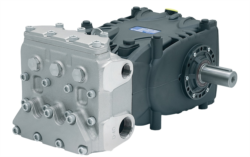
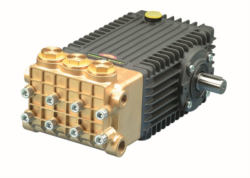
The Interpump PUMP WW90 R + FLANGE B3B14 represents the entry level for compact industrial applications. This unit delivers 8 L/min (2.11 US GPM) at 90 bar (1,300 PSI) pressure while consuming only 1.47 kW of power. Its compact dimensions (177×175×130 mm) and lightweight 5.2 kg mass make it ideal for mobile systems, portable equipment, and space-constrained installations. Theoretical hydraulic power = (90 × 8) / 600 = 1.2 kW, with the 1.47 kW motor accounting for efficiency losses. Applications include light-duty pressure washing, small process transfer systems, and component testing equipment.
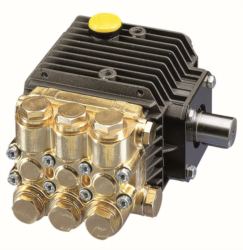
Moving to mid-range applications, the Interpump TSX 10.130 220/50 MULTIREG+ROTOTEK delivers 9.5 L/min at 130 bar (1,885 PSI) with integrated regulation and jet reaction control (<29 N). This unit weighs 44.5 kg and operates at maximum 160 bar (2,300 PSI), providing operational headroom for system transients. The pressure-regulation function eliminates the need for separate relief valves, reducing system complexity. Theoretical power = (130 × 9.5) / 600 = 2.06 kW. This specification suits general industrial pump-down operations, moderate-pressure cleaning systems, and transfer applications throughout Singapore's food processing, chemical, and manufacturing sectors.
For demanding high-pressure applications, the Interpump PUMP 5015 R ATEX represents industrial-grade performance. This 14.7 kW motor delivers 15 L/min at an extraordinary 500 bar (7,250 PSI)—among the highest pressure ratings available in compact form. At these extreme pressures, theoretical hydraulic power = (500 × 15) / 600 = 12.5 kW, with the 20 hp (14.7 kW) specification accommodating losses and providing operational margin. The ATEX certification indicates suitability for explosive atmospheres, critical for petrochemical and pharmaceutical operations in Singapore. Rotation speed of 1,450 rpm ensures reliable long-term operation under the high thermal loads associated with extreme-pressure systems.
The Interpump TSX 15.150 415/50 MULTIREG99 bridges moderate and high-pressure applications, delivering 15 L/min at 150 bar (2,175 PSI) with maximum rated pressure of 180 bar (2,610 PSI). Theoretical power = (150 × 15) / 600 = 3.75 kW. This specification exemplifies the modern trend toward integrated pressure regulation—the MULTIREG99 and TOTAL STOP functions eliminate external valve requirements while providing precise system control. The 44.5 kg unit suits industrial cleaning systems, process water delivery, and precision spray applications throughout Singapore.
Step-by-Step Pump Selection by Flow and Pressure Requirements
Step 1: Document Your System Requirements
Begin by establishing actual system demands, not theoretical ideals. Measure or calculate three values: (1) Required flow rate in L/min during normal operation, (2) System resistance in bar (sum of component pressure drops plus load pressure), and (3) Peak duty cycle (hours per day, operating frequency). For Singapore operations, assume continuous operation in 35°C ambient conditions unless installation includes temperature-controlled enclosures.
Step 2: Calculate Theoretical Hydraulic Power
Using the formula Power (kW) = (Pressure × Flow) / 600, calculate minimum required motor power. Apply a 1.25-1.4× safety factor to account for efficiency losses and operational margin. For example: 130 bar × 9.5 L/min / 600 = 2.06 kW theoretical; multiply by 1.3 = 2.68 kW minimum motor specification. This margin prevents motor overheating in tropical Singapore climates and accommodates component degradation over equipment lifespan.
Step 3: Cross-Reference Available Equipment Specifications
Match your calculated requirements against available pump specifications. For a 130 bar, 9.5 L/min requirement, the TSX 10.130 at 2.5+ kW becomes immediately visible as properly sized. Avoid oversizing—a 15 L/min, 500 bar pump would be wasteful and inappropriate, while a 90 bar unit would be incapable.
Step 4: Account for Duty Cycle and Efficiency Loss
Continuous-duty applications in Singapore's heat demand higher efficiency equipment with integrated cooling. Intermittent applications tolerate smaller motors. Verify that selected motor power rating matches duty cycle recommendations in technical specifications.
Step 5: Confirm Pressure Safety Margin
Select pumps with maximum rated pressure 15-25% above system requirement. The TSX 15.150 at 180 bar maximum suits 150 bar continuous operation. This margin protects against pressure spikes from load transients and component failures.
Best Practices for Flow-Pressure Selection in Tropical Singapore Operations
Account for Thermal Effects
Singapore's tropical environment accelerates fluid degradation and reduces cooling efficiency. Select pumps with integrated pressure regulation to minimize heat generation. The MULTIREG-equipped units (TSX series) consume less parasitic power than fixed-displacement designs, reducing thermal load by 10-15% in continuous operations.
Prioritize Pressure Margin Over Exact Matching
While specifying 150 bar when your system requires exactly 150 bar seems efficient, equipment operating at absolute maximum specification generates excessive heat and fails prematurely. The TSX 15.150's 180 bar maximum rating provides 20% headroom—this margin costs nothing in purchase price but extends equipment lifespan significantly.
Consider System Scalability
Singapore's manufacturing operations frequently scale production. Specifying equipment 10-15% oversized versus absolute minimum creates future capacity without equipment replacement. A facility initially requiring 9.5 L/min can upgrade to 15 L/min operation by adjusting system configuration rather than replacing the pump.
Verify Integration with Existing Components
Pump selection must account for downstream filter, valve, and hose specifications. Over-specifying pressure forces expensive component upgrades throughout the system. Conversely, undersizing creates bottlenecks. The PUMP 5015 R ATEX at 500 bar requires industrial-grade system components—this is not compatible with standard industrial hose assemblies rated 350 bar maximum.
Validate Against Manufacturer Duty Cycle Recommendations
Interpump technical documentation specifies rotation speed (rpm) and intended duty cycles. Equipment rated 1,450 rpm operates efficiently under continuous load, while higher-speed designs (2,800 rpm) suit intermittent applications. Singapore's 24/7 manufacturing requires continuous-duty equipment—verify rpm specifications match your operation schedule.
Conclusion and Next Steps
Matching pump flow rate and pressure to your specific industrial application requires systematic analysis of system demands, calculation of hydraulic power requirements, and careful selection against available equipment specifications. The relationship between flow, pressure, and power is fundamental—undersizing creates system failure while oversizing wastes energy and reduces equipment lifespan. Singapore's tropical operating environment makes this analysis even more critical, as heat generation and efficiency losses compound in high-temperature conditions.
Real industrial pumps like the Interpump WW90 series (8 L/min, 90 bar), TSX 10.130 (9.5 L/min, 130 bar), and PUMP 5015 R ATEX (15 L/min, 500 bar) represent carefully engineered solutions for distinct application classes. Each specification reflects optimized trade-offs between power consumption, operational pressure margin, and thermal performance.
Ready to specify the right pump for your industrial application? Browse our complete pumps and compressors selection, or contact 3G Electric's technical team. Our Singapore-based engineers have specified equipment for manufacturing, cleaning, and processing operations throughout the region for over 30 years. We'll help you match flow and pressure specifications to your exact requirements, accounting for tropical climate conditions and long-term operational efficiency. Reach out today for a consultation—proper pump selection begins with understanding your system, and we're here to guide that process.