Understanding Specification Mismatch in Industrial Pumps & Compressors
Specification mismatch occurs when selected Pumps & Compressors units fail to meet application requirements across flow rate, pressure, power input, or mechanical compatibility dimensions. For procurement engineers managing industrial installations across Singapore's diverse manufacturing sectors, these mismatches represent one of the most preventable yet costly failure modes. Unlike mechanical failures that develop over time, specification errors manifest immediately upon startup—resulting in system rejection, emergency reorders, and operational delays.
3G Electric's 35+ years as an industrial equipment distributor has positioned us to observe recurring patterns in specification errors. The most common issue: engineers specify pump models based on marketing flow rates without accounting for system pressure losses, suction line resistance, or actual delivery requirements. A secondary pattern involves power input miscalculations—selecting motors that cannot sustain rated pressures under real-world load conditions.
Procurement teams must establish verification protocols before purchase commitment. This guide provides technical frameworks for identifying these mismatches and selecting correct alternatives.
Section 1: Flow Rate vs. Pressure Trade-off Analysis
The Specification Conflict
Industrial applications rarely require maximum flow at maximum pressure simultaneously. Yet procurement specifications often list both metrics without clarifying the actual operating envelope. This creates selection confusion: a high-flow, low-pressure pump may appear cheaper but fail when system pressure increases beyond design limits.
Consider two competing requirements:
- Scenario A: Hydraulic press requiring 150 bar sustained pressure with 80 L/min flow during pressing cycles
- Scenario B: Same application requests 200 L/min "for future capacity" at "at least 150 bar"
Scenario B forces selection of larger displacement pump families, increasing capital cost and motor power requirements. Pressure ratings scale linearly; flow requirements drive displacement.
Practical Troubleshooting Matrix
Step 1 - Validate Actual Operating Pressure: Request load analysis from end-user engineering. Measure pressure during representative duty cycles, not peak theoretical conditions. Systems often run at 70-80% rated pressure in actual operation.
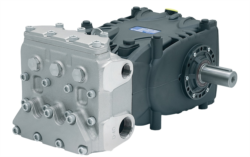
Step 2 - Calculate Required Displacement: Use formula: Displacement (cc/rev) = (Required Flow in L/min × 1000) ÷ (RPM × Efficiency). For Pratissoli KF30 pumps delivering 106 L/min at 1450 rpm, displacement calculates to approximately 73.1 cc/rev—this becomes your baseline specification.
Step 3 - Cross-Reference Pressure Rating Against Application: KF30 units rated at 200 bar suit medium-pressure hydraulic systems. If application demands 280 bar, this pump becomes unsuitable regardless of flow rate. Conversely, Pratissoli MW40 pumps offering 210 bar ratings with 211 L/min flow handle higher-pressure requirements while maintaining similar displacement efficiency.
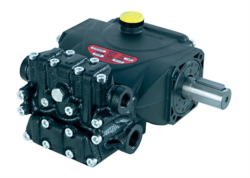
Step 4 - Verify Motor Power Availability: Hydraulic power formula: Power (kW) = (Pressure in bar × Flow in L/min) ÷ 600. For 150 bar and 100 L/min requirement, minimum power input = (150 × 100) ÷ 600 = 25 kW. KF30 rated at 40 kW provides adequate margin; compact Interpump E1D1808 units at 2.72 kW prove insufficient for this scenario.
Common Procurement Errors
Error 1 - Selecting by Flow Alone: Procurement teams sometimes source pumps meeting flow specifications without verifying pressure capability. A 300 L/min pump designed for 100 bar cannot sustain delivery when system pressure reaches 200 bar—it cavitates and fails within hours.
Error 2 - Underestimating System Losses: Hydraulic lines, filters, proportional valves, and accumulators create backpressure. Actual delivery pressure at pump discharge equals: (Load pressure) + (System losses). Ignoring losses leads to undersized pump selection. In Singapore's humid industrial environment, filter clogging accelerates, increasing system losses by 30-40 bar over operational cycles.
Error 3 - Confusing Displacement with Flow: Pump displacement (cc/rev) remains constant; actual flow varies with RPM and viscosity. A 74 cc/rev pump delivers 107 L/min at 1450 rpm but only 68 L/min at 1000 rpm. Procurement specifications must clarify operating RPM.
Section 2: Power Input and Motor Compatibility Assessment
Identifying Undersized Motor Specification
Motor power inadequacy represents the second-largest specification mismatch category. Procurement engineers frequently select pump-motor combinations based on catalog ratings rather than actual system duty.
Systematic Power Verification
Mechanical Load Analysis: Request duty cycle profile from application engineering:
- Continuous operating pressure and flow
- Peak pressure duration (seconds or minutes)
- Idle periods allowing thermal dissipation
- Ambient temperature (critical for Singapore operations where tropical heat reduces cooling efficiency)
Example: 210 bar system at 211 L/min flow:
- Theoretical power = (210 × 211) ÷ 600 = 73.85 kW
- Real power requirement = 73.85 ÷ 0.93 = 79.4 kW
- MW40 rated at 85 kW provides adequate margin for transient peaks.
- Continuous duty (S1): Motor power must exceed real power requirement by 15-20%
- Intermittent duty (S3): Duty cycle percentage reduces required motor size. 50% duty cycle allows 50% smaller motor
- Thermal margin: Singapore's 35°C ambient temperatures degrade motor efficiency 2-3% versus rated conditions. Add 5% additional power margin
Power Mismatch Consequences
Undersized motors demonstrate:
- Reduced pump displacement due to insufficient rotational speed
- Thermal runaway: motor draws excessive current attempting to deliver rated flow, generating heat that reduces winding insulation life
- Control system tripping: soft-starters and VFDs detect overcurrent, causing nuisance shutdowns
- Pump cavitation: suction-side pressure drops when motor cannot maintain speed, allowing vapor formation
Section 3: Mechanical Compatibility and Interface Standardization
Pump-Motor Coupling Failures
Mechanical interface mismatches frequently damage equipment before operational testing. Procurement teams must verify:
Shaft Connection Standards:
- Pump input shaft diameter and keyway specifications (ISO metric or SAE standards)
- Motor output shaft diameter and key dimensions
- Coupling type: flexible jaw couplings, elastomeric couplings, or rigid couplings
- Overhung load limits (pump weight moment distribution on motor shaft)
Interpump E1D1808 units with 5 kg weight create minimal overhung load, suitable for direct motor coupling. MW40 pumps weighing 264 kg require rigid mounting frames and potentially flexible couplings to accommodate thermal expansion.
Mounting Interface Verification:
- SAE flange or ISO flange standards (metric vs. Imperial specification confusion causes rejection)
- Bolt circle diameter, count, and thread pitch
- Mounting surface flatness tolerance (typically 0.05 mm over 100 mm span)
- Reservoir connection ports: NPT (National Pipe Thread) vs. ISO metric (G) thread confusion causes leakage
- Vertical vs. horizontal pump orientation (affects bearing loads and oil cooling)
- Suction line configuration: pump must position below fluid level minimum 0.5 meters for flooded suction
- Discharge line pressure rating: hose and fitting specifications must match pump operating pressure plus 25% safety margin
- Ambient environment: corrosive industrial atmosphere or washdown environments require stainless steel construction. Interpump ET1C1612 with PTFE construction provides chemical resistance; standard units corrode within 18-24 months in aggressive Singapore coastal facilities.
Component Integration Checklist
Pump Selection:
- ☐ Flow requirement verified against actual duty cycle (not marketing maximum)
- ☐ Pressure rating exceeds application peak pressure by minimum 10%
- ☐ Power input calculation confirms available motor capacity with 15-20% thermal margin
- ☐ Suction and discharge port specifications confirmed (thread type, size, pressure rating)
- ☐ Material compatibility with system fluid established (mineral hydraulic oil, water-glycol, synthetic)
- ☐ Seal material compatibility with fluid confirmed (nitrile, PTFE, FKM)
- ☐ Shaft connection and mounting interface matches available motor
- ☐ Nameplate power rating exceeds calculated power requirement
- ☐ Voltage, phase, and frequency availability at installation site confirmed
- ☐ Soft-starter or VFD programming supports pump control strategy
- ☐ Thermal protection class (IP55 minimum for industrial environments)
- ☐ Service factor minimum 1.15 for continuous duty applications
- ☐ Suction line diameter sized for 0.6 m/s fluid velocity maximum (prevents cavitation)
- ☐ Discharge line hose rated for 1.5× pump operating pressure
- ☐ Relief valve set point confirmed 5-10% above maximum system pressure
- ☐ Cooler capacity verified for continuous duty thermal load: Cooling demand (kW) = Flow (L/min) × Pressure (bar) ÷ 600 × (1 - Overall efficiency)
- ☐ Filter bypass pressure prevents unfiltered operation: typically 3.5 bar differential
Section 4: Troubleshooting Decision Framework for Procurement Engineers
Pre-Purchase Verification Protocol
Before finalizing specification or purchase order, implement this verification sequence:
Phase 1 - Requirements Definition (Week 1):
1. Request formal application specification from end-user engineering including duty cycle profile, pressure/flow ranges, ambient conditions
2. Perform independent hydraulic power calculation using the formulas provided in Section 2
3. Identify motor availability and confirm power rating margin exceeds 15% minimum
4. Validate mechanical interface compatibility through CAD or physical sample verification
Phase 2 - Specification Cross-Check (Week 2):
1. Request pump technical datasheet from distributor (3G Electric provides complete Pratissoli and Interpump documentation)
2. Verify volumetric and mechanical efficiency ratings—ensure power calculation used realistic efficiency, not theoretical 100%
3. Confirm operating pressure rating against application maximum pressure plus transient spikes
4. Cross-reference suction line design against pump inlet requirements
5. Validate seal and material compatibility with actual system fluid and temperature range
Phase 3 - System Integration Assessment (Week 3):
1. Review complete piping schematic with suction/discharge line diameters, valve placement, accumulator volumes
2. Calculate combined system losses (line friction, filter pressure drop, valve pressure drop) against pump pressure rating margin
3. Confirm cooler selection based on thermal load calculation in Section 3
4. Verify relief valve settings accommodate transient pressure peaks without nuisance opening
5. Obtain written certification from pump supplier confirming application suitability
Phase 4 - Documentation Retention (Ongoing):
Maintain specification verification file including:
- Original application requirements
- Pump technical datasheet with efficiency curves
- Motor nameplate data
- System schematic with component specifications
- Supplier application suitability certification
- Thermal load calculation and cooler selection
- Relief valve pressure setting documentation
This documentation supports root cause analysis if performance issues develop post-installation, enabling rapid identification of specification contributions versus operational factors.
When to Reject Proposed Specifications
Reject if:
- Supplier cannot provide efficiency ratings (volumetric and mechanical separately)
- Motor power rating falls below calculated requirement without documented load margin analysis
- System pressure design lacks 10% safety margin above application peak pressure
- Suction line diameter calculation unavailable (risk of cavitation)
- Discharge line pressure rating unspecified (potential rupture risk)
- Material compatibility not documented for system fluid
- Thermal load calculation missing from cooler specification
- Pump supplier cannot confirm application suitability in writing
- Flow specification exceeds 20% above calculated requirement (unnecessary cost increase)
- Pressure rating exceeds application needs by >30% (over-engineered solution)
- Motor power includes <10% thermal margin (insufficient for real-world operation)
- System integration incomplete (suction/discharge design unspecified)
- Alternative products with lower cost and equivalent performance available (comparative specification analysis required)
Leveraging 3G Electric's Technical Support
As your industrial equipment distributor with 35+ years experience, 3G Electric provides comprehensive technical support for specification verification:
- Product Selection Assistance: Our technical team cross-references your application requirements against complete Pratissoli and Interpump product families, identifying optimal solutions and alternatives
- Efficiency Data and Power Calculations: We provide detailed efficiency curves enabling accurate power requirement calculations specific to your operating conditions
- System Integration Guidance: Our engineers review your complete schematic, identifying integration risks and providing optimization recommendations
- Application Suitability Certification: We provide written documentation confirming product suitability for your specific duty cycle and operating environment
- Post-Installation Support: Should performance questions arise, our technical library and field experience support rapid root cause identification
Proactive specification verification through systematic troubleshooting frameworks prevents costly installation failures and ensures system reliability. Contact our technical team to validate your Pumps & Compressors specifications before procurement commitment.