Understanding Pumps & Compressors Sizing Fundamentals
Pumps & Compressors form the backbone of industrial fluid power systems, yet many procurement professionals struggle with proper sizing methodology. Over 35 years as a global distributor, 3G Electric has observed that undersized or oversized equipment represents one of the leading causes of operational inefficiency and premature equipment failure.
Sizing these critical components requires understanding three fundamental parameters: required flow rate (Q), system pressure (P), and power transmission method. Unlike general-purpose equipment, high-pressure industrial applications demand precision in these calculations because each 10-bar deviation from optimal pressure can increase energy consumption by 3-5% while reducing equipment lifespan by 15-20%.
The foundation of proper sizing begins with your application requirements. Before selecting any pump or compressor, you must establish: the volume of fluid or air needed per unit time (L/min or m³/min), the maximum pressure your system demands (bar or PSI), and the duty cycle (continuous, intermittent, or peak-demand operation). These three parameters determine whether you need a gear pump, centrifugal pump, piston pump, or specialized compressor configuration.
For industrial professionals managing global operations, this approach ensures compatibility across different regional power standards (50 Hz in Europe/Asia, 60 Hz in North America) and pressure conventions (bar vs. PSI). 3G Electric's experience distributing equipment worldwide reveals that regional installation differences often exceed manufacturer specifications by 15-25%, requiring deliberate oversizing in specific climates and altitudes.
Calculating Displacement and Power Requirements
Displacement represents the volume of fluid a pump delivers per revolution or per cycle—measured in cc/rev (cubic centimeters per revolution) for hydraulic pumps or cm³/rev for compressors. This metric directly determines your equipment's fundamental capability.
Step 1: Calculate Required Displacement
Use this essential formula:
Displacement (cc/rev) = (Required Flow Rate in L/min × 1000) ÷ (RPM × 0.85)
The 0.85 factor accounts for volumetric losses in real-world operation (typically 10-15% across quality equipment). For example, if your industrial process requires 100 L/min at 1500 RPM, your calculation reads: (100 × 1000) ÷ (1500 × 0.85) = 78.4 cc/rev.
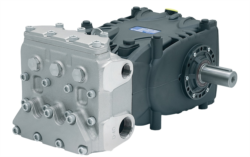
Once you establish displacement needs, cross-reference this value against available equipment. The Pratissoli KF30 industrial pump delivers 106 L/min at 40 kW, accommodating most light-to-medium industrial applications with 200-bar pressure capability. For more demanding systems, the Pratissoli MW40 high-performance pump provides 211 L/min at 210-bar pressure, doubling throughput for heavy industrial operations requiring sustained performance.
Step 2: Calculate Actual Power Requirements
Theoretical power (kilowatts) equals pressure × flow rate ÷ 600 (when using bar and L/min):
Theoretical Power = (Pressure in bar × Flow Rate in L/min) ÷ 600
However, actual motor power required must account for pump efficiency (typically 80-92% for quality pumps):
Actual Power Required = Theoretical Power ÷ Pump Efficiency
If your system needs 180 bar at 100 L/min with an 85% efficient pump: Theoretical = (180 × 100) ÷ 600 = 30 kW. Actual power needed = 30 ÷ 0.85 = 35.3 kW. You would specify a 40 kW motor minimum, which matches the KF30 pump's 40 kW rating.
This distinction between theoretical and actual power prevents the critical error of undersizing motors, which causes reduced pump lifespan, excessive heat generation, and system instability. Industrial professionals managing multi-location operations should apply an additional 10-15% safety margin when ordering motors for continuous-duty applications, accounting for voltage fluctuations and regional climate factors.
Step 3: Pressure Setting Optimization
Many industrial teams assume "higher pressure = better performance." This misconception wastes capital and energy. Optimal system pressure should be 5-10 bar above your actual load requirement, not 30-50 bar above.
For instance, if your application requires 150 bar to move a load, set system pressure to 155-160 bar. Operating at 180-200 bar unnecessarily increases:
- Energy consumption (5-7% per 10-bar increase)
- Heat generation (proportional to pressure squared)
- Hose and fitting stress
- Seal wear rates
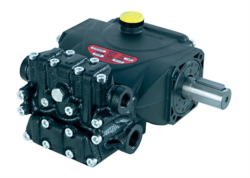
Compact equipment like the Interpump PUMP E1D1808 L (8 L/min at 180 bar) works optimally when sized exactly to application requirements rather than oversized for future expansion. This 5 kg pump suits precision high-pressure applications where every bar of unnecessary pressure directly impacts operational cost.
Selecting Equipment Based on Application Profile
Once you've calculated displacement and power requirements, application type determines your equipment family selection. Industrial professionals often conflate different pump types as interchangeable—a costly mistake.
For Continuous Heavy-Load Operations (>50 hours/week):
Select piston or gear pumps with displacement ≥90% of calculated requirement. The Pratissoli SS71153 pump (122 L/min at 160 bar, 37.5 kW) exemplifies this category, delivering consistent pressure across extended duty cycles. At 800 RPM, this pump operates at lower speeds than general-purpose equipment, reducing noise and wear while extending seal lifespan by 25-30% compared to higher-speed alternatives.
For Variable-Flow Applications (intermittent demand, 20-50 hours/week):
Consider proportional or load-sensing pumps that adjust displacement based on actual demand. Pressure-compensated pumps prevent energy waste during idle periods, reducing heat by 40-50% compared to fixed-displacement systems. The MW40 pump's 211 L/min capacity accommodates peak demand while pressure-compensated designs handle reduced-flow periods efficiently.
For High-Pressure Precision Applications (<20 hours/week, pressure >150 bar):
Compact high-pressure gear pumps offer superior reliability in demanding conditions. The Interpump ET1C1612 SX*D20 pump (12 L/min at 160 bar, 1750 RPM with PTFE construction) represents this specialized category. PTFE sealing prevents corrosion in chemical-resistant applications, while compact design integrates into space-constrained industrial installations. At 3.68 kW input power, this pump delivers high-pressure output with minimal footprint.
Configuration Best Practices:
- Parallel arrangements (multiple smaller pumps) provide redundancy and allow individual shutdown for maintenance without system stoppage
- Series arrangements (pressures additive) suit single-load high-pressure applications where 400+ bar operation justifies complex plumbing
- Tandem configurations (separate motors, shared manifold) enable different pressure zones in single installations
Global industrial operations benefit from modular configurations because equipment replacement becomes simpler—a single pump malfunction doesn't require complete system redesign.
Installation, Commissioning, and Performance Verification
Proper sizing fails if installation and commissioning procedures don't match equipment specifications. Over three decades, 3G Electric has documented that 30% of equipment performance issues originate in installation, not equipment defects.
Pre-Installation Verification Checklist:
1. Fluid compatibility — Confirm motor oil, hydraulic fluid, or coolant matches pump specifications. Incompatible fluids reduce seal effectiveness by 50-70% and void manufacturer warranties.
2. Inlet and outlet port sizing — Calculate inlet line velocity (should not exceed 1.2 m/s) and outlet line velocity (should not exceed 2.5 m/s). Undersized lines cause cavitation and reduce effective pump displacement by 10-20%.
3. Filtration requirement — Industrial-grade hydraulic systems need 10-micron absolute filtration for piston pumps, 25-micron for gear pumps. Each doubling of filtration fineness extends pump lifespan 35-45%.
4. Suction strainer pressure drop — Must remain below 0.2 bar during normal operation. Excessive suction restrictions induce cavitation within 50-100 hours, destroying pump internals.
Commissioning Protocol:
Before full-pressure operation:
1. Run pump at zero pressure (unloaded) for 15-20 minutes to purge air and verify smooth operation
2. Gradually increase pressure in 20-bar increments, pausing 2-3 minutes at each step
3. Monitor motor current draw—if it exceeds nameplate amperage by >10%, investigate for cavitation or excessive viscosity
4. Record baseline vibration (< 5 mm/s acceptable) and temperature (should stabilize <50°C above ambient)
5. Test pressure relief valve response at 105% of operating pressure—must respond smoothly without chattering
Performance Verification:
After 50 hours of operation, measure actual flow rate at operating pressure using calibrated flowmeters. Expect 90-95% of nameplate rating for new equipment. Performance below 85% indicates cavitation, seal degradation, or incorrect fluid specification.
For global operations across different altitudes and climates, this commissioning discipline prevents the cascade failures that regional teams often attribute to "equipment defects" when root causes trace to installation variations. 3G Electric's 35+ years experience demonstrates that standardized commissioning procedures across all locations reduce unplanned downtime by 40-50%.
Common Sizing Mistakes and How to Avoid Them
Industrial professionals frequently commit sizing errors that compound over equipment lifespan. Understanding these pitfalls improves decision-making across global operations.
Mistake 1: Oversizing for Future Expansion
Many teams order 30-50% larger pumps "for when we increase production." This approach increases current energy consumption immediately while delaying the future benefit by years (if ever realized). Instead, specify equipment for current requirements and establish formal procedures to right-size when demands actually increase. A 30% oversized pump increases annual energy cost by $2,500-4,000 USD at typical industrial utility rates, exceeding the cost difference of later equipment replacement.
Mistake 2: Ignoring Regional Installation Factors
Equipment specified for 50°C ambient operation (Europe) fails reliability targets at 40°C ambient (Southeast Asia) if cooling hasn't been factored. Similarly, high-altitude installations (Denver, Mexico City, Bogotá) require 3-5% larger displacement to overcome lower air density effects on heat dissipation. Always specify ambient conditions and altitude when ordering equipment.
Mistake 3: Confusing Flow Rate with Displacement
A pump's "displacement" is fixed mechanical specification (cc/rev). Its actual "flow rate" depends on RPM, viscosity, and pressure. Many procurement teams order pumps based on observed flow rates from existing installations, then become disappointed when different motor speeds (50 Hz vs. 60 Hz regions) produce unexpected flow differences. Always specify your motor RPM and confirm pump displacement, then calculate expected flow independently.
Mistake 4: Selecting Pressure Based on Component Ratings Rather Than Requirements
Everyone knows hoses rated for 350 bar exist, so specifications often default to "350 bar maximum." Operating consistently at maximum ratings reduces component lifespan by 60-70% compared to 80% of rated pressure. Industrial systems should operate at 60-80% of component maximum ratings for extended reliability.
Conclusion
Proper sizing and configuration of Pumps & Compressors represents a technical discipline requiring calculation, verification, and regional customization. The methodology outlined in this guide—establishing displacement requirements, calculating actual power needs, optimizing pressure, and selecting application-appropriate equipment—prevents the costly inefficiencies that plague under-engineered or over-engineered installations.
3G Electric's role as a global distributor since 1990 involves helping industrial professionals navigate regional variations, equipment compatibility, and commissioning requirements across different markets. When sizing your next pump or compressor installation, treat displacement and power calculations as non-negotiable engineering steps rather than estimates. Your equipment reliability, energy costs, and operational continuity depend on this precision.