Understanding Pumps & Compressors Capacity Tiers for Production Growth
Pumps & Compressors form the hydraulic backbone of manufacturing operations, yet many procurement teams size equipment based on current demand rather than anticipated growth. Over 35 years, 3G Electric has supplied industrial equipment across Singapore's evolving sectors—petrochemical, electronics assembly, food processing, and precision engineering—where undersizing creates bottlenecks and oversizing wastes operational budget.
Capacity planning for Pumps & Compressors requires a three-dimensional analysis: flow rate (L/min), pressure rating (bar), and power consumption (kW). These three variables interact inversely—a compact pump delivering high pressure may sacrifice flow volume, while large-displacement pumps running at low speed prioritize steady flow over peak pressure. Understanding this trade-off prevents costly mid-cycle replacements.
Tier 1: Compact High-Pressure Pumps for Precision Applications
Application Profile: Electronics assembly, precision die-cutting, micro-machining, laboratory equipment, and specialized pressure testing systems that demand consistent performance in confined spaces.
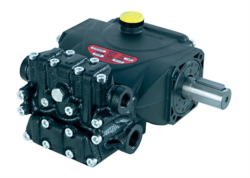
The Interpump E1D1808 L represents the entry point for high-pressure precision work. Delivering 8 L/min at 180 bar with just 2.72 kW input and weighing only 5 kg, this pump suits applications where space constraints are non-negotiable. At 2800 rpm, it generates sufficient pressure for injection molding auxiliary circuits, press-feed systems, and test benches requiring rapid response cycles.
Similarly, the Interpump ET1C1612 SX*D20 offers 12 L/min at 160 bar with 3.68 kW power, operating at 1750 rpm with PTFE construction for chemical compatibility. Compared to the E1D1808, the ET1C1612 trades 33% lower speed for 50% greater flow—ideal for applications where dwell time exceeds cycle frequency.
Procurement Consideration: Compact pumps excel in pilot circuits, secondary pressure stages, and remote system branches. However, their power density means running multiple units in parallel for primary drive circuits. A two-unit E1D1808 configuration (16 L/min, 180 bar, 5.44 kW) costs more initially than a single larger pump but offers redundancy and modularity—critical for facilities where unplanned downtime triggers production line stops.
Tier 2: Mid-Range Workhorse Pumps for Standard Industrial Operations
Application Profile: Conventional injection molding, hydraulic press lines, materials handling systems, standard CNC operations, and general manufacturing where flow demand (50–150 L/min) is stable and pressure requirements are moderate (160–210 bar).
The Pratissoli SS71153 delivers 122 L/min at 160 bar with a 37.5 kW motor running at 800 rpm. This mid-range workhorse balances displacement (122 cc/rev nominal) with speed, making it suitable for continuous-duty circuits in injection molding barrel pressure, hydraulic press main drives, and process fluid circulation. The low-speed design reduces noise (typical 78–82 dB at full load) and extends component life compared to high-speed alternatives.
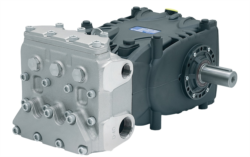
For applications requiring greater pressure headroom, the Pratissoli KF30 from the KF Family scales up: 106 L/min at 200 bar with 40 kW power at 72 kg. Despite lower flow than the SS71153, the KF30's 200 bar rating accommodates aggressive load cycles and tight tolerance work—common in automotive suppliers and tier-one component manufacturers across Singapore's industrial parks.
Procurement Consideration: Mid-range pumps (60–150 L/min) represent the largest installed base in Singapore manufacturing. 3G Electric's 35-year track record shows these units achieve 6,000–8,000 operating hours before planned maintenance when integrated with adequate filtration (≤10 micron absolute). Comparing the SS71153 (122 L/min @ 160 bar) to the KF30 (106 L/min @ 200 bar): if your process requires both volume and pressure, the SS71153 edges ahead for general duty; if peak pressure spikes demand 200 bar, accept the KF30's 15% lower flow as a pressure insurance premium.
Tier 3: High-Displacement Pumps for Heavy-Duty and Multiple-Circuit Systems
Application Profile: Multi-function hydraulic systems, combined-circuit layouts, high-volume material handling, large-scale extrusion, and facilities running 2–3 independent pressure-demand circuits from a single pump outlet manifold.
The Pratissoli MW40 from the MW H.P. Family represents the heavy-lift tier: 211 L/min at 210 bar with 85 kW power, weighing 264 kg. At roughly 2× the displacement of the KF30, the MW40 targets facilities requiring sustained high flow without parallel-pump configurations. Its 210 bar rating matches the KF30 pressure class, making it suitable for aggressive cutting-fluid delivery (precision grinding), multi-station press banks, or integrated hydraulic palletizing systems.
The MW40's larger displacement ratio (approximately 75 cc/rev) typically runs at 1500–2000 rpm in variable-displacement configurations, offering the prime advantage of proportional pressure-flow response. Unlike fixed-displacement pumps that waste unneeded flow as heat, MW-series designs integrate load-sensing or pressure-compensating logic, cutting auxiliary cooling demand by 20–35% in part-load scenarios common in batch manufacturing.
Procurement Consideration: Upgrading from mid-range (KF30, SS71153) to heavy-displacement (MW40) implies architectural shift: existing manifold galleries must accommodate 211 L/min without velocity violations (>4 m/s in main lines causes erosion). The MW40 requires proportional valve integration, pilot pressure sensing, and feedback loops—adding $8,000–$15,000 in control system cost. However, operational efficiency gains justify this investment for facilities projecting ≥40% annual production growth over the equipment's 10-year service life.
Capacity Planning Framework: Right-Sizing for Singapore Operations
Step 1: Baseline Demand Mapping
Document current system flow (at full production cycle) in L/min and peak pressure in bar for each active circuit. Many facilities underestimate demand because production has scaled organically; flow measurements often reveal 15–25% undercapacity in aging systems.
Step 2: Growth Projection (3-, 5-, 10-year horizons)
Singapore's manufacturing sector targets 3–5% annual productivity gains. If current demand is 80 L/min, a conservative 5-year plan projects 102 L/min. Tier 2 pumps (KF30 @ 106 L/min or SS71153 @ 122 L/min) accommodate this growth; undersizing to 100 L/min invites a Tier 3 upgrade within 3 years—a costly false economy.
Step 3: System Architecture Assessment
Single-circuit systems (one pressure demand) often favor large-displacement pumps (MW40) due to proportional control efficiency. Multi-circuit layouts (independent press, clamp, and eject functions) may be better served by parallel mid-range units (two KF30s = 212 L/min), offering circuit isolation and maintained pressure under load imbalance.
Step 4: Thermal Budget Validation
At part load, pump input power ÷ 0.85 (typical electrical efficiency) equals heat generation (kW). If your facility average load is 60% of maximum, a 40 kW KF30 dissipates ~28 kW continuously. Undersized cooling (inadequate tank surface, blocked radiators) raises fluid temperature above 60 °C, accelerating seal degradation. Procurement teams often omit cooling cost—budget 8–12% of pump cost for matching cooler capacity.
Technical Comparison Matrix for Decision-Making
Compact Tier (E1D1808, ET1C1612): Best for <20 L/min sustained demand, space-constrained locations, secondary circuits. Trade-off: higher specific power (kW per L/min), shorter maintenance intervals at high utilization.
Mid-Range Tier (KF30, SS71153): Best for 100–150 L/min continuous duty, balanced pressure-flow demand (160–200 bar). Trade-off: modest size footprint, proven reliability in Singapore's industrial base, standard manifold compatibility.
Heavy-Duty Tier (MW40): Best for >180 L/min or complex multi-circuit proportional systems. Trade-off: higher capital cost, requires advanced control electronics, demands skilled technician base for maintenance.
Purchasing Strategy: 3G Electric's experience across 35+ years shows procurement engineers save 12–18% by standardizing on two platform sizes (e.g., KF30 for 90% of applications, MW40 for special projects). This approach reduces spare parts inventory, simplifies technician training, and accelerates troubleshooting when cross-system issues arise.
Conclusion: Building Scalable Hydraulic Infrastructure
Pumps & Compressors selection transcends datasheet specifications—it is a long-term infrastructure decision. Singapore's competitive advantages in precision manufacturing and chemical processing depend on hydraulic reliability, and undersizing today guarantees expensive emergency upgrades tomorrow. By evaluating capacity across three tiers and planning for documented growth, procurement engineers can right-size systems that deliver sustained performance, predictable maintenance costs, and headroom for operational flexibility.
As your equipment distributor since 1990, 3G Electric supports this process with technical capacity audits, system modeling, and integration support for Italian-engineered Pratissoli and Interpump units proven in regional operations.