Understanding Pumps & Compressors Specification Alignment
Pumps & Compressors form the backbone of industrial fluid power systems, yet many procurement engineers struggle with matching manufacturer specifications to actual application needs. The challenge isn't finding equipment—it's selecting the right unit that delivers performance without over-specification or under-performance. With 35+ years of experience distributing industrial equipment globally, 3G Electric has guided thousands of procurement teams through this critical decision process.
The core issue: a pump specified at 200 bar pressure doesn't automatically suit a 160 bar application, just as a 106 L/min flow rating means little without understanding duty cycle and peak demand windows. This article provides procurement engineers with a practical framework for specification matching—ensuring your equipment selection delivers reliability, efficiency, and cost optimization.
The Three-Layer Specification Matching Framework
Layer 1: Application Duty Profile Assessment
Before comparing datasheets, define your application's duty profile across three dimensions:
Pressure Demand — Identify both sustained and peak pressure requirements. Many applications specify maximum pressure but operate at 60-70% of rated capacity during normal duty. For example, a hydraulic press application might require 210 bar peaks during compression cycles but run at 160 bar steady-state. Understanding this distinction prevents over-specification.
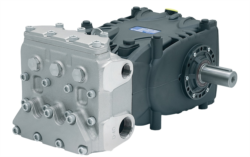
The Pratissoli MW40 delivers 210 bar maximum pressure and suits applications requiring both sustained high-pressure operation and peak demand spikes. Its 85 kW motor and 264 kg frame support continuous duty cycles without thermal stress.
Flow Rate Consistency — Calculate volumetric flow demand during peak operation, not average operation. A system requiring 122 L/min peak flow with 80% duty cycle has different equipment requirements than one requiring 122 L/min continuously. The Pratissoli SS71153 delivers exactly 122 L/min at 160 bar, making it ideal for applications with moderate but consistent flow demands at 800 rpm operation.
Operational Window — Document how frequently equipment operates at peak specification versus partial load. Equipment running 40 hours weekly at full capacity has fundamentally different thermal, maintenance, and longevity profiles than equipment running 2 hours weekly at full capacity. This determines whether you prioritize durability or cost efficiency.
Layer 2: Technical Specification Cross-Referencing
Once your application profile is clear, systematic specification cross-referencing prevents mismatches:
Displacement-to-Flow Mapping — Flow rate (L/min) = Displacement (cc/rev) × RPM ÷ 1000. However, most manufacturers rate displacement for specific RPM values. When comparing pumps, always verify the RPM at which flow ratings are specified. The Interpump ET1C1612 SX*D20 delivers 12 L/min at 1750 rpm—relatively low displacement but optimal for compact, high-pressure hydraulic applications. Conversely, the Pratissoli KF30 provides 106 L/min at 40 kW input, requiring higher displacement for volume-intensive applications.
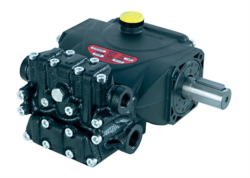
Power Input vs. Pressure Output Balance — Never assume higher kilowatt ratings equal better performance. Power consumption reflects the product of pressure and flow: Power (kW) = (Pressure [bar] × Flow [L/min]) ÷ 600. A 37.5 kW motor powering a 122 L/min pump at 160 bar is efficiently matched. Conversely, a 40 kW motor driving only 8 L/min (as in the Interpump E1D1808 L, SKU: E1D1808S-000 compact gear pump at 2800 rpm) indicates a different application profile—likely high-pressure, low-volume injection or clamping systems where gear pump efficiency matters more than displacement.
Pressure Rating Hierarchy — Understand that "rated pressure" differs from "burst pressure" or "intermittent peak pressure." Most industrial pumps are rated at continuous pressure; intermittent peaks can exceed these by 10-20%. For Singapore's tropical environment with high ambient temperatures, selecting equipment rated 20-30 bar above your actual requirement provides thermal safety margin. The MW40's 210 bar rating suits applications where 180-200 bar sustained operation is necessary.
Layer 3: Application-Specific Selection Scenarios
High-Pressure, Low-Volume Applications — Industrial clamping, injection molding, or press systems operating above 150 bar with flow demands under 20 L/min benefit from compact gear pumps. The Interpump E1D1808 L's 8 L/min at 180 bar exemplifies this category—at only 5 kg and 2800 rpm, it fits space-constrained installations while maintaining high-pressure capability.
Sustained High-Flow Operations — Agricultural irrigation, water circulation, or industrial cooling systems requiring 100+ L/min at moderate pressures (100-180 bar) demand larger displacement pumps optimized for volumetric delivery. The Pratissoli KF30's 106 L/min at 200 bar represents this sweet spot for applications where flow volume is primary.
Mixed-Duty Hydraulic Systems — Equipment serving both high-pressure peaks and high-flow sustained phases (common in construction machinery, forestry equipment, or industrial presses with multiple circuits) often requires dual-pump configurations or variable displacement designs. The Pratissoli SS71153 at 122 L/min, 160 bar, and 800 rpm handles mixed-duty scenarios where moderate displacement with excellent control precision is essential.
Tropical Industrial Environments — Singapore's high humidity (75-95%) and ambient temperatures (28-35°C) require specification attention. Sealed bearing housings, corrosion-resistant materials, and thermal management become critical. When comparing specifications, verify sealing standards (ISO VG grades for fluid compatibility) and material certifications. Interpump's PTFE construction in models like the ET1C1612 SX*D20 provides superior corrosion resistance compared to standard elastomers in tropical humidity.
Matching Specification to Total Cost of Ownership
The lowest-quoted unit often produces the highest lifecycle cost. Procurement engineers should weight specification matching against three TCO factors:
Efficiency Losses — A pump specified 30% oversized for your application wastes 8-12% of input power as heat and internal leakage. Over 5-year operation at Singapore's industrial energy rates (S$0.25-0.35/kWh), this represents significant waste. Match displacement and pressure precisely to rated requirements.
Maintenance Intervals — Equipment operating consistently within design specifications (70-85% of rated capacity) achieves manufacturer-specified maintenance intervals. Over-specified equipment running at 40-50% capacity experiences premature seal wear and control instability, actually increasing maintenance frequency. Under-specified equipment stressed near 95%+ of capacity fails prematurely.
Spare Parts Availability — 3G Electric's three-decade distribution presence in Asia-Pacific ensures critical spare parts availability within 48-72 hours for Pratissoli and Interpump equipment. Specification matching ensures your selected pump aligns with readily available replacement components—shaft seals, bearing assemblies, displacement cartridges—rather than obscure legacy models requiring 4-6 week procurement windows.
Practical Specification Matching Workflow for Procurement Teams
Step 1: Document Application Parameters
- Required sustained pressure (bar)
- Peak pressure tolerance and duration
- Required sustained flow (L/min)
- Duty cycle percentage and operational hours
- Ambient temperature range and humidity
- Space constraints and weight limits
- Power (kW) = (Pressure × Flow) ÷ 600
- Add 15-20% safety margin for thermal consideration
- Verify displacement (cc/rev) and rated RPM
- Confirm pressure rating at continuous duty
- Check material certifications for environmental compatibility
- Review seal and bearing assembly specifications
- Does the pump deliver 85-95% of required specifications?
- Is the motor power input within ±10% of calculated requirement?
- Are spare parts and technical support available in Singapore?
- Does the equipment fit thermal and spatial constraints?
- Obtain efficiency curves across 25%, 50%, 75%, and 100% load
- Review pressure-flow characteristics at your operational RPM
- Confirm thermal performance in ambient conditions exceeding 30°C
Conclusion: Specification Matching as Procurement Strategy
Pumps & Compressors specification matching transforms procurement from specification-hunting into strategic equipment selection. Rather than selecting the lowest-cost unit or defaulting to oversized safety margins, procurement engineers who systematically match technical specifications to application duty profiles achieve superior equipment reliability, lower operating costs, and simpler maintenance planning.
With 35+ years serving industrial procurement teams across Asia-Pacific, 3G Electric maintains extensive technical resources—including performance datasheets, thermal modeling tools, and application engineering support—to guide specification matching decisions. Our distributed inventory of Pratissoli and Interpump equipment across Singapore and regional hubs ensures your selected pump specifications translate into immediate availability, rapid deployment, and long-term support.
Your next equipment procurement should begin not with a quote request, but with a comprehensive application assessment. The specification match you achieve will determine five years of operational performance.