Understanding Thermal Load and Pump Sizing for Singapore HVAC Systems
Pumps & Compressors in HVAC applications must be precisely matched to the thermal load of the building or facility. Many contractors in Singapore rely on generic equipment selection without calculating the actual cooling demand, leading to undersized systems that struggle during peak heat periods or oversized equipment that wastes energy and increases operational costs.
Thermal load in kilowatts (kW) is the starting point for all sizing calculations. In Singapore's tropical climate, with ambient temperatures reaching 32–35°C and high humidity, peak cooling loads are typically higher than in temperate regions. The basic relationship between thermal load and pump flow rate is:
Flow Rate (L/min) = Thermal Load (kW) × 1000 / (Temperature Differential × Specific Heat × Density)
For chilled water systems, this simplifies to approximately:
Flow Rate (L/min) ≈ Thermal Load (kW) × 60 / Temperature Differential (°C)
If a building requires 100 kW of cooling with a 5°C temperature differential (typical for chilled water circuits), the pump must deliver approximately 1,200 L/min. With 35+ years' experience distributing industrial pumps, 3G Electric has helped contractors across Southeast Asia avoid costly undersizing errors by validating these calculations during the specification phase.
Matching Pump Displacement and Motor Power to Actual System Demand
Once flow rate is established, contractors must select a pump with adequate displacement (cubic centimeters per revolution) and motor power (kilowatts). Displacement and rotational speed determine actual flow delivery:
Flow Output (L/min) = Displacement (cc/rev) × RPM / 1000
A pump with 100 cc/rev displacement operating at 1,500 rpm delivers 150 L/min. However, contractors must account for:
- System pressure requirements: Singapore's high-rise buildings often operate chilled water systems at 3.5–5 bar to overcome vertical height resistance. Higher pressure reduces effective displacement and requires more motor power.
- Friction losses in piping: Long ductwork and numerous fittings in complex HVAC networks increase pressure drop. A contractor must add 0.5–1.5 bar safety margin to nominal system pressure.
- Motor efficiency derating: Tropical ambient temperatures (30°C+) reduce motor cooling efficiency, requiring 10–15% power oversizing compared to temperate climate calculations.
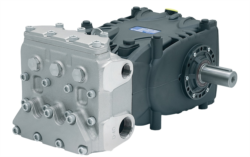
For example, a 100 kW cooling load in Singapore with 5°C differential requires ~1,200 L/min at 4.5 bar system pressure (accounting for piping losses). The Pratissoli KF30 delivers 106 L/min at 200 bar, suitable only for compact or secondary loops. The Pratissoli MW40 provides 211 L/min at 210 bar with 85 kW input power—a better fit for mid-sized systems. For larger loads exceeding 2,000 L/min, the Pratissoli SS71153 delivers 122 L/min at 160 bar with 37.5 kW power, though multiple units or larger displacement models may be necessary.
Compressor Selection for Air-Cooled and Water-Cooled Condensers
In condensing circuits, compressor displacement must match the refrigerant mass flow required by the evaporator thermal load. This relationship is:
Refrigerant Mass Flow (kg/h) = Thermal Load (kW) / Latent Heat of Refrigerant (kJ/kg)
For R-410A refrigerant at typical evaporator conditions (5°C), latent heat is approximately 185 kJ/kg. A 100 kW cooling load requires 1,945 kg/h refrigerant circulation. The compressor must move this mass at the required volumetric displacement:
Compressor Displacement (cc/rev) = (Mass Flow × Specific Volume) / (RPM × 1000)
Singapore's humid tropical climate creates additional challenges:
- Condenser cooling capacity: Water-cooled condensers (common in high-rise buildings with chilled water towers) operate most efficiently at 30–32°C. Air-cooled condensers struggle above 38°C ambient, requiring larger displacement or higher-speed compressors.
- Refrigerant subcooling: Adequate subcooling (3–5°C below saturation temperature) prevents liquid flashing in expansion devices. Inadequate subcooling due to undersized condensers or high ambient temperatures reduces system capacity by 3–5%.
- Compressor motor matching: Scroll and screw compressors typical in Singapore HVAC systems operate at 1,450–3,500 rpm depending on design. Motor power (kW) must account for superheat rejection and discharge pressure rise.
Contractors should verify that compressor displacement matches the design refrigerant velocity in suction lines (4–6 m/s for vapor lines, 1–2 m/s for liquid lines) to prevent flashing and ensure oil return to the crankcase.
System Integration: Pump and Compressor Coordination in Chilled Water Circuits
In integrated chilled water systems, the evaporator pump and compressor must work in coordination. The evaporator pump circulates chilled water through building loads at a fixed flow rate, while the compressor modulates capacity to maintain setpoint temperature. Mismatched equipment causes operational problems:
- Oversized pump, undersized compressor: Excessive water flow through the evaporator creates low temperature differentials, preventing the compressor from developing adequate capacity. The system cycles on and off frequently, reducing efficiency and increasing wear.
- Undersized pump, oversized compressor: Low flow rates cause excessive temperature rise across the evaporator. The compressor operates continuously at high superheat, increasing discharge temperatures and reducing lifespan.
- Pressure mismatch: If the chilled water pump is sized for 3 bar but the system design pressure is 5 bar (due to piping losses and vertical height), the pump cannot maintain adequate flow, and building zones experience insufficient cooling.
3G Electric's technical team recommends calculating the complete system curve—plotting system pressure drop against flow rate—and selecting pumps and compressors that operate at the design point (intersection of pump curve and system resistance curve). For the tropical Singapore market, always include 15% flow margin and 20% pressure margin to account for:
- Fouling of heat exchanger tubes in humid conditions
- Degradation of chiller performance during peak summer loads
- Future building expansion or increased cooling demand
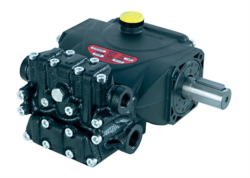
The Interpump E1D1808 L compact gear pump (8 L/min at 180 bar, 2.72 kW) suits secondary circuits and low-flow applications such as pump-down systems or lubrication circuits. The Interpump ET1C1612 SX*D20 (12 L/min at 160 bar, 3.68 kW) provides compact, high-pressure performance for modular or retrofit HVAC applications where space and weight are constrained.
Practical Commissioning and Performance Verification
After installation, contractors must commission pumps and compressors to verify that actual performance matches design specifications. Measurement points include:
- Chilled water flow rate: Use differential pressure across a calibrated orifice plate or magnetic flowmeter. Compare measured flow to pump displacement × RPM calculation. If flow is 10% below design, investigate cavitation (inadequate inlet pressure), impeller wear, or motor slip.
- System pressure drop: Measure pressure at pump inlet and discharge. Subtract inlet pressure from discharge pressure to determine actual pump head. High head (above design) indicates fouled strainers, partially closed valves, or compressor overcharge in condensing circuits.
- Refrigerant subcooling and superheat: For compressor-based systems, verify compressor inlet superheat (typically 10–20°C) and condenser outlet subcooling (typically 3–5°C). Deviations indicate refrigerant charge errors or compressor capacity mismatch.
- Motor power input: Measure electrical power (kW) at the motor terminals using a three-phase power meter. Compare to nameplate rating. Sustained power draw above 110% of nameplate indicates overload and requires immediate investigation.
In Singapore's tropical climate, vibration and noise monitoring is essential. High-frequency noise or excessive vibration often signals cavitation (low inlet pressure) or bearing wear accelerated by high ambient temperatures. Using equipment like the Pratissoli KF30 or Pratissoli MW40 from established manufacturers ensures access to performance documentation and spare parts, critical for maintaining system reliability during extended heat waves or humidity spikes.
With over 35 years of experience supplying pumps and compressors across Asia-Pacific, 3G Electric provides contractors with technical support to validate sizing calculations, troubleshoot performance issues, and select replacement components that maintain system efficiency throughout the equipment lifespan.