Introduction: Material Degradation in Tropical Operations
Pumps & Compressors deployed across Southeast Asia face environmental stressors absent in temperate climates. High humidity, salt-laden air, temperature cycling, and aggressive fluid chemistry combine to accelerate material degradation, reducing component lifespan and increasing maintenance costs. Procurement engineers selecting equipment for Singapore operations must understand material specifications beyond flow rate and pressure ratings.
With over 35 years of experience supplying industrial equipment to tropical markets, 3G Electric recognizes that material selection directly impacts total cost of ownership. A pump specified with standard materials may fail within 18 months in coastal environments, while properly specified alternatives deliver 5+ years of reliable service.
Section 1: Corrosion Mechanisms in Tropical Industrial Systems
Galvanic Corrosion and Material Pairing
Tropical humidity accelerates galvanic corrosion when dissimilar metals contact in the presence of electrolytes. Standard carbon steel pump housings paired with stainless steel shafts create micro-galvanic cells that pit within months under high humidity. The problem intensifies in coastal Singapore facilities where salt spray provides continuous electrolyte.
The solution requires understanding the galvanic series and material compatibility. Pumps must feature:
- Unified material families (stainless-to-stainless, aluminum-to-aluminum) where possible
- Isolating gaskets (EPDM, PTFE) between dissimilar metals
- Protective coatings (epoxy, powder coat) rated for ISO 12944 C5-M (very high corrosivity)
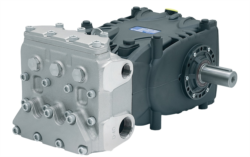
The Pratissoli KF30 high-performance industrial pump addresses this through Italian engineering standards that mandate SS316L stainless steel construction for all wetted surfaces, eliminating galvanic cell formation. With 106 L/min flow at 200 bar, the KF30 suits tropical hydraulic systems while maintaining material integrity.
Crevice Corrosion in Stagnant Fluid Pockets
Compressor discharge systems and pump manifolds trap fluid in blind holes and under flanges. In tropical heat (28-35°C ambient), stagnant fluid regions develop localized oxygen depletion, creating environments where even stainless steel undergoes crevice corrosion. Chloride concentrations in salt-laden air accumulate in these zones, accelerating pitting.
Mitigation strategies include:
- Specifying PTFE gaskets instead of NBR (nitrile), which absorbs moisture
- Selecting pump designs with fully drilled or open-ended cavities
- Implementing drain plugs in all low points for preventive flushing
- Using corrosion inhibitor packages in hydraulic fluids (ASTM D665B water separation ≥95%)
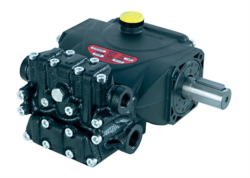
The Interpump ET1C1612 SX*D20 compact pump incorporates PTFE construction explicitly for high-pressure environments prone to crevice attack, operating at 12 L/min and 160 bar without conventional seals that absorb moisture.
Section 2: Material Specifications for Tropical Pump Selection
Stainless Steel Grades and Selection
Not all stainless steels perform identically in tropical marine environments. The common 300-series family presents distinct corrosion profiles:
SS304: Contains 18% Cr, 8% Ni. Adequate for inland tropical locations but insufficient for coastal Singapore. Pitting potential index (PPI) of 25-30 means failure risk in high-chloride atmospheres.
SS316/316L: Contains 18% Cr, 10% Ni, 2-3% Mo. Molybdenum addition increases PPI to 45-50, providing 3-4× better pitting resistance than 304. 316L's reduced carbon content minimizes carbide precipitation during welding, critical for pump bodies manufactured through submerged arc welding.
SS6Mo/254SMO: Premium duplex stainless with 6% Mo, 20% Cr, 7% Ni. Achieves PPI >60 and resists crevice corrosion at chloride concentrations exceeding 5000 ppm. Cost premium of 300-400% restricts use to critical, high-reliability applications.
For Singapore operations, procurement engineers should specify minimum SS316L for all wetted components. This balances corrosion resistance with cost-effectiveness. The Pratissoli MW40 high-performance pump delivers 211 L/min at 210 bar with Italian-engineered material standards ensuring tropical durability across 85 kW rated power.
Elastomer and Seal Material Selection
Pump seals experience simultaneous attack from fluid chemistry, temperature cycling, and ozone in tropical environments. Standard NBR (nitrile) rubber swells in synthetic hydraulic fluids and degrades under UV exposure within 12-18 months in outdoor installations.
Tropical-rated elastomers include:
- PTFE/EPDM: Polytetrafluoroethylene for low fluid absorption; EPDM backing for flexibility. Resists synthetic fluids and maintains dimensional stability across 15-50°C temperature swings.
- FKM (Viton): Superior chemical resistance; acceptable for mineral oil and PAO-based hydraulics. Higher cost than EPDM but extends seal life to 3-4 years in aggressive environments.
- Perfluoroelastomer (FFKM): Premium option for extreme chemical environments (high-temperature hydraulic fluids). Cost exceeds FKM by 150% but necessary where seal replacement labor exceeds material cost.
The Interpump ET1C1612 SX*D20 specifies PTFE construction explicitly, ensuring zero fluid absorption and extended service intervals in tropical humidity.
Cast Material Considerations
Pump housings manufactured from ductile iron (EN-GJS-400-15) exhibit acceptable strength but poor corrosion resistance in coastal environments. Iron content oxidizes preferentially, creating subsurface voids that propagate under cyclic pressure loading.
Alternative housing materials:
- Aluminum bronze (C95400): 9-11% Al, 3-4% Fe. Excellent seawater resistance; ASTM G48 Method C (6% ferric chloride) shows <1 mm/year corrosion rate. Suitable for pump housings in salt-spray zones.
- Nodular ductile iron with epoxy coating (ISO 12944 C5): Cost-effective for inland tropical facilities. Requires quinquennial recoating maintenance.
- Ductile iron with nickel plating (25-50 µm): Provides 3-5 year protection; more economical than full stainless conversion.
Procurement engineers should request material certifications (mill test reports) confirming alloy composition when specifying tropical applications. Avoid cost-reduction pressure that substitutes lower-grade materials; the long-term cost impact typically exceeds material savings by 8-12×.
Section 3: Fluid Specification and Material Compatibility
Hydraulic Fluid Selection for Tropical Climates
Tropical heat accelerates oxidation of mineral-based hydraulic fluids. A fluid with ISO VG 46 viscosity grade exhibits acceptable oxidation stability (ASTM D2272 induction period ≥900 minutes) at 40°C, but under 50°C continuous operation common in Singapore, induction period drops to 400-500 minutes within 6 months.
Fluid selection significantly impacts material compatibility:
- Mineral oil (ISO VG 46): Standard baseline; adequate for temperate climates. In Singapore, requires additive packages (antioxidant, anti-corrosion) to maintain ASTM D665B water separation >95%. Synthetic cost premium of 30-50% often justified by extended oil life and reduced pump wear.
- PAO (polyalphaolefin) synthetic: Inherently superior oxidation stability; induction period remains >1200 minutes under extended tropical operation. Compatible with FKM and PTFE seals. Cost premium justified in continuous-duty systems (compressors, cooling circulation pumps).
- Ester-based hydraulics: Excellent lubricity and tropical stability; high water absorption requires closed-loop systems with active dehydration. Necessary for critical reliability applications but demands operator training.
Fluid corrosivity testing (ASTM D665B) should be performed on all candidate fluids using materials proposed for the pump. A hydraulic fluid passing ASTM D665B on copper may fail on ferrous surfaces, requiring fluid adjustment or material specification change.
The Pratissoli SS71153 pump, rated for 122 L/min at 160 bar with 37.5 kW motor operation, requires specification of fluid chemistry matched to its 800 rpm rotational speed and pressure environment. Slow-speed pumps are more sensitive to fluid oxidation; fluid degradation reduces viscosity film thickness at bearing interfaces, accelerating wear.
Section 4: Specification Development and Procurement Strategy
Material Specification Framework
Procurement engineers should develop material specifications addressing:
1. Wetted Surface Requirements
- All pump and compressor housings, ports, manifold blocks: minimum SS316L or aluminum bronze (C95400)
- Pump shafts, internal sleeves: SS316L with shot peening to increase fatigue strength
- Bearing surfaces: hardened tool steel (58-62 HRC) with electroless nickel plating (15-25 µm) for corrosion protection
- Shaft seals: PTFE lip with EPDM backing or FKM for synthetic fluid systems
- Face seals (if pump application requires): hard-face carbon (tungsten carbide) with elastomer backup rings specified per DIN 3760 pressure ratings
- Manifold gaskets: PTFE sheets (ASTM D4475) instead of NBR cork composites
- Fasteners: A4-70 stainless steel or zinc-nickel plated (12-25 µm) per ASTM B842
- Unpainted steel surfaces: hot-dip galvanized (ASTM A123) or epoxy primer (75 µm) plus topcoat (75 µm) per ISO 12944 C5
- Aluminum components: anodized (Type II, 15-25 µm) or epoxy powder coat (100 µm minimum)
- Mill test reports confirming alloying elements (optical emission spectroscopy minimum)
- Pressure test certificates (ASTM E1030) at 1.5× maximum rated pressure
- NORSOK M-505 material suitability documentation for corrosive environment applications
- Fluid compatibility test results (ASTM D2619 copper corrosion test; ASTM D4378 hydrolytic stability)
Supplier Selection and Long-Term Partnerships
3G Electric's 35+ years of experience supplying industrial equipment across Southeast Asia emphasizes that material consistency requires supplier partnerships, not transactional procurement. Pump manufacturers with stable supply chains (like Pratissoli and Interpump Group, both represented in our portfolio) maintain consistent material specifications across production batches, critical for fleet-level reliability.
When evaluating suppliers:
- Request production material certifications for 2-3 units before full commitment
- Verify manufacturing process controls (welding procedure specifications per ASME Section IX)
- Confirm in-house material testing capabilities (salt spray ASTM B117, cyclic corrosion ASTM G85 Annex 3)
- Establish warranty terms addressing corrosion failure (beyond standard 12-month wear coverage)
The KF30, MW40, Interpump PUMP E1D1808 L, and Interpump ET1C1612 SX*D20 represent manufacturing lines with established tropical deployment records, reducing specification risk through proven field performance.
Conclusion: Material Selection as Risk Management
Pumps & Compressors material selection in tropical Singapore operations extends beyond datasheet specifications. Corrosion mechanisms, fluid chemistry, thermal cycling, and manufacturing consistency demand integrated procurement strategy addressing material compatibility across all system components.
Procurement engineers who invest time in material specification development reduce emergency downtime, extend equipment lifespan from 2-3 years to 5-7 years, and achieve true total cost of ownership reductions of 30-40% compared to lowest-cost equipment procurement. 3G Electric's technical team can assist in developing material specifications aligned with your facility's environmental profile and operational requirements.