Understanding Controls & Safety Through Pressure Drop Management
Controls & Safety in industrial burner systems extends far beyond flame detection and electrical interlocks. For plant managers operating in Southeast Asia's humid, corrosive environments, managing pressure drop across control components represents a critical—and often overlooked—dimension of system reliability. With 35+ years of experience distributing industrial equipment throughout the region, 3G Electric has observed that most burner failures stem not from catastrophic component failure, but from gradual pressure loss that degrades combustion efficiency and triggers nuisance shutdowns.
Pressure drop is the reduction in gas pressure as fuel flows through regulators, solenoid valves, and safety blocks. Every control component introduces resistance to flow. If you spec components without calculating cumulative pressure loss, your burner inlet pressure may fall below the minimum required for proper atomization and flame stability—particularly critical in the high-ambient-temperature environments common across Malaysia, Thailand, and Indonesia.
Calculating System Pressure Budget: A Practical Framework
Your pressure budget begins with three fixed points: inlet supply pressure (typically 5–50 mbar for industrial gas applications), minimum burner inlet pressure (usually 3–5 mbar to maintain flame quality), and maximum allowable pressure drop (2–5 mbar, depending on burner manufacturer).
Consider a typical Southeast Asian boiler installation: your gas utility provides 10 mbar supply pressure. Your burner requires a minimum of 4 mbar to maintain proper flame ionization and combustion efficiency. This leaves you a 6 mbar budget across your entire control chain.
Now you must account for each component's pressure drop specification:
- Main gas block: 3–5 mbar typical drop at rated flow
- Solenoid valve coil pack: 1–2 mbar
- Pressure regulator module: 0.5–1 mbar
- Piping and fittings (corroded copper or mineral-fouled): 1–3 mbar
Total real-world drop often exceeds 7 mbar—exceeding your budget and causing low-pressure shutdowns. This is where component selection becomes a Controls & Safety decision, not merely a procurement exercise.
The SIT Tandem gas block 0837013 is engineered specifically for this constraint. Its 5 mbar pressure drop at 4.8 m³/h flow rate leaves sufficient margin in tight pressure budgets. The servo-assisted regulation mechanism automatically compensates for upstream supply fluctuations—common in regions where gas infrastructure varies hourly—maintaining consistent burner inlet pressure without nuisance shutdowns.
Conversely, older relay-based pilot systems often employ simple mechanical regulators with fixed reduction characteristics. Under high ambient temperature (40°C+ in Southeast Asian summers), gas density changes degrade regulator response, causing pressure drift and flame instability.
Component Selection: Matching Flow Capacity to System Demand
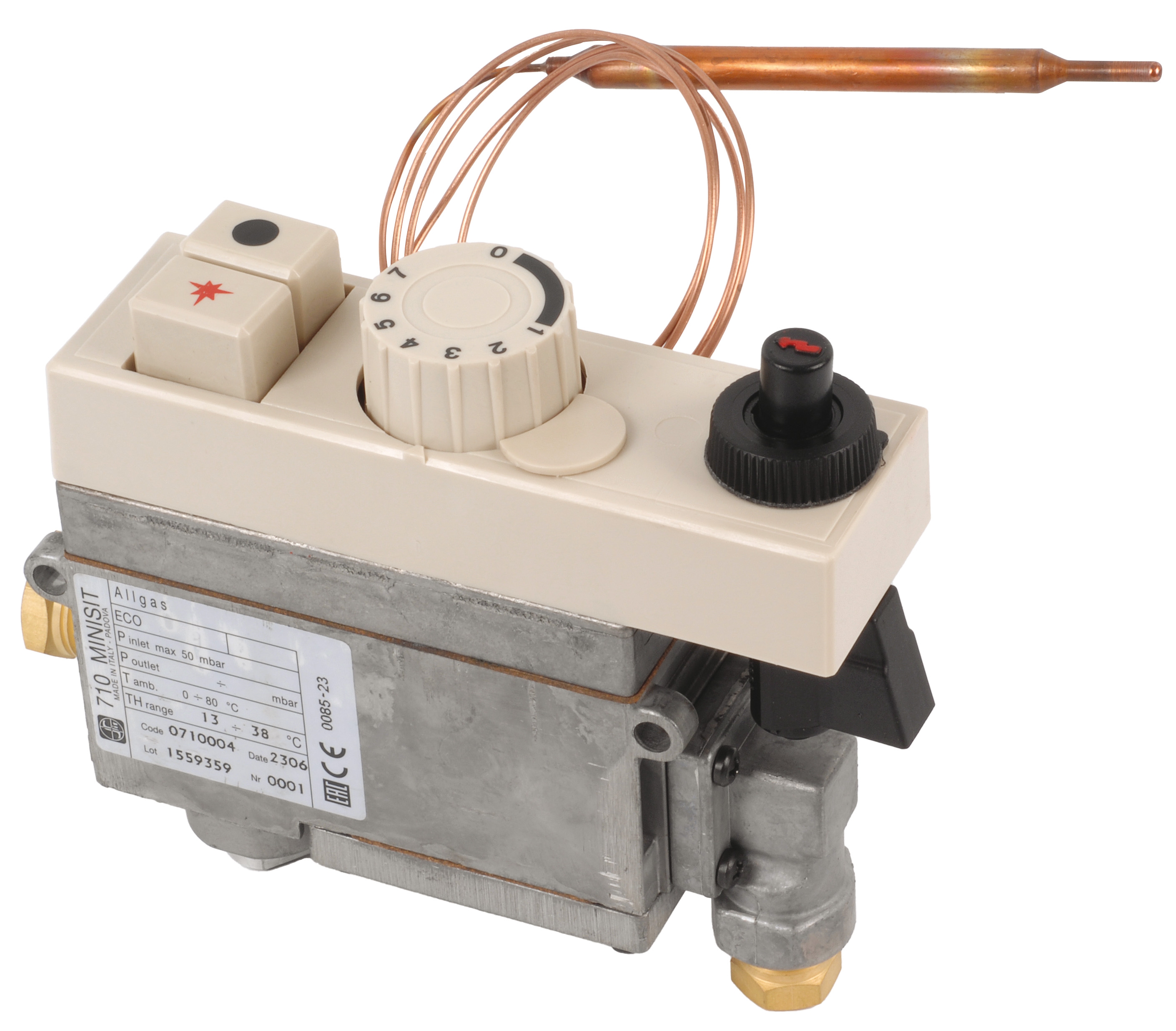
Flow capacity specifications are equally misunderstood by plant operators. The SIT Minisit gas block 0710004 handles up to 3.9 m³/h (Family I classification), while the Tandem block reaches 4.8 m³/h. These are not interchange specifications.
Select a block rated for 50% above your maximum anticipated burner demand. Why? Because:
1. Pressure drop curves are non-linear: Operating at 80% rated capacity produces higher pressure loss than manufacturer datasheets suggest, because flow turbulence increases exponentially near maximum ratings.
2. Seasonal and load variations: Industrial facilities in Southeast Asia often run burners at 40–60% capacity during off-peak cooling season, then spike to 90%+ during peak heating demand. Your block must handle both extremes without pressure collapse.
3. Safety margin for future expansion: Malaysian and Indonesian manufacturing facilities frequently expand production capacity without upgrading fuel infrastructure. Oversizing your control block provides 3–5 years of headroom before pressure budget becomes critical again.
For a 3.5 m³/h burner application, specify the Tandem block (4.8 m³/h rated) rather than the Minisit (3.9 m³/h). The additional cost—typically 15–20% higher—is recovered through:
- Elimination of pressure-drop-related nuisance shutdowns (maintenance labor at $80–150/hour in Singapore and Malaysia)
- Extended component lifespan (lower turbulence reduces solenoid valve erosion)
- Improved combustion efficiency (2–4% fuel savings across a 500 kW boiler)
Pressure Regulation Architecture: Servo vs. Diaphragm
The SIT Sigma gas block 0845063 represents the modern servo-assisted regulation approach: dual solenoid valves modulate gas flow continuously, maintaining set-point pressure regardless of upstream supply fluctuations or downstream demand changes. This is fundamentally different from simple diaphragm regulators.
Diaphragm regulators are passive devices: a flexible membrane balances inlet pressure against a calibrated spring. When outlet pressure drops (burner consumes more gas), the diaphragm flexes, opening the valve and allowing more gas to flow. When outlet pressure rises (burner demand decreases), the diaphragm closes the valve. This feedback loop is mechanical and time-delayed.
In humid Southeast Asian environments—where salt-laden coastal air and industrial pollutants contaminate regulators—diaphragm materials (often butyl rubber or EPDM) degrade. The diaphragm becomes sticky, causing sluggish response and pressure overshoot. Overshoot introduces flame flicker, carbon deposits on burner heads, and incomplete combustion.
Servo-assisted regulation (Sigma block) uses electronic feedback: a pressure transducer continuously monitors outlet pressure, sending signals to microprocessor logic that adjusts solenoid valve duty cycles millisecond-by-millisecond. Response time drops from 500–1000 ms (diaphragm) to 50–100 ms (servo), and diaphragm degradation becomes irrelevant because the diaphragm moves minimally—it's an on-off valve, not a modulating component.
For critical installations (large boilers, hospitals, data centers), servo-assisted blocks justify the 40–60% cost premium over diaphragm types. For standard industrial heating applications in Malaysia and Thailand, diaphragm blocks remain cost-effective if you commit to 12-month service intervals.
Moisture and Corrosion: Southeast Asia-Specific Challenges
Southeast Asian humidity (60–95% year-round) creates unique pressure-drop risks absent in temperate climates. Gas piping often develops internal corrosion—copper oxide deposits, iron sulfide scale—that gradually narrows pipe bore diameter. A 10 mm copper line can lose 20–30% of its internal diameter over 5 years to corrosion.
Pressure drop across corroded piping increases proportionally to diameter reduction. A system calculated for 1.5 mbar pipe loss at installation may experience 3–4 mbar loss by year three, pushing outlet pressure below minimum and triggering shutdowns.
Mitigation strategies:
1. Install replaceable inlet strainers (100–150 micron) on all gas blocks. Clean quarterly in coastal regions.
2. Specify stainless-steel piping for sections exposed to spray or salt air (15–30% cost premium, recovers through elimination of corrosion-related downtime).
3. Pressure-test piping annually: A portable manometer (approximately $180–250) allows you to measure actual inlet and outlet pressures, detecting degradation before burner shutdowns occur.
Practical Maintenance and Diagnostic Protocol
Establish a Controls & Safety maintenance routine tied to pressure monitoring:
Monthly: Record inlet pressure, outlet pressure, and gas flow rate (if burner has measurement provision). Plot trends in a simple spreadsheet. A 0.5 mbar per month decline indicates corrosion or component wear; schedule component inspection.
Quarterly: Inspect gas block exterior for corrosion or moisture. In coastal Thailand and Malaysia, white-powdered copper oxide indicates moisture ingress. Replace the inlet strainer and verify outlet pressure recovery.
Annually: Perform full pressure drop calculation against as-built drawings. If calculated drop exceeds 4 mbar, budget for component upgrade the following fiscal year.
On shutdown events: Don't assume the burner is faulty. Measure inlet and outlet pressure with the control block powered but not firing. If outlet pressure is below 3 mbar, the issue is pressure drop, not combustion. Consult 3G Electric's technical team to evaluate whether your control chain requires upsizing.
The SIT 0577211 control box integrates microprocessor-based diagnostics that log pressure anomalies. If your facility operates microprocessor-enabled burners, export diagnostic logs quarterly and share with your equipment supplier—they provide early warning of pressure-related degradation.
Conclusion: Pressure Management as Strategic Operations
For plant managers in Southeast Asia, Controls & Safety transcends electrical interlocks and flame detection. Pressure drop management determines whether your burner operates reliably for 15 years or fails within 3–5 years. By systematically calculating pressure budgets, right-sizing control blocks like the Tandem or Sigma blocks, and implementing quarterly monitoring, you transform Controls & Safety from a compliance checkbox into a strategic reliability driver.
3G Electric's 35+ years distributing industrial equipment throughout Southeast Asia has shown us that the most reliable facilities are those that measure pressure drop, not those that trust nameplates. Start measuring this week.