Understanding Burners & Combustion System Architecture
Burners & combustion systems are far more complex than simply igniting fuel and air. For plant managers responsible for steam generation, process heating, or thermal processing, understanding how each component contributes to overall system reliability is critical. The integration of burners & combustion equipment involves coordinating fuel supply, air delivery, ignition systems, flame detection, and safety interlocks—all working within milliseconds of each other.
With 35+ years of experience distributing industrial equipment across Southeast Asia, 3G Electric has guided hundreds of facility managers through successful burner system implementations. The difference between a system that runs reliably for 15 years and one that experiences chronic failures often comes down to component selection and integration strategy rather than sheer equipment cost.
In Singapore's competitive manufacturing and facilities management landscape, downtime is expensive. An unplanned burner shutdown can cascade through dependent processes, affecting product quality and customer delivery schedules. This guide focuses on the practical decisions plant managers must make when specifying, integrating, and maintaining burners & combustion systems.
Critical Component Selection: Control Relays and Pressure Monitoring
Selecting the Right Burner Control Relay
The burner control relay is the "brain" of your combustion system. It monitors safety conditions, sequences the ignition process, verifies flame presence, and manages shutdown. Your selection directly impacts system uptime and safety certification compliance.
The Kromschroder BCU 570WC1F1U0K1-E control relay exemplifies modern burner control design. This relay supports direct ignition and intermittent/continuous pilot ignition modes, giving you flexibility to match your specific burner configuration. Compliance with EN 746-2 and EN 676 standards ensures alignment with Singapore's regulatory framework and international equipment standards.
When evaluating control relays, plant managers should consider:
- Ignition mode compatibility: Does your burner use direct ignition or pilot flame? Some systems use intermittent ignition (spark each cycle) while others maintain a continuous pilot. The control relay must match your burner's design.
- Flame detection method: UV detection is faster but requires clear sightline to flame. Ionization detection is slower but works in dusty environments. Your relay must support your chosen method.
- Electrical supply: Single or three-phase? What voltage? An undersized or incorrect power supply causes nuisance shutdowns.
- Approval ratings: Check that the relay meets both local Singapore regulations and your equipment's original certification.
A common integration error occurs when plant managers source a control relay that technically "fits" but doesn't match the burner's ignition sequence timing. This leads to intermittent lockouts where the system cycles off despite normal operation.
Pressure Monitoring for Safety and Performance
Pressure switches are overlooked by many plant managers but represent a critical safety layer. They verify that fuel is available at the correct pressure and that combustion air is being delivered at designed flow rates.
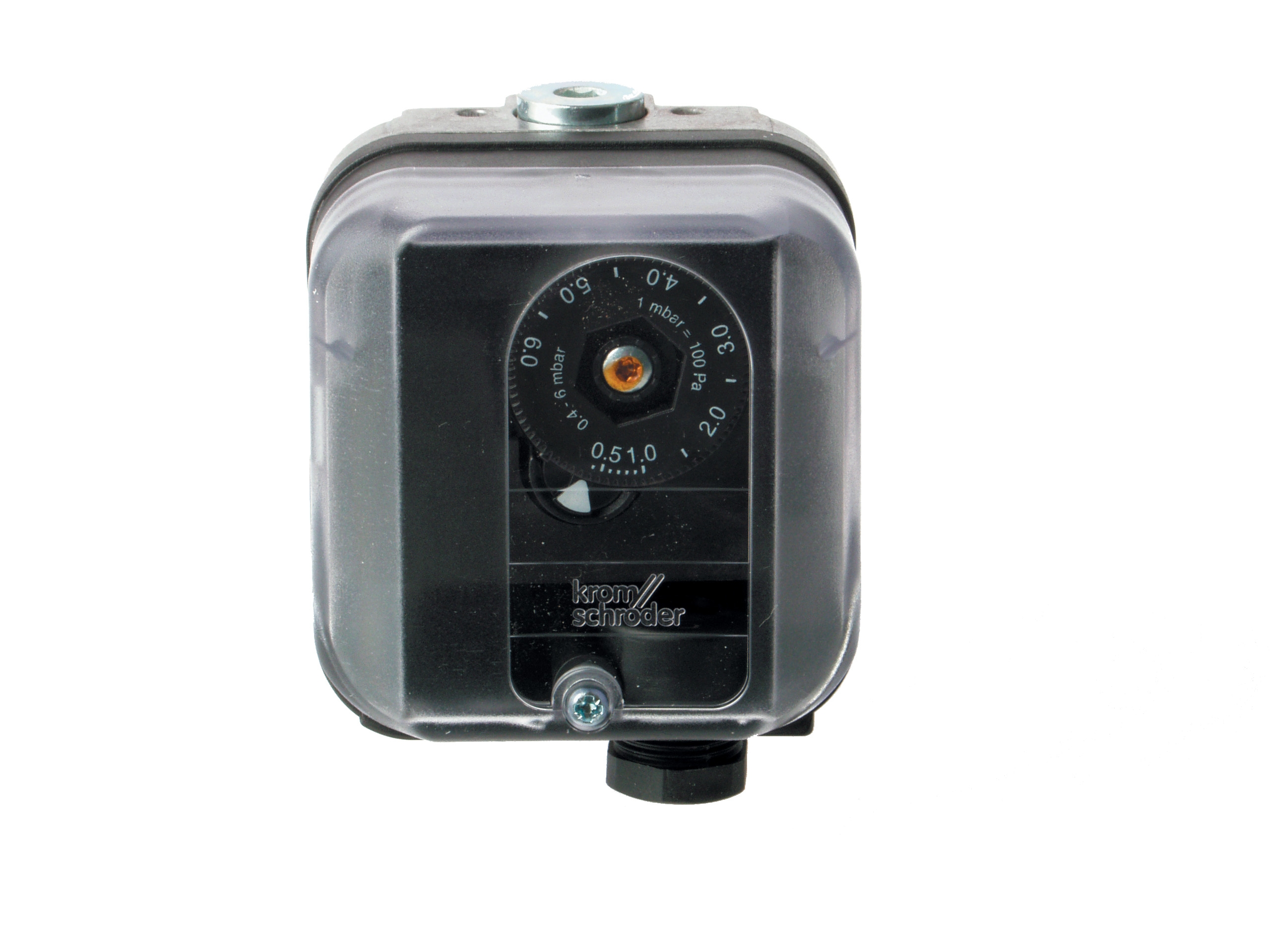
The Kromschroder DG 50U/6 pressure switch is rated SIL 3 and Performance Level e, meeting rigorous safety standards including EN 1854, FM, UL, and AGA certifications. For industrial burner applications, this level of certification means the pressure switch reliably detects unsafe conditions and can be counted on in safety shutdown calculations.
Plant managers should validate:
- Pressure range: Is the switch set for your fuel supply pressure (e.g., gas at 20 mbar, oil at 10 bar)? Incorrect setpoints prevent proper ignition.
- Differential settings: Hysteresis (differential pressure between open and close) prevents chatter in borderline conditions. Too narrow a differential causes nuisance switches; too wide and you miss real pressure loss.
- Installation location: Pressure taps must be correctly positioned to measure the right pressure point. Gas supply pressure differs from combustion chamber pressure.
- Maintenance access: Can technicians easily test and adjust the switch? Poor access leads to deferred maintenance.
A plant that experiences occasional "no pilot pressure" lockouts despite adequate supply typically has either a misadjusted pressure switch or contamination in the pressure sensing line. These are maintenance issues that corrective action catches quickly.
Flame Detection and Safety Relay Integration
Matching Flame Detection to Your Burner Type
Flame detection is not optional—it's your system's confirmation that combustion is actually occurring. Without it, unburned fuel accumulates in your combustion chamber, creating explosion risk.
The Siemens LFL 1.622 safety control unit is designed for gas, oil, or dual-fuel burners with medium to high power ratings. It features both UV and ionization flame monitoring, allowing you to choose the detection method best suited to your specific burner and environment.
UV Detection works by sensing ultraviolet light from the flame itself. Advantages: Fast response (100-200 milliseconds), reliable in most industrial environments. Disadvantages: Requires direct flame sightline, can be blinded by arc welding or bright ambient light in the combustion chamber area.
Ionization Detection senses electrical conductivity in the flame (ions). Advantages: Works even when flame is partially obscured, less affected by ambient light. Disadvantages: Slower response (1-2 seconds), can be affected by contaminated fuel that changes combustion characteristics.
Plant managers should consider your fuel quality and burner environment:
- Heavy fuel oil with variable contamination: Ionization detection is more tolerant of fuel quality variations.
- Natural gas with consistent supply: UV detection offers faster response and simpler maintenance.
- Dual-fuel operation: The Siemens LFL 1.622 supports both methods, letting you optimize per fuel type.
A critical integration point: The flame detector electrode must be positioned to view the active flame but not be exposed to direct soot accumulation. In high-carbon-content fuel applications, electrode fouling causes false shutdowns. Regular cleaning (monthly to quarterly, depending on fuel quality) is mandatory.
Controlled Air Damper Capability
Modern safety relays integrate air damper control, adjusting combustion air as burner load varies. This maintains efficient combustion across the operating range and reduces excess oxygen in exhaust (improving efficiency and reducing emissions).
When integrating damper control, validate:
- Damper actuator type: Electric, pneumatic, or hydraulic? Must the relay drive the actuator directly, or are separate control modules needed?
- Feedback mechanism: Does the damper position feedback to the control relay? Without feedback, the relay cannot confirm damper response.
- Speed of response: Air damper movement must coordinate with fuel supply changes. Fuel too fast and air too slow causes explosive conditions; air too fast and fuel lagging causes flameout.
Many older installations have mechanical linkages between burner modulating valve and air damper. Modern integrated systems use electronic coordination, offering better control and faster response.
Practical Integration Workflow for Plant Managers
Phase 1: Specification and Equipment Selection
Before ordering any equipment, document your requirements:
1. Fuel type and specification: Natural gas (what pressure, composition), LPG, light oil, heavy oil, dual-fuel?
2. Burner model and nameplate data: Thermal input (kW), ignition method, flame detection type already specified.
3. Existing control infrastructure: What voltage and phase power is available? Are there legacy safety interlocks that must integrate?
4. Environmental conditions: Ambient temperature range, humidity, vibration level, dust contamination.
5. Regulatory requirements: Building codes, insurance requirements, industry standards applicable to your facility.
For a steam boiler burner system, your specification might read: "Industrial gas burner, 500 kW, direct ignition with intermittent pilot, requires SIL 2 safety rated controls, 400V three-phase power, installation in heated mechanical room with natural gas at 20 mbar supply."
With this specification, you can confidently select the Kromschroder BCU 570WC1F1U0K1-E (compatible with your ignition mode) and the Kromschroder DG 50U/6 pressure switch (rated for your safety requirement).
Phase 2: Installation and Commissioning
Proper installation prevents 80% of burner problems:
- Fuel line design: Size fuel supply line for pressure drop not exceeding 5-10% at maximum flow. Undersized lines cause sluggish ignition.
- Combustion air path: Ensure air inlet is clean and unrestricted. Blocked air damper, clogged filters, or ductwork damage reduces oxygen availability.
- Electrical connections: Use appropriately gauged wiring for control circuits. Loose connections in safety circuits create false readings.
- Pressure tap installation: Install taps with snubbers (small restrictions) to dampen pressure pulsation and prevent false switch operation.
- Flame detector positioning: Mount 3-6 inches from flame core, with clear sightline and shield from direct contact with burner.
Commissioning is where integration happens: With fuel off and air running, verify the control relay recognizes all safety conditions (pressure OK, flame detector active, all interlocks satisfied). Then ignite and confirm flame detection responds within specification (typically 1-3 seconds after ignition).
Phase 3: Testing and Validation
Before putting the system into service, conduct these tests:
1. Manual shutdown test: Cut fuel supply and verify the control relay shuts down within 2 seconds and remains off until manually reset.
2. Ignition sequence test: Cycle the ignition process 5 times, confirming pilot flame lights and main flame ignites consistently.
3. Flame loss test: Once running, briefly interrupt fuel supply and confirm the system detects flame loss and shuts down safely.
4. Pressure switch test: Temporarily reduce fuel pressure and confirm the pressure switch initiates shutdown.
5. Air damper response: If equipped with modulating damper, increase and decrease burner load, confirming damper tracks smoothly.
Document all test results. This baseline becomes your reference for future troubleshooting.
Maintenance Integration for Long-Term Reliability
Plant managers must establish a maintenance schedule that keeps the burner system operating within design parameters. Integration doesn't end at startup—it's ongoing.
Monthly checks:
- Visual inspection of burner for soot accumulation or oil leakage
- Verification that the control relay responds to manual shutdown command
- Check fuel supply pressure and air supply pressure against design specifications
- Clean flame detector electrode (ionization cell or UV window)
- Inspect combustion air inlet and damper for debris
- Test pressure switch operation by isolating and confirming it closes at design pressure
- Replace fuel filter and combustion air filter
- Full safety shutdown sequence test (as per commissioning)
- Inspect oil burner nozzle (if applicable) and replace if worn
- Verify electrical connections are tight and corrosion-free
When you maintain integrated components as a system rather than servicing individual parts, you catch degradation before it causes failure. A technician who replaces a flame detector electrode during routine quarterly cleaning prevents the nuisance shutdowns that might otherwise frustrate your production team.
Conclusion: System Integration Prevents Downtime
Burners & combustion systems achieve reliability when every component—control relay, pressure switch, flame detector, fuel supply, and air delivery—work as an integrated whole. Plant managers who invest time in understanding this integration during specification and commissioning reap rewards in stable operation, predictable maintenance costs, and safe facility management.
3G Electric's experience distributing industrial burner components and control systems across Singapore and Southeast Asia shows that the most problematic installations are typically those where components were selected in isolation, without attention to how they coordinate. The cheapest control relay is false economy if it doesn't integrate properly with your burner and safety requirements.
Use this guide to develop a specification that clearly documents your system requirements, select components matched to those requirements, commission thoroughly with documented tests, and maintain systematically. Your facility will operate reliably, your team will understand how the system works, and you'll avoid the midnight calls for emergency repairs that plague poorly integrated installations.