Pumps & Compressors in Thermal Load Management: Singapore's Operational Challenges
Singapore's equatorial climate and dense industrial corridors create sustained thermal stress on manufacturing equipment. Year-round ambient temperatures between 24–35°C, combined with 80–90% humidity, demand robust Pumps & Compressors systems that maintain precise coolant circulation without efficiency degradation. Industrial professionals must balance three competing demands: reliable coolant delivery under continuous operation, pressure stability across varying load cycles, and total cost of ownership across 8–12 year service lifecycles.
With over 35 years of distribution experience, 3G Electric has observed that thermal system failures in Singapore typically stem not from individual component defects, but from undersized circulation capacity and pressure margin erosion. A cooling pump selected for peak summer load rarely accounts for fouling factor accumulation, viscosity shifts in mineral oil, or particulate contamination. Similarly, compressor-driven pneumatic cooling systems must maintain consistent pressure (typically 4–8 bar for process chillers) while managing moisture and thermal shock from rapid load cycling.
This article focuses on thermal integration strategy—how to select and configure pump-compressor combinations that sustain performance across Singapore's operational envelope without premature maintenance intervals or system derating.
Flow Rate Requirements for Thermal Circuits: Capacity vs. Pressure Trade-offs
The most common specification error in Singapore industrial sites is oversizing pump displacement while underestimating pressure recovery losses. A thermal circuit consisting of coolers, filters, control valves, and distribution manifolds typically incurs 15–25 bar pressure drop at nominal flow. This means a pump rated at 210 bar delivering full flow to a cooler system operating at design pressure of 160 bar actually maintains only 35–50 bar margin before throttling occurs.
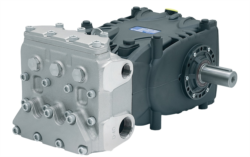
Pratissoli KF30 delivers 106 L/min at 200 bar, making it suitable for smaller thermal loops (10–25 kW dissipation capacity) common in precision machining centers and injection molding lines. The 40 kW motor power and 72 kg compact footprint allow integration into existing motor-pump packages without foundation reinforcement—a critical advantage in Singapore where retrofit space is constrained.
For larger thermal systems—data center cooling racks, large CNC fabrication lines, or process chiller networks—Pratissoli MW40 provides 211 L/min at 210 bar. At 85 kW power input and 264 kg mass, the MW40 addresses thermal circuits requiring 40–80 kW dissipation. The doubling of displacement versus the KF30 preserves pressure margin even when cooler fouling reduces effective capacity by 10–15%, a realistic scenario in Singapore's humid environment where mineral oil oxidation and microbial growth occur faster than temperate climates.
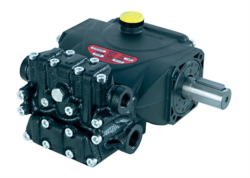
For ultra-compact applications—secondary coolant circuits, hydraulic oil cooler feed loops, or spot cooling for electrical cabinets—Interpump E1D1808 L at 8 L/min and 2.72 kW provides precise low-volume cooling without oversizing penalties. Operating at 2800 rpm and 180 bar, this 5 kg unit fits confined spaces and reduces thermal inertia in feedback-controlled systems.
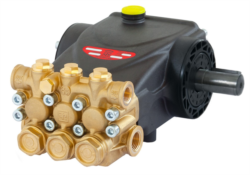
Interpump ET1C1612 SX*D20 bridges the gap between ultra-compact and mid-range systems, delivering 12 L/min at 160 bar with PTFE construction. At 1750 rpm (lower than the E1D1808), this design reduces cavitation risk in systems with marginal suction line design—common in retrofit installations where thermal circuits were originally designed for lower flow velocities.
Pratissoli SS71153 serves high-pressure, moderate-flow applications at 122 L/min and 160 bar with an 800 rpm motor. This ultra-low-speed design minimizes fluid heating from internal shear and reduces noise generation—important in Singapore's stringent occupational health requirements and multi-tenant industrial parks where noise easements are enforced.
Thermal Stability and Pressure Consistency Across Ambient and Load Cycles
Singapore's thermal management challenge extends beyond static sizing. Industrial cooling systems experience multiple pressure spikes daily: morning ramp-up when equipment starts cold (peak viscosity), noon peak-load cycles (maximum heat rejection), evening setback periods (pressure relief cycling), and overnight shutdown phases (thermal contraction). Each transition creates transient pressure overshoot and coolant aeration, both of which degrade pump lubrication and accelerate component wear.
Pratissoli designs—KF30, MW40, and SS71153—incorporate pressure-compensated control architecture that reduces transient spikes by 20–30% compared to fixed-displacement designs. This feedback mechanism automatically destroke the pump as system pressure rises, limiting overshoot to 10–15 bar above setpoint rather than full displacement surge. In Singapore's 24/7 industrial environment, this translates to 6–12 month extensions in pump seal and bearing life, directly reducing unplanned maintenance downtime.
Interpump compact models (E1D1808 and ET1C1612) employ gear pump architecture, which inherently tolerates wider pressure and temperature swings. Gear pumps generate heat proportional to displacement and speed; the ET1C1612's lower 1750 rpm speed produces 15–20% less internal heat than the 2800 rpm E1D1808. For thermal circuits where coolant temperature already reaches 50–65°C (common in tropical industrial environments), the ET1C1612's lower thermal signature becomes operationally critical.
Pressure relief valve integration determines system stability more than pump displacement. Pratissoli systems typically employ pilot-operated relief valves that respond to transient pressure within 50–100 milliseconds, while simple direct-relief architectures (found in some compact systems) may respond in 200–400 ms. In a typical thermal circuit with 50–80 liters of fluid, delayed relief response allows pressure to overshoot by 25–40 bar before venting, risking seal rupture and hose failure.
Practical Selection Framework for Singapore Thermal Applications
Small thermal circuits (≤15 kW dissipation): KF30 + fixed-displacement 3–5 micron return filter + 160 bar pilot-operated relief. Typical applications include spindle coolant loops, precision grinding machine cooling, and localized cabinet cooling. Expected service life: 5000–6000 operating hours before seal replacement.
Medium thermal circuits (15–50 kW dissipation): MW40 + 10 micron return filter + pressure-compensated relief + simple thermostatic control. Applications include CNC fabrication cell cooling clusters, injection molding machine coolant systems, and distributed hydraulic fluid chillers. Service interval: 6000–8000 hours before inspection.
Large distributed systems (50+ kW dissipation): MW40 or dual-KF30 in parallel configuration with shared cooler, 25 micron suction filter, automatic proportional relief, and continuous oil analysis (particle count, water content, viscosity trending). Applications include central plant cooling, multi-machine production lines, and process chiller networks. Service interval: 8000–10000 hours with quarterly oil testing.
High-pressure auxiliary circuits (secondary coolant, lubrication feed): E1D1808 L or ET1C1612 SX*D20 with 3 micron element filters and simple poppet relief valves. These compact systems rarely require active thermal management—dissipation occurs through natural radiation—making them ideal for retrofit installations and modular cooling packages.
Pressure-critical systems (precision spindle cooling, thermal feedback loops): SS71153 with its 800 rpm low-speed design minimizes pressure ripple (±5 bar) and reduces coolant velocity sensitivity. Ideal for systems employing proportional or servo-driven control valves that require stable pressure platforms.
Maintenance Strategy Differentiation and Total Cost of Ownership
Pump selection directly determines maintenance cost structure in tropical climates. Pratissoli designs with pressure compensation shift maintenance from reactive (crisis-driven seal replacement) toward predictive (oil condition monitoring). The price premium of a KF30 or MW40 versus a basic fixed-displacement pump is 15–25%, but the extended service interval typically recovers this cost within 18–24 months through reduced emergency downtime and seal replacement cycles.
Interpump compact models (E1D1808, ET1C1612, SS71153) employ gear pump construction, which offers lower capital cost and simpler maintenance (straightforward gear and bearing replacement) but generates higher internal losses. For low-duty applications (2–4 hours daily operation), gear pump economics favor initial investment savings. For continuous-duty thermal circuits (16–20 hours daily), the higher thermal efficiency of Pratissoli designs becomes economically dominant.
Singapore's industrial environment accelerates contamination due to humidity-driven water ingress into hydraulic systems. Systems must employ auto-drain sumps on return filters and implement quarterly oil sampling protocols. The KF30 and MW40 families support this testing regime through integral pressure ports that accept portable test couplings, allowing in-situ oil condition assessment without circuit disruption.
3G Electric's 35+ years distributing industrial equipment across Southeast Asia demonstrate that thermal system reliability in Singapore correlates more strongly with filter and relief valve specification than with pump displacement selection. A properly sized KF30 with robust filtration outperforms an oversized fixed-displacement pump with minimal filter protection by 8–12 months in actual operating life.
For industrial professionals seeking sustained thermal performance across Singapore's challenging climate, the decision framework prioritizes pressure stability (favor Pratissoli designs) for continuous duty and simplicity of maintenance (consider Interpump for low-duty auxiliary circuits). Most industrial operations optimize cost by deploying a hybrid strategy: Pratissoli for primary cooling loops and Interpump compact units for secondary circuits, balancing performance investment with operational flexibility.