Understanding Specification Matching vs. Over-Selection
Procurement engineers frequently face pressure to standardize equipment across facilities, yet one-size-fits-all approaches to Pumps & Compressors selection often result in 20–40% capital waste and unnecessary operational costs. Over-sized units consume excess energy, require larger electrical infrastructure upgrades, and generate unnecessary maintenance overhead. Conversely, undersized equipment leads to production bottlenecks and accelerated wear.
With over 35 years of equipment distribution experience across Asia-Pacific, 3G Electric has observed that specification mismatch remains the leading cause of pump and compressor underutilization. Singapore's compact industrial footprint and multi-storey manufacturing environments amplify this problem—spatial constraints and utility limitations demand precise right-sizing rather than arbitrary selection based on maximum capacity.
The fundamental challenge lies in translating application requirements into concrete performance parameters: required flow rate (L/min or m³/h), system pressure (bar or PSI), duty cycle classification, fluid characteristics, installation constraints, and maintenance accessibility. Each variable influences not only equipment selection but also total cost of ownership across the asset lifecycle.
Establishing Baseline Application Requirements
Flow Rate Calculation Methodology
Flow rate represents the volume of fluid the pump or compressor must deliver per unit time. Many procurement teams default to nameplate specifications without validating against actual process demands, leading to significant oversizing.
For hydraulic circuits, calculate required flow using this framework:
- Identify all actuators (cylinders, motors) operating simultaneously
- Determine individual actuator speed or rotational velocity requirements
- Apply the formula: Required Flow = Actuator Area × Velocity × Number of Units
For example, a pressing operation with four identical cylinders (80 mm diameter) requiring 0.5 m/s extension speed demands: (5,027 mm² × 0.5 m/s × 4 units) = 10.05 L/min minimum.
For compressor applications, consider:
- Peak demand (simultaneous tool operation)
- Average demand (typical production cycle)
- Leakage allowance (5–15% depending on line condition)
- Pressure drop compensation (pressure loss across distribution network)
Singapore's high-humidity tropical climate necessitates additional capacity allocation for moisture removal and cooler operation—typically 10–15% margin above calculated demand.
Pressure Requirement Analysis
System pressure depends on load characteristics and component specifications, not arbitrary selection. A critical mistake involves specifying maximum available pressure (e.g., 280 bar) when application requires only 100 bar. Higher pressure ratings demand expensive component upgrades and consume additional energy.
Determine minimum required pressure through:
- Load calculation: Required Pressure = Applied Force ÷ Actuator Area
- Component manufacturer specifications (all seals, hoses, valves have maximum ratings)
- System friction losses (typically 5–10 bar across properly designed circuits)
- Safety margin (10–15% above minimum)
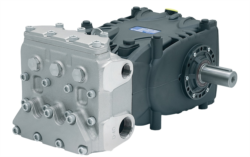
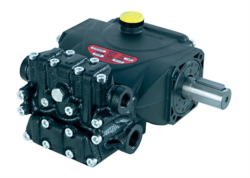
For instance, the Pratissoli KF30 delivers 200 bar maximum—appropriate for medium-duty industrial applications. Applications requiring only 160 bar operation should not mandate a 200 bar pump; instead, specify Interpump ET1C1612 SX*D20 which operates at 160 bar, reducing component stress and energy consumption.
Duty Cycle Classification Impact
Duty cycles dramatically influence specification selection and equipment longevity. ISO classification defines five duty patterns:
- S1 (Continuous): Full load operation indefinitely—requires conservative sizing and premium cooling
- S2 (Short-Term): Fixed duration at full load with cooling periods—permits moderate oversizing
- S3 (Intermittent): Repeated load/no-load cycles—permits greater intermittent peaks
- S4 (Intermittent with Starting Load): High starting torque plus intermittent operation
- S5–S8 (Cyclic/Intermittent with Complex Profiles): Variable loads with specific duty patterns
A compressor operating S2 (2-hour shifts with 4-hour cooling) can function with 15–20% intermittent oversizing. A continuous S1 operation demands exact sizing; oversizing only increases cost and electricity consumption without performance benefit.
Technical Specification Matching Framework
Comparison Matrix Development
Procurement engineers should construct specification matrices comparing candidate equipment against application requirements. The Pratissoli MW40 provides a useful reference point for medium-high performance applications:
- Flow: 211 L/min (suitable for multi-actuator systems)
- Pressure: 210 bar (general industrial hydraulics)
- Power: 85 kW (requires adequate electrical supply)
- Weight: 264 kg (installation space and foundation requirements)
For applications requiring lower flow rates, the Interpump PUMP E1D1808 L offers compact-footprint alternatives:
- Flow: 8 L/min (single-actuator or supplementary systems)
- Pressure: 180 bar
- Power: 2.72 kW (minimal electrical infrastructure)
- Weight: 5 kg (easy installation and repositioning)
1. Listing all application requirements in column 1 (flow rate, pressure, power, dimensions, etc.)
2. Entering actual application demand in column 2
3. Recording each candidate equipment specification in subsequent columns
4. Calculating variance percentages for each parameter
5. Applying weighting factors (flow rate criticality = 30%, pressure = 25%, energy efficiency = 20%, space constraints = 15%, cost = 10%)
6. Scoring each candidate against weighted criteria
Equipment scoring >85% on weighted criteria typically represents optimal specification match.
Integration with Existing System Architecture
Singapore facilities frequently operate multiple independent or interconnected systems. Specification matching must account for existing infrastructure:
- Electrical supply limitations: Amperage availability, phase configuration, power factor correction requirements
- Cooling capacity: Ambient temperature (Singapore averages 27–32°C year-round), heat rejection from oversized equipment
- Distribution network: Existing piping diameter, valve pressure ratings, accumulator capacity
- Maintenance accessibility: Space for filter cartridge replacement, oil sampling ports, coupling access
The Pratissoli PUMP SS71153 operates at 800 rpm with 37.5 kW power—suitable for direct-coupled or belt-drive configurations in retrofit scenarios where higher-speed alternatives would require transmission modifications.
Practical Implementation and Validation
Specification Verification Checklist
Before procurement commitment, validate specifications using this verification framework:
Performance Validation
- Confirm flow rate requirement against simultaneous load operation (not theoretical maximum)
- Cross-reference pressure rating with highest-pressure component in system
- Verify power supply capacity (electrical load + 15% safety margin)
- Validate thermal management (cooler capacity for ambient conditions)
- Measure available installation space (height, width, depth including connection fittings)
- Confirm flange types and port sizes against existing connections
- Identify access routes for delivery and installation
- Plan maintenance accessibility (oil drain, filter cartridge replacement, coupling service)
- Verify compliance with Singapore's Electrical Safety Regulations
- Confirm noise emissions comply with workplace standards (<85 dB at 1 meter)
- Validate MTBF (Mean Time Between Failure) specifications against maintenance planning
- Confirm warranty and spare parts availability through established distributors
Cost-of-Ownership Projection
Equipment cost represents only 15–25% of total ownership expense. Procurement engineers must model lifecycle costs:
Calculation Framework:
- Equipment cost (capital expenditure)
- Installation and integration (labor, modifications)
- Annual energy consumption: (Motor Power in kW × Operating Hours × Electricity Cost per kWh)
- Preventive maintenance (filter replacement every 1000–2000 hours; fluid analysis annually; seal replacement per manufacturer intervals)
- Unplanned downtime costs (production loss, emergency repairs, expedited shipping)
- Disposal and environmental compliance
Over a 7-year lifecycle, energy costs typically exceed equipment cost for continuous-duty applications. A 10 kW compressor oversized for 5 kW average demand wastes approximately SGD 5,000–8,000 annually in excess electricity consumption across typical Singapore operational patterns.
Regional Considerations for Singapore Operations
Singapore's operational environment introduces specific specification demands:
Tropical Climate Factors
- High ambient temperature and humidity necessitate robust cooling and moisture removal
- Increased corrosion risk requires stainless steel or epoxy-coated components
- Air quality (marine/industrial) demands enhanced filtration
- Limited floor space demands vertical or compact mounting configurations
- Multi-storey facilities require lightweight designs and overhead lifting provisions
- Utility costs (electricity, compressed air) justify premium efficiency ratings
- Ministry of Manpower (MOM) machinery safety standards
- Electromagnetic compatibility requirements for electrical equipment
- Environmental Protection and Management Act (EPMA) compliance for fluid handling and disposal
3G Electric's 35+ years of regional distribution experience ensures access to equipment specifications optimized for Singapore's operational profile, along with local service infrastructure and spare parts availability.
Specification Documentation and Procurement
Once specifications are validated, create formal documentation:
Technical Purchase Specification (TPS) Document Should Include:
- Application description and duty cycle classification
- Flow rate requirement (minimum, normal, peak) with calculation methodology
- Pressure specification (minimum, normal, maximum) with load justification
- Power/electrical requirements with supply confirmation
- Physical dimensions and installation constraints
- Connection types and sizes
- Environmental factors (ambient temperature, humidity, contamination)
- Maintenance and service requirements
- Regulatory and safety certifications required
- Performance test requirements before acceptance
This documentation prevents miscommunication, enables competitive bidding among suppliers, and creates contractual clarity regarding performance expectations.
Conclusion
Specification matching for Pumps & Compressors extends beyond selecting equipment with adequate maximum ratings. Precise right-sizing directly impacts capital expenditure efficiency, operational costs, facility energy consumption, and maintenance burden. By applying systematic calculation methodologies, creating specification comparison matrices, validating against actual requirements, and accounting for regional operational factors, procurement engineers can eliminate selection errors and optimize total cost of ownership across asset lifecycles. 3G Electric's technical team stands ready to support specification validation and sourcing for Singapore operations.