Understanding Pumps & Compressors: Core Differences for Industrial Selection
Pumps & compressors serve fundamentally different functions in industrial systems, yet both are essential for fluid transfer and pressure management across Southeast Asian manufacturing operations. Pumps move liquids—typically hydraulic fluids, water, or specialized industrial oils—while compressors pressurize gases, primarily air. However, the selection process for both technologies shares critical similarities: understanding flow rate requirements, pressure specifications, environmental conditions, and total cost of ownership.
With over 35 years of experience distributing industrial equipment across the region, 3G Electric has observed that many procurement engineers struggle with pump and compressor selection because they approach each technology in isolation. The most effective strategy involves comparing competing technologies side-by-side against your specific application requirements, climate considerations, and maintenance capabilities.
Centrifugal vs. Gear Pumps: Flow Rate and Pressure Trade-offs
Centrifugal Pumps: High Flow, Lower Pressure Applications
Centrifugal pumps excel when you need high volumetric flow rates at relatively moderate pressures. These units rely on rotating impellers to accelerate fluid radially outward, converting velocity into pressure. In Southeast Asian facilities handling cooling water circulation, general process fluid transfer, and HVAC systems, centrifugal pumps dominate because they deliver consistent flow with minimal maintenance requirements.
Key advantages include simple design, lower acquisition costs, and tolerance for abrasive or particulate-laden fluids. However, centrifugal pumps struggle with high-pressure applications and perform poorly when handling low-viscosity fluids at high pressures—common scenarios in hydraulic systems.
Gear Pumps: Precision Pressure Delivery
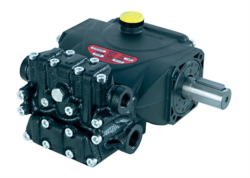
Gear pumps, exemplified by solutions like the Interpump PUMP E1D1808 L, operate through interlocking gears that trap fluid in expanding and contracting chambers. This positive displacement design delivers fixed flow volumes per rotation, making gear pumps ideal for high-pressure hydraulic applications requiring precise control.
The E1D1808 L delivers 8 L/min at 180 bar pressure with only 2.72 kW input power, making it exceptionally efficient for compact, high-pressure systems common in Southeast Asian manufacturing operations. Gear pumps maintain pressure accuracy across varying shaft speeds and handle viscous fluids effectively—critical advantages when operating hydraulic presses, injection molding systems, and precision machine tools.
Comparison Framework:
- Flow capacity: Centrifugal pumps: 50–500+ L/min; Gear pumps: 2–300 L/min
- Pressure range: Centrifugal: 3–30 bar; Gear: 50–280 bar
- Viscosity tolerance: Centrifugal: 20–100 cSt; Gear: 10–500 cSt
- Cost efficiency: Centrifugal lower upfront; Gear higher upfront but superior pressure control
For Southeast Asian operations balancing capital investment with precision requirements, selecting between these technologies requires quantifying your actual pressure and flow demands. Specify these before considering equipment.
High-Performance Industrial Pumps: Scaling Capacity for Larger Operations
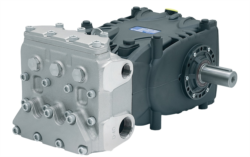
As your industrial operation grows beyond basic fluid transfer, high-performance pump systems become necessary. The Pratissoli KF30 and Pratissoli MW40 represent entry and mid-tier solutions for substantial hydraulic demand.
Mid-Range: The Pratissoli KF30 Platform
The KF30 delivers 106 L/min at 200 bar with 40 kW power consumption, establishing a solid performance tier for facilities requiring moderate to high flow with consistent pressure. Italian-engineered by Pratissoli (Interpump Group), this unit provides the reliability that Southeast Asian operations demand in humid, temperature-variable climates. At 72 kg, the KF30 integrates into existing equipment layouts without infrastructure modifications.
Applications well-suited to KF30 capacity include:
- Hydraulic lifting and material handling systems
- Mid-scale industrial presses
- Fluid power circuits requiring moderate flow with reliable pressure maintenance
- Circulation systems in processing facilities
When your operation requires nearly double the flow capacity, the Pratissoli MW40 escalates to 211 L/min at 210 bar with 85 kW power. This heavy-duty solution weighs 264 kg and powers large-scale hydraulic systems across mining, construction equipment support, and heavy manufacturing sectors prevalent throughout Southeast Asia.
The MW40's superior capacity justifies its higher acquisition cost when you're operating multiple production lines or equipment simultaneously requiring substantial hydraulic power. Key differentiator: the MW40 maintains pressure stability under sustained load—critical for operations running continuously in tropical Southeast Asian environments where component stress accelerates under heat.
Specialized High-Pressure Compact Solutions
For applications where space constraints exist alongside pressure demands, the Interpump ET1C1612 SX*D20 offers 12 L/min at 160 bar in a compact envelope. Weighing significantly less than full-scale systems, this pump suits:
- Retrofit installations in existing equipment
- Mobile hydraulic systems
- Precision automation requiring limited flow at high pressure
- Equipment modifications where weight matters
The PTFE construction resists corrosion in humid Southeast Asian climates, extending service life compared to standard steel components.
Reciprocating Pumps and Variable Flow Systems: Advanced Control for Complex Operations
Reciprocating pump technology, often overlooked in basic comparisons, provides distinct advantages when your operation requires variable flow rates or must accommodate pressure fluctuations. The Pratissoli SS71153 exemplifies this capability, delivering 122 L/min at 160 bar with an 800 rpm motor configuration.
Why Reciprocating Design Matters
Reciprocating pumps use piston or plunger mechanisms to create discrete displacement volumes, enabling variable flow through pressure-compensated swashplate designs. This differs fundamentally from fixed-displacement gear pumps and from centrifugal pumps' pressure-dependent flow variations.
Southeast Asian operations benefit from reciprocating pump flexibility when:
- Production demands fluctuate throughout shifts or seasonally
- Multiple independent hydraulic circuits share a single pump source
- Pressure requirements vary between sequential process stages
- Energy efficiency during partial-load operation matters significantly
The SS71153's 37.5 kW motor delivers substantial flow while the 800 rpm design (lower than typical 1500–3000 rpm alternatives) reduces noise and heat generation—crucial advantages in facilities operating near residential areas or where worker comfort affects productivity.
Climate, Maintenance, and Total Cost of Ownership in Southeast Asia
Environmental Considerations Specific to the Region
Southeast Asian climates—characterized by high humidity, temperature swings, and salt air corrosion in coastal areas—impose unique demands on pump systems. Tropical downpours and seasonal flooding risk component damage and fluid contamination. When comparing pump technologies, factor these maintenance intensities:
1. Centrifugal pumps: Require frequent seal maintenance in humid environments; vulnerable to corrosion if not regularly drained
2. Gear pumps: Sealed designs protect internals; minimal exposure to environmental contaminants; longer intervals between maintenance
3. Reciprocating pumps: Piston/plunger exposure requires careful seal maintenance but generally tolerate moisture better than centrifugal designs
Fluid Compatibility and Regional Supply Chain
Your pump selection must align with available hydraulic fluids in your local market. While Pratissoli and Interpump pumps accommodate standard ISO VG 46 hydraulic oils available throughout Southeast Asia, some specialized systems demand fluids with longer lead times or higher costs. Verify fluid availability before committing to equipment selections.
Total Cost of Ownership Calculation
Compare pumps across 5-year ownership cycles including:
- Initial acquisition: Equipment cost plus installation
- Energy consumption: kW × operating hours × local electricity rates
- Maintenance: Seal replacements, fluid analysis, filter changes (varies 20–40% between technologies)
- Downtime risk: System failure costs during production
- Residual value: Used equipment resale or refurbishment potential
For Southeast Asian operations, the total cost often favors gear and reciprocating pumps despite higher upfront investment, as their sealed designs and pressure stability reduce maintenance frequency and unplanned downtime.
Practical Selection Workflow
Step 1: Quantify Requirements
Document: Peak flow demand (L/min), operating pressure (bar), duty cycle (continuous/intermittent), and fluid type.
Step 2: Match Technology to Application
Centrifugal for flow-dominant applications; gear for high-pressure systems; reciprocating for variable-demand operations.
Step 3: Evaluate Environmental Factors
Consider humidity, temperature range, corrosion risk, and fluid storage challenges specific to your facility location.
Step 4: Source Compatible Components
3G Electric's 35+ years experience distributing industrial equipment across Southeast Asia ensures availability of compatible motors, couplings, manifolds, and support systems for Pratissoli and Interpump product lines.
Step 5: Validate Total Cost of Ownership
Calculate 5-year costs including energy, maintenance, and contingency downtime reserves before finalizing procurement.
By systematically comparing pump technologies against documented requirements rather than defaulting to familiar equipment, Southeast Asian industrial professionals optimize both capital allocation and operational reliability.