
Understanding Measurement & Detection for Your Multi-Equipment Operations
Measurement & Detection spans far beyond single-point monitoring. As a plant manager, you're responsible for maintaining dozens of interconnected systems—hydraulic presses, pneumatic conveyors, thermal processing units, and fluid distribution networks. Each requires different measurement parameters and detection thresholds. The challenge isn't finding instruments; it's integrating them into a cohesive monitoring strategy that gives you actionable intelligence without overwhelming your maintenance team.
After 35+ years supplying industrial equipment globally, 3G Electric has helped countless plant managers standardize their measurement approaches. The most successful operations don't rely on scattered analog gauges and reactive troubleshooting. Instead, they deploy systematic measurement & detection protocols that catch problems before equipment fails.
This guide walks you through implementing a practical framework that works in real facilities with real budget constraints.
Establishing Your Baseline: Pressure Point Monitoring Across Hydraulic and Pneumatic Systems
Pressure is your first critical measurement. Hydraulic systems operating beyond design parameters wear seals, overheat fluid, and damage pumps. Pneumatic systems suffer leaks and inefficiency when operating outside specified ranges. Yet many plants operate on old analog gauges mounted on equipment—impossible to read remotely, inaccurate, and providing no data history.
Start with your primary pressure points:
- System main line pressure (pump discharge)
- Actuator load pressure
- Return line backpressure
- Pilot pressure (if applicable)
For static pressure measurement, the Preciman Manometer ABS vert D80 0/+16bar G1/2 provides ±2.5% accuracy with a glycerin-filled 80 mm dial that's readable in harsh shop environments. Install these at key system intersections—they serve as your reference standard for validating electronic sensors.
But manometers only work if someone reads them regularly. For continuous monitoring, you need transmitters. The Dwyer Transmitter 629-05-CH-P2-E5-S1 delivers 4-20 mA output with 0.5% accuracy across 0-100 psid range. The NPT 1/4" connection fits standard tapped ports on hydraulic manifolds. Wire these to your PLC or data logger—suddenly you have pressure history. You can spot trends: gradual pressure creep indicating seal wear, sudden drops suggesting leaks, and cycling patterns revealing load variations.
Implementation priority: Start with your highest-failure systems. If your molding press hydraulics fail twice yearly, that's your first transmitter installation. If pneumatic conveyors experience seasonal efficiency loss, measure pilot pressure during problem seasons.
Pressure switches add a safety layer. The Dwyer Pressure switch DXW-11-153-4 with setpoint range 0.41–0.55 bar and IP65 protection can trigger alarms, shut down equipment, or activate secondary systems. Set these conservatively—5% above your normal operating pressure. That way, a pressure spike (seized actuator, blocked return line) triggers response before damage occurs.
Temperature Detection: The Overlooked Failure Indicator
Fluid temperature is your canary in the coal mine. Hydraulic oil degrades above 60°C. Pneumatic system heat indicates excessive friction or leaking compressed air doing work it shouldn't. Yet many plants never measure system temperature until equipment fails.
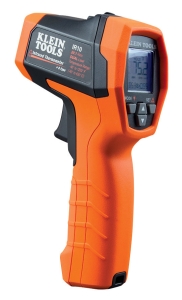
Infrared thermometers offer non-contact measurement without disrupting systems. The CBM Infrared thermometer with type K input measures -40 to 650°C with 20:1 optical resolution and adjustable emissivity. This matters: a 3°C misreading on a 60°C hydraulic manifold changes your diagnosis. With adjustable emissivity (0.10–1.00), you read accurate temperatures on painted, weathered, or corroded surfaces. The IP54 rating and 3 m drop protection mean it survives shop floors.
Practical temperature detection strategy:
- Daily: Spot-check pump discharge temperature on critical hydraulic systems. Record it. Establish baseline. A 2°C rise over days suggests increased load or cooler failure.
- Weekly: Compare actuator inlet vs. return line temperature. A 4°C differential reveals normal heat generation. A 1°C difference suggests low flow or cavitation.
- Monthly: Thermal audit all equipment during peak load. Identify hot spots. A bearing running 15°C hotter than design temperature will fail within weeks.
The Type K input on the CBM thermometer lets you integrate permanent thermocouples into your most critical locations. Wire them through a data logger, and you capture temperature 24/7 without human intervention. When your nitrogen generator begins overheating, you get a trend—not a sudden failure email at 2 a.m.
Flow Measurement: Closing the System Performance Loop
Pressure and temperature tell you something is wrong. Flow measurement tells you what is wrong. A pump losing prime shows as pressure drop and temperature rise. A pump cavitating shows as oscillating pressure and noise—but also reduced flow. Actuator drift reveals low flow through control valves.
The Dwyer Medium flow metal probe MAFS-20 with 71 cm probe length and 1/4-20 thread connection measures fluid velocity in distribution lines. The metal construction handles industrial oils and emulsions. Mount it in your main distribution line or return manifold—it tells you immediately whether flow matches demand.
Practical flow monitoring steps:
1. Document baseline: Run your hydraulic system under known load. Record pump pressure (transmitter), system temperature (infrared or thermocouple), and estimate flow from pump displacement and RPM. The MAFS-20 gives you actual flow to compare against calculation. If calculation predicts 15 GPM but probe shows 12 GPM, you've found a 20% system loss.
2. Set flow alarms: If pump should deliver 20 GPM at pressure, set a low-flow alarm at 18 GPM. Maintenance responds before efficiency degrades or heat builds.
3. Detect load changes: Seasonal production variations change system flow patterns. Tracking flow reveals when you're operating near capacity—critical for planning upgrades.
Integrating Measurements into Actionable Maintenance Decisions
Raw data means nothing. A transmitter showing 85 bar and a thermometer showing 58°C only matter if you know what to do with them.
Create measurement & detection thresholds specific to each system:
| System | Normal Pressure | Alert Threshold | Shutdown Level | Normal Temp | Alert Temp |
|--------|-----------------|-----------------|-----------------|-------------|------------|
| Main Hydraulic Pump | 80 bar | 95 bar | 120 bar | 50°C | 62°C |
| Pilot Control | 25 bar | 30 bar | 35 bar | 48°C | 65°C |
| Pneumatic Main Line | 6.5 bar | 7.2 bar | 8.0 bar | 35°C | 50°C |
These aren't guesses—base them on equipment manuals, manufacturer recommendations, and your facility's historical failure data. After two years of monitoring, you'll refine them based on patterns.
Assign measurement responsibility:
- Daily checks: Frontline operators record morning pressure/temperature on critical systems using checklists. Takes 5 minutes per station.
- Weekly analysis: Maintenance technician reviews recorded data, looks for trends (gradual pressure rise, temperature creep), orders spare parts if failure seems imminent.
- Monthly reporting: Present trends to operations. Show how proactive measurement prevented three potential failures last quarter—justifies continued investment.
Transmitters and data loggers automate this, but the discipline must exist first. Start manual. Prove the concept. Then invest in automation.
Selecting and Deploying Equipment from 3G Electric
3G Electric stocks all measurement instruments you need—we've been a global industrial equipment distributor for 35+ years. We don't sell the cheapest instruments; we supply the ones that work in real facilities.
The products referenced here represent different measurement approaches:
- Preciman manometer ({{PRODUCT:ROS29018|Preciman Manometer ABS vert D80 0/+16bar G1/2}}) for reference standards and visual verification
- Dwyer transmitter ({{PRODUCT:DWY06008|Dwyer Transmitter 629-05-CH-P2-E5-S1}}) for continuous 4-20 mA pressure monitoring
- Dwyer pressure switch ({{PRODUCT:DWY24008|Dwyer Pressure switch DXW-11-153-4}}) for automatic alarm response
- Dwyer flow probe ({{PRODUCT:DWY28018|Dwyer Medium flow metal probe MAFS-20}}) for system efficiency verification
- CBM infrared thermometer ({{PRODUCT:MES40004|CBM Infrared thermometer with type K input}}) for temperature diagnostics
A plant manager's first installation typically costs $3,000–$8,000 for five critical monitoring points. Within 12 months, prevented failures pay for the equipment. After that, it's pure margin: lower energy costs, extended equipment life, fewer emergency repairs, and higher production availability.
Contact 3G Electric for equipment selection help. Our team understands industrial measurement. We'll recommend instruments matched to your specific systems and budgets.
Implementation Timeline: Your First 90 Days
Don't overload your operation with simultaneous installations.
Week 1–2: Identify your highest-risk system. Audit current measurement method. Is it accurate? Is data recorded? What failures occur?
Week 3–4: Install one Preciman manometer as reference standard. Train operators to read it daily. Create a simple log.
Week 5–8: Install Dwyer transmitter on the same system. Connect to PLC or simple data logger. Capture 3 weeks of baseline data.
Week 9–12: Review data. Identify patterns. Set alert thresholds. Install pressure switch to automate response. Run side-by-side comparison: what did your old gauge miss that the transmitter caught?
Month 4+: Expand to other critical systems. Repeat the process. Build your measurement framework incrementally.
This approach proves ROI at each step. Your maintenance team understands the value. Your operators engage with monitoring. By year two, measurement & detection is standard practice.