
Understanding Measurement & Detection in Modern Plant Operations
Measurement & Detection equipment forms the nervous system of industrial facilities. Without accurate real-time data on pressure, temperature, and flow rates, plant managers operate blind—making reactive decisions instead of proactive adjustments that prevent costly downtime. Over 35 years serving industrial operations, 3G Electric has observed that plants investing in proper measurement and detection infrastructure reduce unplanned maintenance incidents by 40-60% while extending equipment lifespan.
The challenge facing today's plant managers isn't whether to implement measurement and detection systems, but rather which combination of instruments delivers the best return on investment for your specific operations. This article compares four measurement and detection instrument categories with practical guidance for selection.
Category 1: Analog Pressure Gauges—Reliable, Visual, Cost-Effective
Overview and Application
Analog pressure gauges remain the foundation of measurement and detection in most industrial facilities. Unlike digital systems requiring power and calibration services, glycerin-filled gauges like the Preciman Manometer ABS vert D80 0/+16bar G1/2 provide continuous visual feedback without electronics.
The Preciman manometer delivers ±2.5% accuracy with an 80 mm dial, making readings visible from 3-4 meters away. The glycerin fill dampens pressure fluctuations, preventing needle chatter that occurs with water-filled or empty gauges. This matters significantly in hydraulic and pneumatic systems where pressure spikes are common.
Key Advantages for Plant Managers
- Zero power dependency: Functions during electrical outages; no batteries or calibration schedules required
- Immediate troubleshooting: Visible gauge readings during startup sequences and emergency shutdowns
- Durability in harsh environments: Sealed 80 mm dial resists dust, moisture, and temperature extremes
- Simple integration: Direct thread connection (G1/2) fits standard manifolds without adapter costs
- Cost baseline: Provides affordable reference points for comparing digital transmitter investments
Use analog gauges as primary indicators on equipment serving as secondary backup systems, or where visual monitoring by operators is a standard operating procedure. Install them on main supply lines and at critical branch points where operators need immediate pressure confirmation during startup sequences.
Category 2: Flow Probes—Detection and Measurement for Process Control
Overview and Application
Flow measurement and detection systems bridge visual gauges and electronic transmitters. The Dwyer Medium flow metal probe MAFS-20 exemplifies this category with its 71 cm insertion length, designed for large-diameter pipes where full line replacement isn't practical.
Measurement and detection flow probes operate by sensing velocity changes as fluid moves through the probe tip. The MAFS-20's 1/4-20 thread connection allows installation through existing tappings, reducing downtime during retrofit projects.
Key Advantages for Plant Managers
- Non-invasive installation: Minimal system shutdown required; threads directly into existing ports
- Extended measurement range: 71 cm probe length captures accurate readings in pipes 200-500+ mm diameter
- Metal construction: Withstands pressure spikes and corrosive fluids in chemical processing plants
- Tangible feedback: Works with analog gauges or connects to electronic display systems
- Troubleshooting capability: Quick identification of flow rate changes indicating bearing wear or valve restrictions
Implement flow measurement and detection probes on cooling loops, hydraulic return lines, and process fluid circuits where flow rate reduction signals impending equipment failure. They're particularly valuable in facilities where predictive maintenance teams track historical flow trends.
Category 3: Electronic Pressure Switches—Automated Measurement & Detection with Control Functions
Overview and Application
Electronic pressure switches add intelligence to measurement and detection systems by triggering actions automatically. The Dwyer Pressure switch DXW-11-153-4 continuously monitors pressure and closes electrical contacts when readings exceed setpoint thresholds—enabling pump shutdown, alarm activation, or bypass valve opening without operator intervention.
The DXW-11-153-4 operates across 0.41–0.55 bar setpoint ranges with 3.46–5.17 bar differential settings, common in low-pressure applications like compressed air systems, vacuum pump protection, and pneumatic conveying lines. Its IP65 protection rating withstands washdown environments and outdoor installations.
Key Advantages for Plant Managers
- Automated safety: Prevents overpressure conditions without requiring constant operator attention
- Electrical integration: 5 A @ 125/250 VAC rating operates standard solenoid valves, alarm circuits, and motor starters
- Setpoint flexibility: Differential adjustment accommodates pressure fluctuations in dynamic systems
- Redundant protection: Pairs with pressure transmitters to create independent safety chains
- Maintenance trending: Frequent switch actuation signals gradual system degradation
Use pressure switches as secondary safety devices protecting compressors, vacuum pumps, and low-pressure hydraulic circuits. They're essential measurement and detection components in facilities without continuous monitoring staff.
Category 4: Digital Pressure Transmitters—Precise Measurement & Detection with Data Logging
Overview and Application
Digital transmitters represent the highest technology level in measurement and detection instrumentation. The Dwyer Transmitter 629-05-CH-P2-E5-S1 converts pressure readings into 4-20 mA signals compatible with PLC inputs, building automation systems, and IoT platforms. Its 0.5% accuracy across 0-100 psid range enables predictive maintenance algorithms that identify failures before they impact production.
Key Advantages for Plant Managers
- Integration with facility systems: 4-20 mA output connects directly to SCADA, HMI displays, and data historians
- Historical analysis: Enables trending analysis revealing seasonal patterns, equipment degradation, and optimal maintenance windows
- Remote monitoring: Pressure data accessible from control rooms or mobile devices
- 0.5% accuracy: Supports precision diagnostics in pharmaceutical, food processing, and semiconductor applications
- IP65 rating with NPT 1/4" connection: Fits existing manifold ports in retrofit installations
While transmitters cost 5-8x more than analog gauges, the ROI calculation includes data that prevents downtime. A single production interruption in food processing or chemical manufacturing typically exceeds the annual cost of a transmitter installation.
When to Specify
Implement transmitters on critical systems where pressure changes indicate product quality issues or where production schedules demand predictive failure alerts. Pair them with analog gauges for operator verification.
Category 5: Infrared Thermometers—Thermal Measurement & Detection Without Contact
Overview and Application
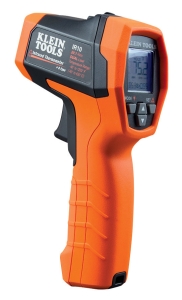
Temperature measurement and detection extends beyond pressure monitoring. The CBM Infrared thermometer with type K input measures surface temperatures from -40 to 650°C without contact, capturing data across moving equipment, high-voltage connections, and rotating machinery where probe contact isn't safe.
The 20:1 optical resolution enables measurement of small surface areas—bearing housings, motor terminal blocks, pump casings—from distances up to 4 meters. Adjustable emissivity (0.10–1.00) accommodates different material types, from polished metals to oxidized surfaces.
Key Advantages for Plant Managers
- Safety in measurement: Non-contact operation eliminates exposure to moving parts, electrical hazards, and extreme temperatures
- Predictive maintenance data: Thermal trends reveal bearing degradation, electrical connection resistance, and insulation breakdown before failure
- Type K thermocouple input: Integrates stationary probes with handheld measurement and detection capabilities
- Rugged design: IP54 rating and 3 m drop protection survive shop floor environments
- Portable troubleshooting: Technicians carry one instrument across multiple systems
Deploy infrared thermometers as part of preventive maintenance programs targeting motor bearings, electrical switchgear, and process equipment. Establish baseline temperatures during equipment commissioning, then track deviations indicating developing problems.
Building Your Measurement & Detection Strategy
Integration Framework
Effective measurement and detection doesn't require choosing one instrument category. Industry-leading plants combine:
- Analog gauges as visible confirmation on primary systems
- Pressure switches providing automated safety protection
- Flow probes detecting circulation problems
- Electronic transmitters feeding data into predictive maintenance systems
- Infrared thermometers supporting thermal diagnostics during rounds
Phase 1: Install pressure switches and analog gauges on all critical equipment. Cost is minimal; safety value is immediate.
Phase 2: Add flow probes to systems where flow reduction correlates with product quality or equipment performance.
Phase 3: Implement transmitters on the three systems contributing most downtime. Collect 12 months of baseline data.
Phase 4: Deploy infrared thermometers to maintenance teams; establish thermal trending on motors, bearings, and electrical connections.
Cost-Benefit Perspective
A plant with 50 critical pieces of equipment spending $8,000 on measurement and detection equipment (gauges, switches, probes, thermometers) typically realizes payback within 6-12 months through prevented downtime. Manufacturing and process facilities running 24/7 often achieve payback within 3 months.
Practical Measurement & Detection Installation Considerations
Environmental Factors
- Tropical/humid locations: Glycerin-filled gauges outperform water-filled versions; sealed switch enclosures essential
- Vibration-intensive machinery: Dampened gauges reduce needle flutter
- Temperature extremes: Digital transmitters require weatherproof enclosures; infrared thermometers need calibration verification
- Washdown environments: IP65-rated switches and transmitters mandatory
Measurement and detection equipment effectiveness depends on proper installation and interpretation. Budget for:
- Technician certification: 2-4 hours per person for transmitter setup and data logging
- Maintenance procedures: Written protocols for thermal trending and pressure switch testing
- Calibration schedules: Annual verification for all measurement and detection instruments
With 35+ years distributing industrial equipment, 3G Electric provides technical guidance on measurement and detection system design. Our team helps plant managers:
- Select appropriate measurement and detection instruments for your facility's pressure, flow, and temperature requirements
- Design integrated systems combining multiple measurement and detection technologies
- Plan installation sequences minimizing downtime
- Establish maintenance and calibration protocols
Measurement & Detection Technology Trends Shaping Plant Operations
Wireless Transmitters: Emerging measurement and detection transmitters eliminate hardwiring costs, enabling rapid sensor deployment across multiple systems.
IoT Integration: Measurement and detection data feeds directly into cloud platforms for analysis by predictive maintenance software.
Hybrid Instruments: Combined pressure/temperature measurement and detection devices reduce installation complexity in multiplex systems.
AI-Driven Diagnostics: Machine learning algorithms analyze measurement and detection data to identify failure patterns invisible to manual trending.
These advances don't eliminate manual gauges and switches—they create layered measurement and detection strategies combining proven analog reliability with digital intelligence.
Summary: Selecting Your Measurement & Detection Mix
Plant managers should view measurement and detection instruments as investments in operational visibility rather than maintenance costs. The combination of Preciman analog gauges, Dwyer pressure switches, flow probes, electronic transmitters, and infrared thermometers creates redundant detection capabilities—ensuring that equipment failures trigger alerts across multiple systems before production impact occurs.
Your measurement and detection strategy should reflect your facility's risk tolerance, production criticality, and available monitoring resources. Start with pressure switches and analog gauges on critical equipment. Add transmitters where historical data justifies the investment. Deploy thermal imaging as your technician expertise develops.
Contacting 3G Electric's team for your measurement and detection equipment ensures access to quality instrumentation and technical guidance developed across three decades of industrial experience.