Low-Pressure Measurement & Detection Systems: Technical Selection Guide for Industrial Applications in Singapore
Low-pressure measurement and detection systems are critical infrastructure components in HVAC, pneumatic, and industrial fluid applications across Singapore's diverse manufacturing and facility management sectors. Unlike high-pressure systems requiring robust containment, low-pressure measurement demands precision, stability, and integration compatibility with automated control systems. This technical guide examines the fundamental principles, component selection criteria, and real-world application strategies that procurement and maintenance engineers must understand to specify reliable measurement systems that balance accuracy, durability, and cost-effectiveness in tropical and humid operational environments.
Core Principles of Low-Pressure Measurement Technology
Low-pressure measurement spans applications below 2 bar (29 psi), where traditional mechanical gauges and modern digital transmitters serve distinct operational roles. The selection between analog and digital instruments depends on integration requirements, personnel skill levels, and data logging needs. Mechanical gauges using diaphragm or capsule elements remain the industrial standard for visual monitoring and fail-safe operation, while digital transmitters enable remote monitoring, alarm integration, and predictive maintenance workflows.
Pressure measurement accuracy is expressed as a percentage of full-scale (FS) reading. A gauge rated ±1.6% FS on a 40 mbar range carries an absolute uncertainty of ±0.64 mbar, which translates to significant measurement variation in tight-tolerance applications. This specification becomes critical when selecting instruments for HVAC balancing, where pressure differentials across filters or heat exchangers must remain within narrow bands to maintain system efficiency. The choice between copper alloy wetted parts and stainless steel construction affects both accuracy stability and corrosion resistance in humid tropical environments like Singapore, where salt-laden air and high moisture accelerate degradation of ferrous materials.
Temperature compensation represents another critical performance factor often overlooked in procurement specifications. Uncompensated mechanical gauges drift 0.3–0.5% per 10°C temperature change, meaning an instrument calibrated at 20°C will exhibit measurement error in heated equipment rooms or outdoor installations. Digital transmitters with integral temperature compensation maintain ±0.5% accuracy across their operating range, a necessity for facilities where process fluids experience 30°C+ temperature swings or installations move between air-conditioned spaces and outdoor cabinets.
Wetted material selection directly impacts measurement reliability and component lifespan. Copper alloy internals suit water, glycerin, and neutral fluid systems but corrode rapidly in acidic or alkaline environments. Stainless steel construction costs 20–40% more but provides superior longevity in corrosive applications and reduces maintenance cycles from annual to triennial intervals—a significant operational advantage in high-availability facilities where downtime carries productivity penalties.
Technical Specifications and Product Selection for Low-Pressure Applications
The Preciman stainless steel vertical pressure gauge D63 exemplifies modern low-pressure measurement design, delivering ±1.6% full-scale accuracy across the 0/+40 mbar range with G1/4 connection and copper alloy wetted parts. This 63mm dial size suits both direct visual observation from 1–2 meters distance and mounting on standardized control panel arrays. The vertical orientation accommodates overhead piping installations common in basement mechanical rooms and plant spaces where horizontal space is constrained. Stainless steel case construction resists rust formation in the damp tropical conditions prevalent across Singapore's warehouse and manufacturing facilities, while the copper alloy internals remain stable across typical facility temperature ranges (15–35°C).
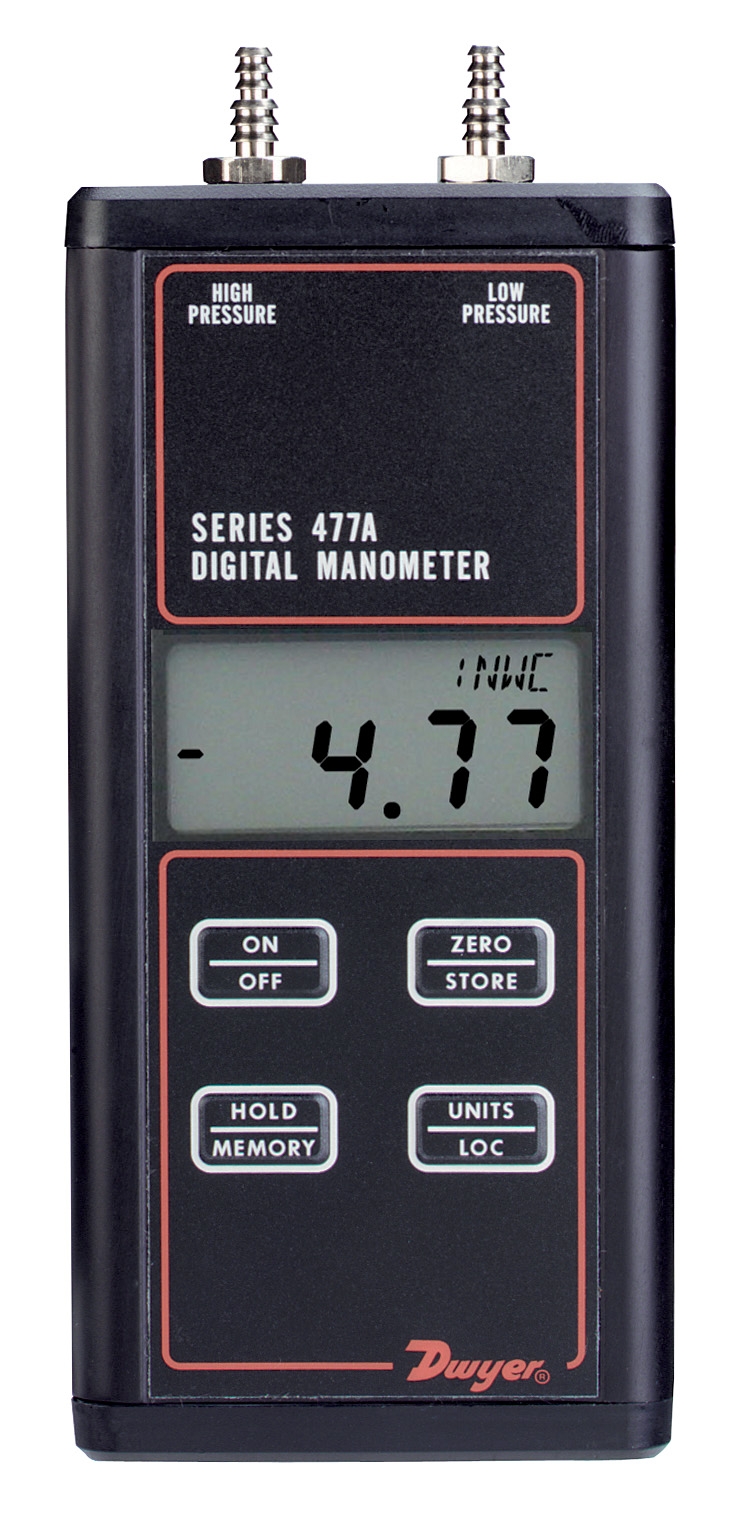
For applications requiring data logging or remote monitoring, the Dwyer digital pressure gauge 477AV-3 provides ±0.5% full-scale accuracy—a 3.2× improvement over mechanical equivalents—across the 0–500 mbar range with integrated data storage for 40 readings. The 477AV-3 operates from 0 to 140°F (-17.8 to 60°C) with temperature compensation active between 32 and 104°F (0 to 40°C), making it suitable for both chilled-water systems and hot-water distribution networks. Multiple pressure unit displays (PSI, mbar, in W.C., mm Hg, Pa, kPa, hPa) eliminate manual conversion errors and accelerate field diagnostics. Portable handheld operation enables technicians to validate system performance at multiple points without permanently installing instruments, reducing capital equipment costs for facilities with extensive piping networks.
Low-pressure differential transmitters like the Dwyer transmitter 616KD-13V-TC (0–1 IN W.C. range, 21 mA max power consumption) integrate seamlessly into building automation systems and HVAC control logic. The 3–5 mm barbed process connections accommodate flexible tubing runs without leak-prone fittings, while screw terminal electrical connections suit both hardwired installations and plug-in sensor modules. This transmitter addresses a critical procurement gap: facilities requiring automated filter change alerts, supply fan interlock, or chilled-water bypass control must source instruments with analog output (4–20 mA) or digital communication protocols (BACnet, Modbus). The 616KD-13V-TC delivers this functionality at lower cost than higher-range transmitters while maintaining accuracy suitable for demand-controlled ventilation strategies.
Gauge selection must account for installation context. Preciman ABS green gauge D50 0/+1.6bar suits compact panels and valve manifolds where space limitations restrict dial diameter to 50mm. The ±2.5% full-scale accuracy and ABS snap-in case design enable rapid panel installation and field replacement without complex mechanical work. Conversely, Preciman ABS gauge green D100 0/+16bar provides larger dial presentation (100mm) and 4× higher pressure range, accommodating hydraulic pilot circuits and compressed air systems where 0/+16 bar monitoring prevents pressure relief valve drift that could impact downstream equipment performance.
Real-World Application Scenarios and Integration Workflows
Consider a 50,000 m² commercial office tower in Singapore's central business district with a 5-MW chilled-water system serving 40+ zones. Mechanical engineers must verify pressure drop across the main filter housing remains below 0.15 bar to confirm adequate flow and prevent evaporator freeze-up. The traditional approach—deploying technicians with a single portable manometer during quarterly inspections—introduces three risks: (1) delayed detection of filter clogging between inspection cycles, (2) measurement inconsistency from instrument drift, and (3) technician overtime expenses for unscheduled emergency diagnostics when filter pressure suddenly rises to 0.40 bar. The modern specification integrates a fixed Preciman stainless steel vertical pressure gauge D63 on each filter bank outlet, paired with a Dwyer 477AV-3 digital manometer for validation and trend recording. Filter technicians now compare real-time gauge readings against historical baselines, executing preventive changeouts 2–3 weeks before emergency conditions develop, reducing energy waste and extending equipment service intervals.
HVAC commissioning presents a second critical scenario: balancing flows across multiple terminal units (fan coil units, air handlers, VAV boxes) requires simultaneous pressure measurement at 8–15 locations, yet most facilities cannot justify installing permanent gauges at every balance point. The solution combines portable digital manometers (Dwyer 477AV-3) with quick-disconnect test couplings on each zone. Commissioning teams record pressure differentials and flow rates at each point, store readings in the digital manometer's memory, then download data to a spreadsheet for system-wide balancing analysis. This workflow reduces commissioning time by 30–40% compared to manual note-taking and enables objective documentation of baseline system performance for future retrofit planning.
Facility managers implementing predictive maintenance programs for compressed-air systems benefit from permanent installation of differential pressure transmitters downstream of air dryers and filters. Automated alerts when dryer pressure drop exceeds 0.5 bar signal resin saturation requiring regeneration before moisture ingress damages downstream precision equipment or painting systems. This application demonstrates how low-pressure transmitters—when integrated with building management systems—transition maintenance from reactive (emergency repairs) to proactive (scheduled service) models, reducing unplanned downtime and extending component lifespan by 60–80%.
Selection Criteria, Best Practices, and Procurement Specifications
Accuracy vs. Operating Budget: Mechanical gauges (±1.6–2.5% FS) suit general monitoring and system diagnostics. Digital instruments (±0.5% FS) justify investment only when measurement uncertainty drives operational decisions—filter change timing, pressure relief valve calibration verification, or chilled-water loop commissioning. Specify the minimum accuracy required; oversizing accuracy wastes procurement capital and introduces unnecessary maintenance complexity.
Wetted Material Selection: Copper alloy components cost 15–20% less than stainless steel equivalents and perform adequately in neutral water and glycerin-based heat transfer fluids. Mandate stainless steel construction for facilities with aggressive environments: coastal locations (salt spray), chemical processing areas (acidic/alkaline vapor), or water systems with pH outside 6.5–7.5 range. Stainless steel instruments in these applications exhibit 5–7 year service life vs. 2–3 years for copper alloy alternatives, yielding lower total cost of ownership despite higher initial capital.
Connection Standardization: G1/4 connections accommodate 90% of European and Asian industrial manifolds and valve bodies. Verify connection threads (ISO 228-1 G-series, NPT, or BSPP) match existing infrastructure before finalizing procurement orders; mixed thread types introduce leak risks and require adapter fittings that compromise reliability. For new installations, standardize on G1/4 across all low-pressure points to simplify training, inventory management, and emergency parts provisioning.
Integration with Building Automation: Facilities planning BACnet or Modbus networks must specify transmitters with integrated communication modules during procurement, not as retrofits. The Dwyer 616KD-13V-TC and equivalent models integrate cost-effectively when purchased with new control logic; retrofitting communication to existing analog transmitters costs 2.5–3× more due to gateway hardware and programming services.
Tropical Environment Considerations: Singapore's 80–90% relative humidity and 25–35°C ambient temperatures accelerate condensation inside gauge cases and accelerate corrosion of ferrous components. Specify instruments with glycerin-filled dials (damped readout, moisture barrier) or stainless steel construction as baseline standards. Budget for triennial re-certification and recalibration; many instruments drift 0.2–0.5% annually in high-humidity environments due to seal degradation and bellows micro-creep.
Spare Parts and Lead Time Management: Mechanical gauges offer universal interchangeability; a failed 0/+40 mbar Preciman unit can be replaced with equivalent models from competing manufacturers within 24 hours. Digital transmitters introduce vendor lock-in; obtain spare units during initial procurement to ensure 48–72 hour replacement capability if primary sensors fail. Facilities in Southeast Asia face 3–4 week lead times for European and US-sourced instruments; dual-sourcing strategies mitigate supply chain disruption risk.
| Instrument Type | Typical Range | Accuracy | Cost Position | Best For |
|---|---|---|---|---|
| Mechanical Capsule Gauge (50-63mm) | 0/+40 mbar to 0/+1.6 bar | ±1.6–2.5% FS | Baseline | Visual monitoring, fail-safe operation, general diagnostics |
| Digital Handheld Manometer | 0/+500 mbar (typical) | ±0.5% FS | 1.5–2× baseline | Commissioning, verification, field diagnostics with data logging |
| Differential Pressure Transmitter | 0/+1 to 0/+5 IN W.C. | ±0.5% FS | 2–3× baseline | Automated monitoring, BMS integration, predictive maintenance |
| Industrial Glass Thermometer | -30 to +120°C (ranges vary) | ±1–2°C (typical) | 0.3–0.5× gauge cost | Temperature-dependent diagnostics, HVAC balancing, process control |
Complementary Measurement and Detection Technologies
Comprehensive low-pressure system diagnostics benefit from integrated temperature monitoring. The Preciman Green thermometer D100 0/120°C with integrated thermowell enables simultaneous temperature and pressure readings during HVAC commissioning, revealing temperature-pressure relationships that indicate fouling (higher ΔT across coil without proportional pressure drop suggests blockage or flow maldistribution). The 100mm dial diameter matches gauge panel layouts, while the 50mm brass stem accommodates standard thermowell installations without modifications.
For immersion temperature measurement in distribution lines, the Preciman industrial thermometer -30/+50°C probe 63 bracket height 200 provides direct fluid measurement with 200mm bracket height suitable for vertical pipe mounting in mechanical rooms. This instrument eliminates reliance on surface-mounted temperature strips (±2–3°C error) and enables technicians to verify heat exchanger performance during emergency diagnostics without specialized tools.
Facilities implementing gas detection programs benefit from calibrated test equipment. The DTekGaz natural gas detection test kit case TS1008 provides methane gas source with distribution valve, 2 diffusers, and 1m tubing, enabling periodic testing of natural gas detection sensors and verification of alarm circuits without introducing actual fuel into the facility—a critical safety requirement for buildings with boiler systems, cooking operations, or fuel backup generation.
Electrical continuity verification supports pressure transmitter commissioning workflows. The CBM continuity tester with 914 mm test leads and 95 mm probe length enables rapid verification of transmitter wiring integrity, connection block continuity, and solenoid coil functionality before placing instruments into service. This preventive check reduces field service callbacks and commissioning delays caused by wiring errors or failed sensor connections.
Implementation Roadmap for Singaporean Facilities
Phase 1 (Assessment): Audit existing low-pressure measurement infrastructure against system criticality and measurement uncertainty. Document all manual gauge locations, note gauge age and last calibration date, and identify systems where measurement failures previously caused operational issues. Prioritize systems where pressure verification enables automated control (demand-controlled ventilation, filter change alerts, compressor unload circuits) for digital transmitter installation.
Phase 2 (Specification): Develop standardized specifications for each application category: (a) visual monitoring gauges, (b) portable verification instruments, (c) automated BMS-integrated transmitters. Include connection thread standards, accuracy requirements, wetted material requirements, and supplier interchangeability provisions. Engage operations and maintenance staff in specification development to ensure procurement matches real-world usage patterns.
Phase 3 (Procurement & Installation): Source instruments through distributors offering local spare parts inventory and technical support. Avoid single-source procurement of critical transmitters; maintain redundant supplies of portable verification manometers to support multiple commissioning projects simultaneously. Schedule installation during planned maintenance windows; test all instruments against calibrated standards before placing into service.
Phase 4 (Verification & Training): Establish baseline measurement records for all permanent gauge installations. Train maintenance technicians on gauge reading accuracy, digital manometer operation, and integration workflows with building automation systems. Document procedures for portable instrument checkout and return to prevent field loss of expensive diagnostic equipment.
Conclusion and Next Steps
Low-pressure measurement and detection systems represent invisible but critical infrastructure in Singapore's industrial and commercial facilities, directly impacting energy efficiency, equipment reliability, and occupant safety. Procurement engineers balancing accuracy requirements, capital budgets, and operational priorities should evaluate both mechanical and digital instruments across multiple application scenarios, recognizing that no single product category optimizes all performance dimensions. Mechanical gauges deliver simplicity and fail-safe operation at minimal cost, while digital transmitters enable automation and predictive maintenance workflows that reduce unplanned downtime and extend equipment service life.
The selection criteria outlined in this guide—accuracy specifications, wetted material compatibility, environmental durability, and integration capabilities—provide objective decision frameworks that align measurement system specifications with operational requirements and total cost of ownership. Facilities implementing systematic measurement and detection programs across pressure, temperature, and electrical parameters achieve 15–25% energy savings, reduce maintenance costs by 20–30%, and improve asset availability by preventing cascading failures that develop when measurement uncertainty delays corrective action.
3G Electric brings 30+ years of experience in industrial equipment distribution across Singapore, supporting facilities with specification development, product selection, and post-installation technical support. Our measurement and detection portfolio includes mechanical gauges, digital transmitters, temperature instruments, and specialized test equipment from established manufacturers including Preciman, Dwyer, CBM, and DTekGaz. Contact our technical team to discuss your facility's measurement requirements, obtain detailed specifications for specific applications, or arrange on-site assessments. We can assist procurement engineers in developing standardized specifications, conducting competitive evaluations, and implementing integrated measurement systems that deliver reliable performance across tropical operating environments. Browse our complete pressure measurement portfolio or explore temperature detection instruments to compare options for your next specification.