
Understanding Measurement & Detection in HVAC Commissioning
Measurement & Detection during HVAC system commissioning is fundamentally about verification before operation. Unlike routine maintenance, commissioning requires you to confirm that every component performs within design specifications before the system handles real thermal loads. In Southeast Asia's humid, demanding climate—where systems face aggressive corrosion and efficiency demands—getting commissioning right prevents costly failures downstream.
With 35+ years of experience supplying industrial equipment across Southeast Asia, 3G Electric has supported thousands of HVAC contractors through commissioning cycles. The measurement tasks during startup differ sharply from troubleshooting existing systems: you're establishing baselines, confirming calibration accuracy, and documenting performance for warranty and compliance purposes.
The core challenge in Southeast Asia is climate variability. Your commissioning day might occur during the dry season, but the system will operate year-round in 80-95% humidity with seasonal temperature swings. Measurement & Detection procedures must account for this reality—your pressure readings, temperature verifications, and flow confirmations need margins that accommodate regional conditions.
Essential Measurement Checkpoints During System Startup
Pressure Verification at Key System Points
Pressure measurement is the first critical checkpoint. Before refrigerant charge, before compressor startup, and at multiple points during initial run, you need accurate pressure data.
Suction and discharge pressure readings confirm compressor health and charge adequacy. Use Preciman Manometer ABS vert D80 0/+16bar G1/2 for glycerin-filled accuracy on HPL or lower-pressure circuits. The 80 mm gauge provides clear visibility in bright Southeast Asian sunlight, and glycerin fill prevents pressure spikes from damaging the needle—critical in humid environments where vibration can stress equipment.
Procedure:
- Record suction pressure with system running at design load (typically after 30 minutes)
- Record discharge pressure simultaneously
- Compare both readings against design specification documentation
- If suction pressure is too high (inadequate superheat), your refrigerant charge is likely excessive
- If discharge pressure exceeds design limits, verify condenser airflow isn't blocked—common issue in dusty Southeast Asian sites
Temperature Detection and Superheat/Subcooling Measurement
Temperature measurement validates refrigerant state change. Superheat (suction line temperature minus saturation temperature at suction pressure) and subcooling (saturation temperature at discharge pressure minus liquid line temperature) determine proper refrigerant charge and expand device operation.
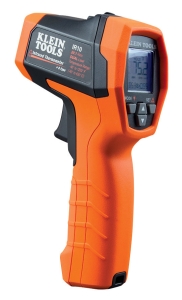
Use CBM Infrared thermometer with type K input for non-contact suction and liquid line temperature readings. The 20:1 optical resolution lets you measure pipe temperature at safe distances without touching hot or cold lines. For Southeast Asia's high-sun environments, the IP54 rating protects against salt spray and dust.
Procedure:
- Measure suction line temperature 6 inches from the compressor inlet
- Measure liquid line temperature just before the expansion device
- Use gauge pressure reading from previous step to determine saturation temperatures
- Calculate superheat: suction line temp – saturation temp at suction pressure
- Calculate subcooling: saturation temp at discharge pressure – liquid line temp
- Commissioning spec typically targets: superheat 8–15°F, subcooling 5–10°F
If superheat exceeds 15°F, refrigerant charge is low; if below 8°F, charge is excessive. These conditions must be corrected before final handoff.
Flow Rate Verification
Airflow and water flow rates confirm the system will deliver design capacity. Undersized flow is a common Southeast Asia commissioning failure—especially in chilled water systems where pipe blockage from manufacturing debris goes undetected.
For air measurement, use air velocity measurement at the discharge grille. For water systems, Dwyer Medium flow metal probe MAFS-20 provides accurate insertion measurement. The 71 cm probe length reaches center-duct measurement positions on standard commercial equipment. Insert through a test port and measure at multiple points across the duct or pipe cross-section; calculate average velocity and multiply by area for volumetric flow.
Procedure:
- Identify design flow rate from system documentation
- Measure actual flow at three points across the duct/pipe diameter
- If actual flow is more than 5% below design, investigate: blocked filters, closed balancing valves, or fan/pump cavitation
- Record each measurement point and time of day (outdoor temperature affects density)
Pressure Switches and Transmitters: Commissioning Verification
Testing Safety Controls
Pressure switches protect compressors from damage. Commissioning requires you to test that switches activate at design setpoints—but safely, without damaging equipment.
Dwyer Pressure switch DXW-11-153-4 provides 0.41–0.55 bar setpoint range with 3.46–5.17 bar differential. In a new installation, you're verifying: (1) the switch is installed at the correct location, (2) the setpoint is correct, and (3) the electrical circuit responds.
Procedure:
- With system off, connect a test load (lamp or buzzer) to the switch circuit
- Gradually increase system pressure by running compressor
- Record pressure reading when the switch opens the circuit (setpoint)
- Allow pressure to fall; record when switch closes the circuit (setpoint minus differential)
- If readings deviate from design specification, the switch is miscalibrated or defective
- Do NOT exceed the switch's maximum rated pressure during testing
This test must occur before final system pressurization. Southeast Asia's heat-stressed components sometimes fail during first-load pressure spikes—early detection of switch malfunction prevents compressor damage.
Real-Time Pressure Transmitters for Monitoring
Dwyer Transmitter 629-05-CH-P2-E5-S1 offers 4-20 mA output for continuous monitoring during commissioning and beyond. Unlike manual gauge readings, transmitters let you log pressure trends over hours or days—essential for validating system stability in the commissioning window.
Installation and commissioning:
- Install transmitter at a protected location (avoid direct sun exposure in Southeast Asia)
- Connect 4-20 mA output to building automation system or data logger
- Zero and span the transmitter against your reference manometer readings
- Run system through full operating cycle and log output signal
- Verify signal accuracy at low, mid, and high pressure points
- If BACnet/automation is installed, verify setpoint alarms trigger at design pressures
The 0.5% accuracy (±0.5 psi across 0-100 psid range) provides commissioning confidence—critical when you're documenting that the system meets contract specifications.
Documentation and Sign-Off Procedures
Creating Your Commissioning Log
Southeast Asian humidity and temperature variability mean commissioning conditions vary significantly day-to-day. Document ambient conditions with your pressure and temperature readings:
Required entries for each measurement:
- Date, time, and local ambient temperature/humidity
- System operating mode (cooling, heating, standby)
- Equipment runtime (hours on compressor before measurement)
- All pressure readings and gauge used (manometer model, serial number)
- All temperature readings and infrared thermometer settings (emissivity adjustment for pipe material)
- Flow rate measurements and calculation method
- Calculated superheat and subcooling values
- Comparison to design specification
- Action taken if out-of-spec (pressure adjustment, charge revision, etc.)
This log protects you: if the system fails weeks later, you have proof the system met spec at handoff. For warranty claims, manufacturers require detailed commissioning documentation—especially in Southeast Asia where climate conditions get blamed for every failure.
Sign-Off and Turnover
Use your completed measurement log as the foundation for sign-off. Walk the building manager or facility operator through:
1. Measured vs. design specifications for pressure, temperature, and flow
2. Location of all test ports and how to read your installed gauges
3. Alarm setpoints on pressure switches and transmitters
4. Maintenance schedule for pressure gauge recalibration (annual for hygroscopic applications)
5. When and how to re-measure superheat/subcooling if refrigerant leaks are suspected
Provide the client with a printed or digital copy of your complete measurement log. This becomes their commissioning certificate—proof the system was verified before operation.
Practical Troubleshooting During Commissioning
Common Southeast Asia Commissioning Failures
Pressure Reading Inconsistencies: Humidity condensation inside manometer gauges creates reading drift. Always use glycerin-filled manometers (like the Preciman ROS29018) in Southeast Asia. If your gauge reading drifts 0.5 bar in minutes, the gauge is absorbing moisture. Replace it before continuing—moisture-contaminated gauges are unreliable.
Temperature Measurement Errors: Infrared thermometers struggle with reflective pipe surfaces. Use the adjustable emissivity feature on your CBM infrared thermometer to match your pipe material (copper, steel, painted). Aim perpendicular to the pipe, not at an angle. If a reading seems inconsistent with pressure data, place a small piece of matte tape on the pipe and measure the tape instead.
Flow Rate Verification Failures: In hot, humid climates, you may commission early morning when outdoor temps are 25°C, but the system will operate in 35°C heat. Air and water densities change with temperature, affecting flow measurement accuracy. Record ambient temperature with every flow reading, or wait until midday for measurement consistency with operational conditions.
Switch and Transmitter Setpoint Drift: Humidity corrodes electrical contacts on older switches. Before commissioning, visually inspect setpoint screws for corrosion. If the pressure switch is more than 5 years old in a coastal Southeast Asia site, replace it during commissioning—don't risk failure after handoff.
Conclusion
Measurement & Detection during HVAC commissioning in Southeast Asia is as much about adaptation as precision. Your equipment specifications were likely written for temperate climates; your job is to verify the system functions correctly in regional conditions—high heat, high humidity, and seasonal extremes.
3G Electric's 35+ years supporting Southeast Asian contractors means we understand these regional challenges. We stock pressure manometers, flow probes, transmitters, and temperature instruments designed for industrial durability—not just lab accuracy.
Take the time to measure correctly at startup. Thorough commissioning documentation protects your reputation, satisfies your clients, and prevents warranty disputes when these systems face their first monsoon season or sustained heat wave.