Why Compressed Air System Diagnostics Matter for Plant Managers
Compressed air is often called the "fourth utility" in industrial facilities across Singapore. Yet most plant managers lack systematic approaches to verify system health until catastrophic failure forces emergency repairs.
Unplanned downtime from compressed air failures typically costs SGD 5,000–15,000 per incident when production halts. More insidious are silent leaks and pressure drop problems that inflate energy bills by 20–40% without obvious warning signs.
Measurement & Detection technologies have evolved dramatically in the past decade. What once required sending technicians into the field with manual gauges now happens through strategic placement of reliable sensors and probes. With 35+ years of experience distributing industrial equipment across Southeast Asia, 3G Electric has guided thousands of plant managers through this transition.
This guide shows you a practical, step-by-step approach to compressed air diagnostics using measurement and detection equipment that actually works in humid, challenging Singapore environments.
Section 1: Understanding Your Compressed Air Baseline
Establish Pressure Reference Points
Before you can detect problems, you must know what "normal" looks like. This requires establishing baseline pressure measurements at critical system points.
Start with your compressor discharge line—this is your primary reference. The discharge pressure typically runs 7–8 bar in most Singapore industrial facilities, though this varies by application.
Next, measure pressure at the main distribution header (the trunk line that feeds branch circuits). Pressure drop between discharge and header should not exceed 0.5 bar under normal flow conditions. If you're seeing 1.0+ bar drop, you have either:
- Undersized main piping
- Significant internal line corrosion
- Kinked or blocked lines
- A failed non-return valve
Use the Preciman Manometer ABS vert D80 0/+16bar G1/2 to establish these baseline readings. Its 80 mm dial and ±2.5% accuracy make it readable from distance without parallax error—critical when you're trying to take consistent measurements in dusty workshop conditions. The glycerin fill prevents needle flutter on pulsating compressed air systems, which is common in Southeast Asian heat where air compressors cycle frequently.
Document these baseline readings in a simple spreadsheet:
- Compressor discharge pressure
- Main header pressure (at 3 points: inlet, mid-run, end-run)
- Branch line pressures (at least 2–3 key production areas)
- Ambient temperature and relative humidity (affects air density and leakage rates)
- Time of day and production load level
Take measurements weekly for four weeks. You'll quickly see if pressure variations correlate with production schedules or indicate actual system degradation.
Identify Leakage Points Without Ultrasonic Equipment
Most plant managers assume they need expensive ultrasonic detectors to find compressed air leaks. In reality, you can locate 80% of leaks using pressure trend data and visual inspection.
If your baseline shows steady pressure drop over 8 hours even when production isn't running (your "off-peak" decay test), you have internal leakage. Typical sources:
- Worn compressor inlet/outlet valve seals (pressure drops 0.3–0.5 bar/hour when idle)
- Failed check valves in branch lines
- Cracked hose couplings or quick-disconnect failures
- Threaded connection leaks (the most common culprit—compressed air finds every gap)
To isolate the leak location:
1. Shut down production and isolate the main compressor using the isolation ball valve
2. Install your pressure gauge downstream and monitor decay every 15 minutes for one hour
3. If pressure holds steady, the leak is upstream (in the compressor or main header)
4. If pressure drops, progressively isolate branch circuits by closing solenoid isolation valves
5. The branch that causes pressure drop when isolated is your problem area
Once you narrow it down to a specific branch or component, use compressed air soap solution (the same bubble test used for refrigerant leaks) to find the exact joint. This low-cost approach saves hours of guesswork.
Section 2: Measuring Flow Rate Under Operating Conditions
Deploy Flow Measurement at Demand Points
Pressure tells you about system health; flow rate tells you about actual equipment performance. Many plant managers skip flow measurement because they assume it requires complex inline instrumentation.
The Dwyer Medium flow metal probe MAFS-20 changes this equation. It's a 71 cm insertion probe with 1/4-20 thread—meaning you can install it in a existing tee fitting without major pipeline modifications. This is critical in Singapore facilities where downtime for equipment changes directly impacts production revenue.
The MAFS-20 connects to any compatible Dwyer flow meter or transmitter. In practical terms, you're measuring the velocity of compressed air passing through your main distribution line. Combined with pipe diameter, this gives you actual flow volume.
Why this matters: Most plant managers operate at constant pressure (they set the compressor to 7.5 bar and leave it) but never verify actual consumption matches design estimates. When production increases or equipment is added, they're often operating overloaded without realizing it.
Here's the diagnostic approach:
1. Install the MAFS-20 probe in a tee fitting on your main header
2. Record flow rate during normal peak production (this is your baseline demand)
3. Record flow rate during off-peak periods (your true leakage + minimum standby draw)
4. Calculate the difference—this is your "phantom load"
In most Singapore facilities, we see 15–25% phantom load from undetected leaks and aging equipment. A manufacturing plant running compressed air 16 hours daily at 20% phantom load wastes roughly SGD 8,000–12,000 annually just in energy costs.
Once you have baseline flow data, you can:
- Right-size a replacement compressor if needed (avoid oversizing)
- Justify investment in leak repair
- Detect equipment degradation (a pneumatic tool that previously drew 10 CFM now drawing 12+ CFM indicates internal wear)
Section 3: Automated Pressure Monitoring and Alarm Detection
Install Pressure Switches for System Protection
Manual measurement catches problems—automated detection prevents them. A pressure switch is your first line of defense against compressor short-cycling, feed-line blockages, and regulator failure.
The Dwyer DXW-11-153-4 pressure switch is specifically designed for compressed air applications. Its 0.41–0.55 bar setpoint range and 3.46–5.17 bar differential range let you protect equipment operating at low pressures (common in pneumatic tool circuits) without false triggering from normal system pulsation.
Why a dedicated pressure switch matters: Your compressor's built-in pressure switch is optimized for load/unload cycling, not equipment protection. An external switch catches failure modes the compressor control system doesn't monitor.
Installation approach for Singapore facilities:
1. Install the DXW-11-153-4 on the main header downstream of your dryer (after moisture removal, before branch distribution)
2. Set the switch to alarm at 0.3 bar below your minimum operating pressure
3. Wire the switch to a visual alarm (colored light stack) visible from your control room or main production floor
4. Additionally, wire it to your PLC or SCADA system if you have centralized monitoring
This catches three critical failures before they stop production:
- Compressor failure or unload valve malfunction (pressure drops below minimum)
- Main line blockage from accumulated moisture/oil (pressure drops under load)
- Dryer element saturation (water carryover causes pressure drop across filter elements)
The IP65 rating is essential in Singapore's humid environment—moisture ingress into electrical connections is a major cause of false alarms in tropical climates. The 5 A @ 125/250 VAC rating handles most standard industrial relay circuits.
Section 4: Temperature and Advanced Diagnostics
Monitor Discharge Temperature as a Health Indicator
Compressed air temperature is often overlooked, but it's one of the best early-warning indicators of compressor problems in tropical climates like Singapore.
Normal discharge temperature should be 65–75°C (accounting for Singapore ambient temperatures of 28–32°C). If discharge temperature exceeds 80°C, you have:
- Compressor oil degradation (reduces lubrication effectiveness)
- Compressor valve sticking or cooling jacket blockage
- Excessive ambient temperature in the compressor room (ventilation problem)
- Compressor working beyond design capacity
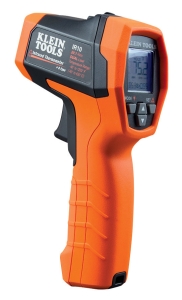
The CBM infrared thermometer with type K input lets you measure discharge temperature without contact—critical because discharge line fittings are under pressure and contact measurement risks operator injury. The 20:1 optical resolution (20:1 means you can measure a 1 cm diameter target from 20 cm distance) is precise enough for diagnostic work.
Temperature trending reveals developing problems:
- Gradual temperature increase over weeks suggests compressor wear or cooling system fouling
- Sudden temperature jump (within hours) suggests immediate mechanical failure
- Temperature variation with ambient conditions indicates the cooling system is working but inadequate for your climate
Use the type K thermocouple input to connect a permanent temperature sensor on the discharge line if your facility supports 24/7 monitoring. This gives you historical temperature data that correlates with production schedules and ambient conditions.
Combine temperature data with pressure and flow measurements, and you can predict compressor failure 2–4 weeks in advance—enough time to schedule replacement during planned maintenance rather than emergency downtime.
Integration: Building Your Measurement & Detection Dashboard
Once you've installed multiple measurement points (pressure, flow, temperature), the real value emerges from seeing patterns.
Create a simple daily check sheet:
| Time | Discharge Pressure (bar) | Main Header Pressure (bar) | Flow (if equipped) | Discharge Temp (°C) | Notes |
|------|--------------------------|---------------------------|-------------------|-------------------|-------|
| 06:00 | 7.5 | 7.3 | — | 68 | Normal startup |
| 09:00 | 7.4 | 7.1 | 45 CFM | 72 | Production peak |
| 12:00 | 7.3 | 7.0 | 38 CFM | 73 | Slight cooling |
Over time, you'll see:
- Expected pressure drop patterns (larger drop = bigger leak)
- Flow consumption tied to production activity
- Temperature changes related to ambient conditions
When readings deviate from pattern, investigate immediately. A 0.5 bar sudden pressure drop or 5°C temperature spike indicates active failure.
For larger facilities (20+ personnel), invest in the Dwyer Transmitter 629-05-CH-P2-E5-S1 which converts pressure readings to 4-20 mA output. This signal can feed directly into your PLC or SCADA system. The 0.5% accuracy and IP65 rating ensure reliable long-term operation in Singapore's heat and humidity. NPT 1/4" connection integrates with standard industrial pneumatic fittings without adaptation.
By combining the transmitter with historian software (many SCADA systems include this), you get automatic trending, alarm generation, and data export for energy audits—all without additional technician field time.
Practical Implementation Timeline for Singapore Facilities
Week 1-2: Baseline Establishment
- Purchase or borrow a quality pressure gauge (the Preciman manometer is ideal)
- Measure compressor discharge, main header, and branch pressures daily
- Create a baseline spreadsheet
- Perform off-peak decay test to identify internal leakage
- Isolate branches to locate problem areas
- Use soap solution to find exact leak points
- Prioritize repair by impact (high-pressure branches first)
- Install the Dwyer MAFS-20 probe in main header
- Establish baseline flow during peak and off-peak periods
- Calculate phantom load
- Quantify energy waste to justify compressor replacement or leak repair
- Install the Dwyer DXW-11-153-4 pressure switch
- Wire alarm indication to visible location
- Integrate with PLC if available
- Use CBM infrared thermometer for weekly discharge temperature checks
- Maintain measurement log
- Review trends monthly to detect developing problems
- Plan compressor replacement based on age, runtime, and trend data
Key Takeaways
Measurement & Detection isn't about buying expensive equipment—it's about applying structured diagnostic discipline to a system most plant managers neglect until failure forces emergency action.
With baseline pressure data, systematic leak detection, flow measurement, and temperature monitoring, you can:
- Reduce unplanned downtime by 40–60%
- Cut compressed air energy costs by 15–25%
- Extend compressor lifespan by 5+ years through early problem detection
- Build a quantified business case for system upgrades
3G Electric has distributed industrial measurement equipment across Singapore and Southeast Asia for over 35 years. We understand the specific challenges plant managers face: tropical humidity, space constraints, production pressure, and limited maintenance budgets. The equipment and approaches outlined here are proven in these real-world conditions.
Start with pressure baseline measurement this week. You'll likely find problems you didn't know existed, and the cost of a single pressure gauge is recovered in the first month through eliminated phantom load.