Understanding Measurement & Detection in Hydraulic and Pneumatic System Design
Measurement & Detection technology forms the backbone of modern hydraulic and pneumatic system reliability in Singapore's manufacturing, offshore, and facility management sectors. Unlike electrical monitoring, which has become standardized across most industrial facilities, pressure and temperature measurement in fluid systems requires careful specification to match both system design parameters and operational environments.
Procurement engineers working with hydraulic and pneumatic systems face a distinct challenge: selecting instruments that must function reliably under variable pressures, fluid types, and ambient conditions while maintaining accuracy tolerances that prevent costly equipment failures. With over 35 years of experience as a distributor of industrial equipment, 3G Electric understands that instrument selection directly impacts system uptime, maintenance costs, and compliance with Singapore's strict industrial safety standards.
The critical difference between general-purpose pressure gauges and application-specific instruments lies in three key areas: isolation ratings, connection thread standards, and material compatibility with hydraulic fluids or compressed air. This article addresses the practical decision-making framework that procurement engineers use when specifying measurement instruments for integrated fluid systems.
Pressure Measurement Specification for Compact Hydraulic Installations
Hydraulic systems in Singapore's maritime and manufacturing sectors commonly operate at pressures between 1 bar (for pilot control circuits) and 250+ bar (for main power systems). However, procurement specifications often fail to distinguish between pressure gauge types suited to different subsystem requirements.
The Preciman Green ABS pressure gauge D100 0/+1bar G1/2 represents a critical class of instrument for secondary circuits, charging circuits, and pilot control applications. The 0/+1 bar range serves specific functions:
- Pilot circuit monitoring: Confirming adequate pilot pressure for directional valve actuation without full system flow
- Charge circuit verification: Monitoring pump inlet pressure in closed-loop circuits to prevent cavitation
- Accumulator pre-charge checking: Verifying nitrogen pre-charge pressure before system commissioning
- Tank return line supervision: Detecting backpressure buildup that indicates filter blockage
The ±2.5% accuracy specification (typical for industrial gauges) translates to ±0.025 bar uncertainty at full scale—sufficient for control circuit diagnostics but inadequate for precision dosing applications. The G1/2 thread connection accommodates most manifold and tank fittings in compact installations without requiring adapter bushings that introduce additional failure points.
For higher-pressure applications, the Preciman ABS manometer axial D63 0/+16bar G1/4 shifts the specification window to medium-pressure circuits. The 16 bar upper limit suits:
- Secondary pump discharge monitoring in multi-pump systems
- Load-holding valve outlet pressure verification
- Counterbalance valve pilot pressure confirmation
- Compressed air receiver pressure supervision
The axial dial orientation (pointer facing outward) improves readability when gauges are installed vertically on manifold stacks—a common configuration in Singapore's confined machinery spaces. The 63 mm dial face provides adequate pointer travel while maintaining compact installation footprints.
Critical specification consideration: Procurement engineers must verify that gauge pressure ranges do not exceed 1.3 times the system's maximum operating pressure. Installing a 0/+250 bar gauge on a 40 bar pilot circuit creates a "dead zone" where pointer movement becomes imperceptible, defeating diagnostic value.
Temperature Detection Integration in Thermal Management Systems
Temperature measurement in hydraulic and pneumatic systems serves dual roles: operational monitoring (confirming fluid cooling adequacy) and diagnostic signaling (detecting subsystem failures through anomalous thermal patterns).
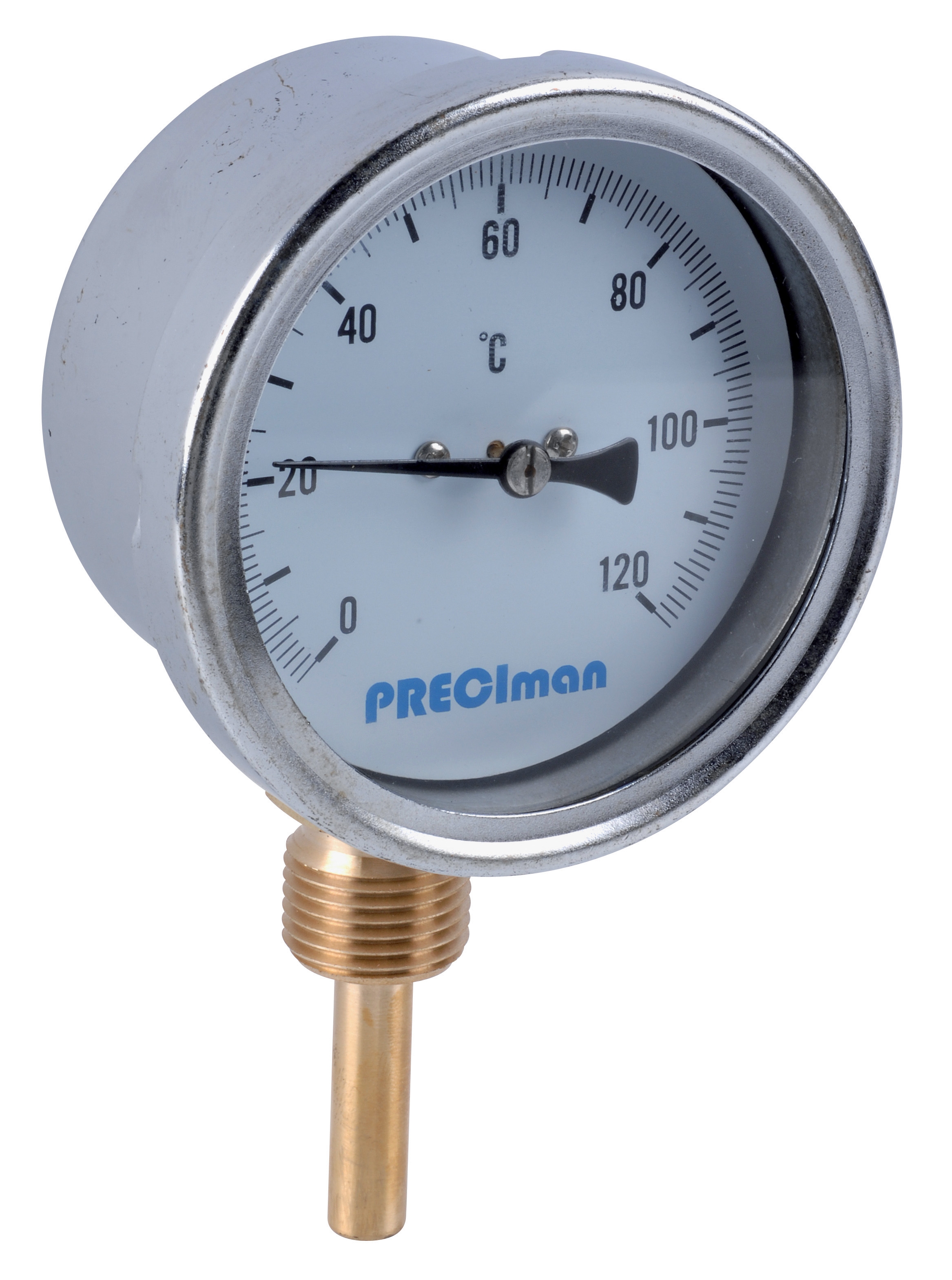
The Preciman Green vertical thermometer D80 -30/+50°C L 10cm with thermowell addresses the most common thermal monitoring requirement in Singapore's industrial applications: detecting excessive fluid temperatures in main hydraulic reservoirs and manifold blocks during system operation. The -30 to +50°C range encompasses:
- Ambient to operating baseline: Monitoring temperature rise from idle conditions
- Thermal alarm setpoints: Triggering cooling system engagement or pump shutdown at predetermined thresholds
- Failure diagnostics: Identifying internal leakage (excessive heat rise) or external blockage (inadequate heat rejection)
The stainless steel stem resists corrosion in humid Singapore environments and protects the glass capillary tube against mechanical damage during commissioning and maintenance. The immersion probe length (10 cm) allows installation in standard 12.7 mm threaded wells without requiring custom drilling.
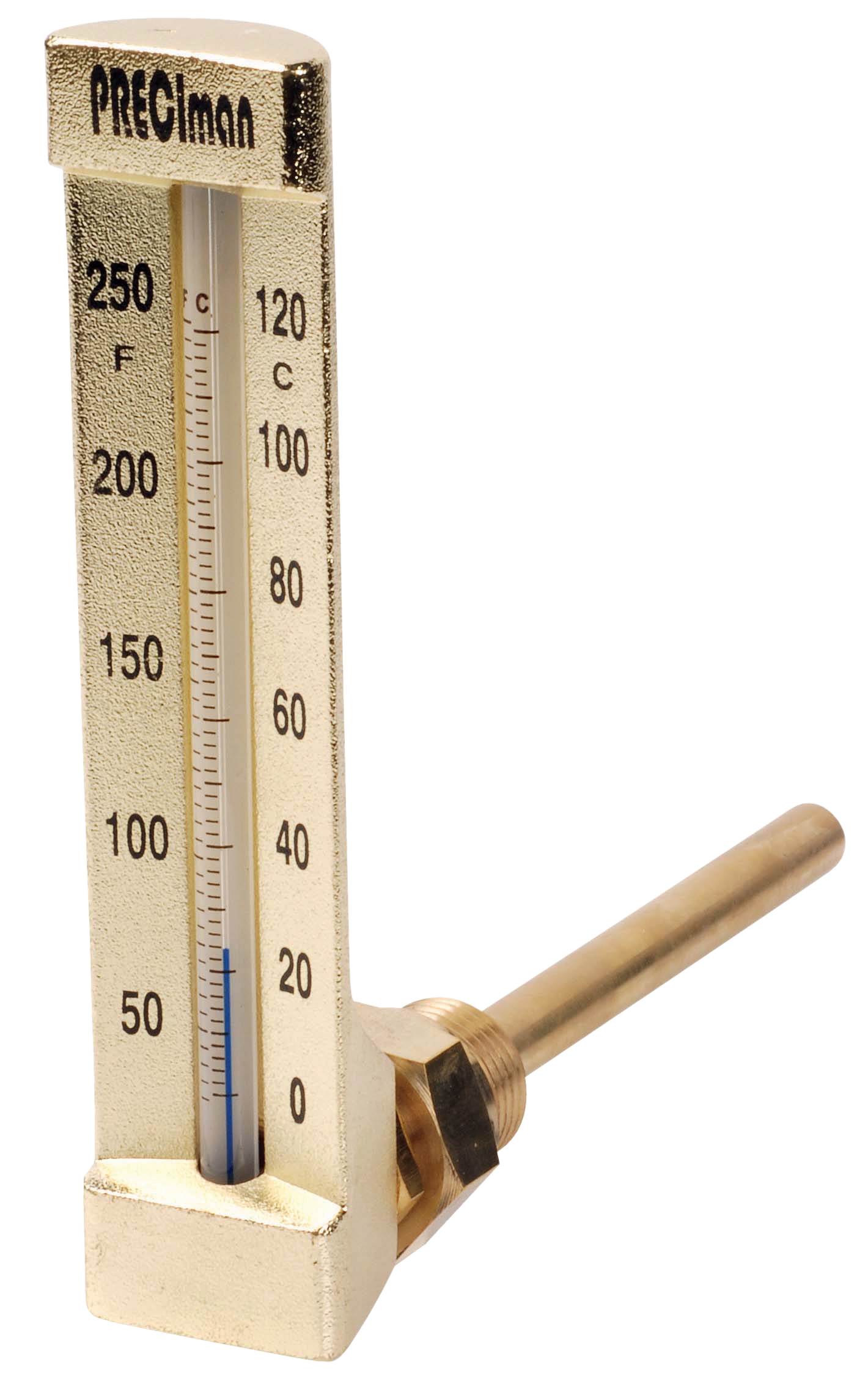
For process-critical applications requiring faster response times and higher measurement accuracy, the Preciman Industrial thermometer 0/+50°C immersion probe 100 elbow height 200 provides alternative installation geometry. The elbow (V-shape) connection suits pipeline installations where straight-entry thermowells create flow obstructions or piping stress. Common applications include:
- Heating/cooling circuit temperature verification: Confirming outlet temperatures in heat exchanger discharge lines
- Compressor discharge monitoring: Detecting excessive air temperature (indicating cooler fouling or excessive load)
- Process fluid conditioning: Monitoring fluid temperature in industrial injection molding or die-casting cooling circuits
Current Detection and Electrical Interlocking in Fluid System Controls
Electrical current detection represents a critical, often-overlooked element of measurement and detection strategy in hydraulic and pneumatic systems. Motor starters, solenoid valve coils, cooling fan drives, and pump displacement control actuators all require real-time current monitoring to verify functional status and diagnose winding failures or control circuit faults.
The Dwyer Miniature current detector MCS-111001 provides compact, non-contact current sensing suitable for manifold-integrated control cabinets and switchgear panels common in Singapore industrial installations. Key functional attributes include:
- 0.01 A minimum detection threshold: Identifies pilot solenoid energization without requiring line-breaking transducers
- Adjustable setpoints: Accommodating various coil current ratings (24 VDC, 120 VAC) and load classes
- 600 V isolation rating: Safe isolation between high-voltage motor circuits and low-voltage control logic
Procurement engineers must coordinate current detector selection with three system elements:
1. Control architecture topology: Does the system use hardwired interlocks (relay-based) or programmable logic controller (PLC) input modules? Current detectors with adjustable thresholds enable analog signal transmission to PLC modules, providing predictive failure warnings before complete coil deenergization.
2. Solenoid failure modes: Hydraulic solenoid coils typically fail in two modes—open winding (zero current draw) or shorted laminations (excessive current draw). Detecting both failure modes requires dual-threshold configuration or redundant detector installation.
3. Installation environment: Manifold cavities, switchgear compartments, and control panels in tropical Singapore environments experience high humidity and temperature cycling. Detector enclosure ratings (IP54 minimum recommended) prevent condensation-induced measurement drift.
Specification Workflow: From System Design to Instrument Procurement
Successful measurement and detection integration requires procurement engineers to follow a structured specification sequence that prevents over-specification (unnecessary cost) and under-specification (inadequate diagnostics).
Step 1: System Architecture Mapping
Document all subsystems requiring monitoring—pilot circuits, main discharge, tank return, accumulator pre-charge, motor cooling, and solenoid valve interlocks. Assign pressure and temperature ranges to each subsystem based on design calculations.
Step 2: Accuracy and Response Time Requirements
Define measurement tolerance requirements. Control circuits typically require ±5% accuracy; diagnostic applications may need ±2.5%. Response time constraints (critical for alarm setpoint reliability) determine thermometer immersion depth and pressure transducer damping settings.
Step 3: Environmental Factor Integration
Singapore's tropical climate (high humidity, saltwater spray in maritime applications, thermal cycling) demands corrosion-resistant materials. Stainless steel stems, ABS dial faces, and sealed connector blocks reduce long-term measurement drift.
Step 4: Installation Geometry Verification
Confirm thread types (G1/2, G1/4 standard; ISO 1219 connection standards). Verify that dial orientations (axial vs. radial) match available manifold or panel space. Avoid installing instruments perpendicular to flow direction, which creates measurement lag.
Step 5: Procurement and Lifecycle Cost Analysis
Compare initial instrument cost against replacement frequency and downtime risk. A ±2.5% accurate gauge (USD 120–180) replacing failed measurements prevents costly system shutdowns—typically justified in continuous-operation applications.
With 3G Electric's 35+ years of experience distributing industrial measurement equipment across Southeast Asia, we understand that specification discipline separates reliable system operations from costly failures. Procurement engineers who follow this workflow achieve measurement systems that deliver both operational visibility and predictive diagnostic capability.