
Introduction: Burners & Combustion Fundamentals for Equipment Specification
Burners & Combustion systems represent one of the most capital-intensive and operationally critical decisions in industrial procurement. Whether upgrading a legacy heating system, expanding process capacity, or specifying equipment for a greenfield facility, procurement engineers must navigate competing factors: thermal output requirements, fuel availability, regulatory compliance, operational footprint, and total cost of ownership.
At 3G Electric, we've distributed industrial combustion equipment globally for over 35 years. In that time, we've observed that specification failures rarely stem from component quality—they emerge from incomplete fuel analysis, undersized thermal capacity, or misalignment between burner type and facility constraints. This guide addresses the decision framework that prevents costly rework and operational disruptions.
Section 1: Fuel Type Analysis and Burner Technology Matching
Understanding Your Fuel Landscape
The first procurement decision is binary: gas or oil, or dual-fuel capability? This choice cascades across equipment cost, maintenance complexity, supply chain resilience, and regulatory footprint.
Natural Gas Burners deliver the lowest operational complexity. They require minimal onsite storage, produce fewer emissions, and integrate seamlessly with modern flame detection and modulation systems. However, gas supply reliability varies by geography. In regions with unstable grid pressure or seasonal supply constraints, gas-only burners create operational risk.
Heavy Oil Burners (typically D2/gasoil or heavier) provide fuel independence and higher energy density per unit volume. They're essential in industrial zones with unreliable gas supply, offshore installations, and facilities requiring seasonal fuel switching. The trade-off is higher maintenance—oil burners demand regular nozzle cleaning, combustion air quality monitoring, and more frequent service intervals.
Dual-Fuel Burners offer operational flexibility but introduce complexity in control logic, valve sequencing, and commissioning. They're justified when:
- Fuel supply is geographically unstable
- Seasonal switching reduces energy cost
- Facility redundancy requires switchover capability
- Existing infrastructure supports both fuel types
For example, the FBR KN 350/M heavy oil burner delivers 465–4070 kW across dual modulating stages with dual fuel (gas/heavy oil) capability, providing the flexibility required in regions with intermittent gas supply or applications demanding fuel switching.
Combustion Air and Facility Constraints
Burner selection must account for combustion air availability. A 5000 kW burner requires approximately 20,000–25,000 m³/h of combustion air at standard density. Facilities with sealed plant rooms, dust-laden environments, or high ambient temperatures often require:
- Dedicated combustion air ducts (adding structural cost)
- Air filtering systems (capital + maintenance expense)
- Air heating in cold climates (efficiency penalty)
These infrastructure demands frequently justify upsizing to larger, more efficient burners that operate at lower modulation range, reducing draft losses and combustion air volume requirements.
Section 2: Thermal Load Calculation and Burner Sizing Methodology
Right-Sizing Prevents Operational Inefficiency
Oversizing is the most common procurement error. A burner selected at 120% of peak load operates at 70% modulation under typical conditions, reducing efficiency, increasing emissions, and shortening service life. Undersizing forces maximum modulation and creates capacity headroom issues during peak demand or seasonal spikes.
Proper sizing methodology:
1. Establish Thermal Demand Profile: Collect 12-month operational data (not design assumptions). Map peak load, average load, and seasonal variation. Include future capacity growth (typically 3–5 years).
2. Account for System Losses: Calculate actual heat loss through insulation, distribution piping, and control margin. Design margins should not exceed 10% above documented peak load.
3. Cross-Reference Fuel Supply Rates: Match thermal output to available fuel delivery infrastructure. For instance, the FBR HI-GAS P1500/M industrial gas burner delivers 4186–15116 kW across a flow range of 60–206 kg/h, requiring verification that facility gas infrastructure (pressure regulation, line diameter, metering) supports sustained operation at specified load.
4. Validate Modulation Range: Ensure the selected burner's turndown ratio (maximum output ÷ minimum output) covers your operational envelope with 15–20% margin on each end. Most modern industrial burners offer 4:1 to 10:1 turndown, sufficient for stable operation across typical facility profiles.
Thermal Output Verification
Thermal output depends on fuel specification and combustion efficiency:
- Natural gas: Gross calorific value ~38–40 MJ/m³; net output reduced by stack losses (typically 8–12% in modern burners)
- Heavy oil: Gross calorific value ~46 MJ/kg; net output reduced by stack losses (typically 10–15% due to higher moisture content in exhaust)
For dual-fuel applications, specification must clearly define which fuel is primary (design load) and which is standby. Control systems prioritize fuel sequencing; miscalculation here creates commissioning delays and safety interlocks failures.
Consider the FBR HI-GAS P650/M CE TL, which delivers 3488–7558 kW with dual-stage modulation. Its narrower thermal band suits facilities with stable, mid-range heating loads, whereas the larger P1500 model serves plants requiring 4+ megawatt capacity.
Section 3: Combustion Control Integration and Safety Device Specification
Pressure Monitoring and Burner Safety Logic
Once burner size is confirmed, safety device specification becomes critical. Modern combustion systems require multi-point pressure monitoring:
- Fuel inlet pressure: Verifies adequate fuel delivery to the atomization nozzle
- Combustion air pressure: Confirms forced-draft fan operation and blockage detection
- Burner discharge pressure (optional): High-reliability systems monitor post-burner line pressure to detect nozzle clogging or flame-impingement conditions
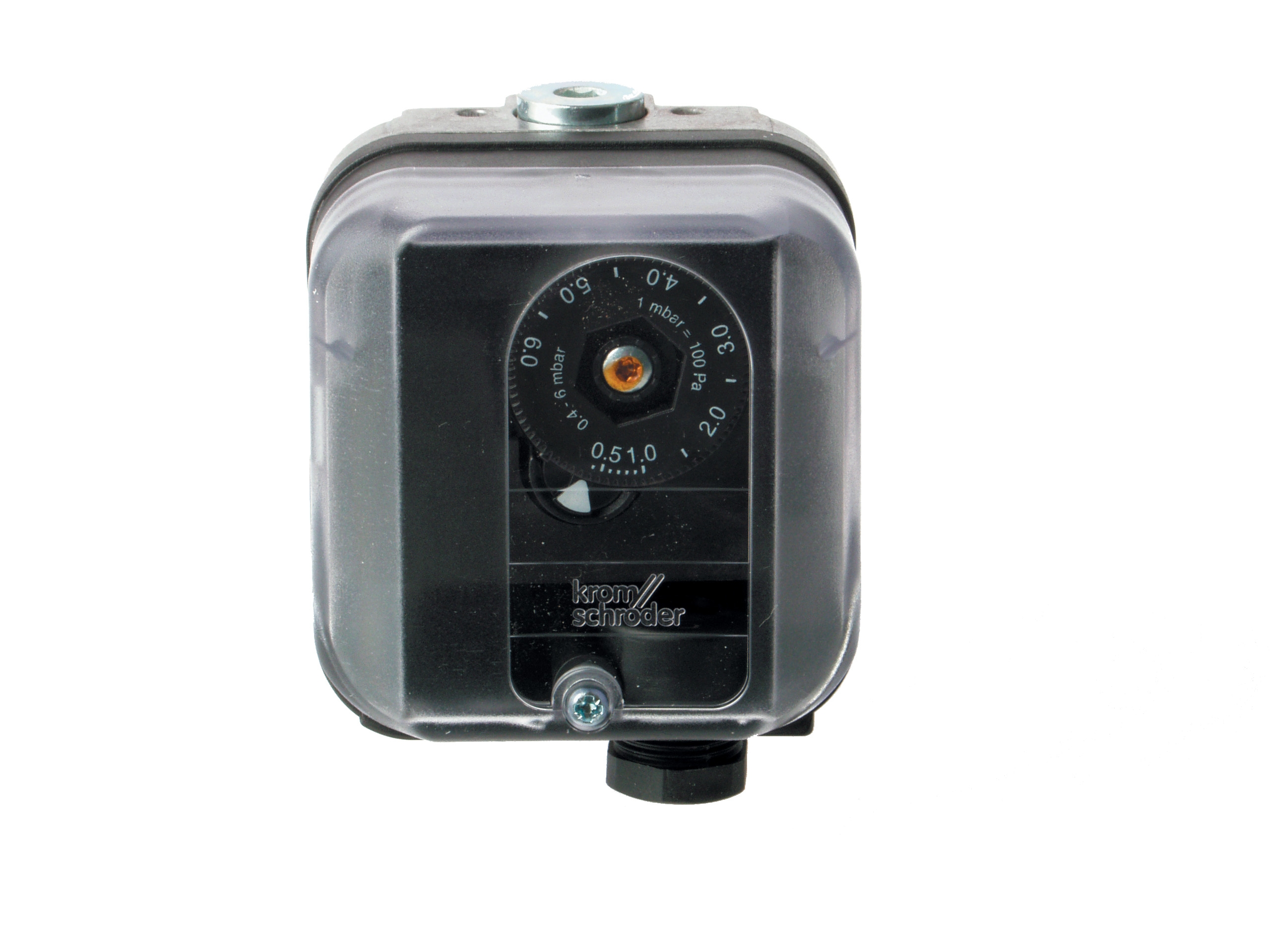
The Kromschroder DG 50U/6 pressure switch is rated SIL 3 and Performance Level e, meeting EN 1854, FM, UL, AGA, and GOST-TR standards. It's specifically engineered for burner control applications where fuel pressure must remain within a tight band (typically ±0.2 bar deviation triggers a safety shutdown). This switch is suitable for both gas and oil burners operating across global regulatory jurisdictions.
Pressure switch selection criteria:
- Setpoint and deadband: Must match burner design pressure (e.g., 2.5 bar for most industrial nozzles) with ±0.3 bar deadband to prevent nuisance trips from supply fluctuations
- Response time: Optimal response is 200–500 ms; faster switches increase false-trip risk, slower switches delay fault detection
- Hysteresis: Manual hysteresis adjustment prevents lock-out cascades during supply pressure ripple
Flame Detection and Burner Safety Interlocks
Flame detection is mandatory in virtually all industrial combustion systems. The technology choice—ultraviolet (UV) or infrared (IR) detection—depends on fuel type and flame characteristics:
- UV detectors: Suitable for gas burners; respond to the UV signature of natural gas flame
- IR detectors: Universally compatible with gas and oil; detect radiant heat across the flame envelope
The Siemens QRB4A-B036B40B flame detector is engineered specifically for oil burner applications with two-wire thermoplastic cable construction and 36 mm mounting hole spacing for secure installation in heating systems. Its IR detection technology works equally well with gas, making it a robust choice for dual-fuel burners.
Flame detector specification requires:
- Viewing angle verification: Ensure the detector has unobstructed sight-line to the flame envelope; partial blockage by refractory or scaling causes nuisance shutdowns
- Detector type matching: IR detectors (like the Siemens QRB4A) tolerate moderate fouling; UV detectors require pristine optical surfaces
- Response time: Modern detectors respond in <1 second; older units at 3–5 seconds create safety margin erosion during emergency shutdown scenarios
Interlock Logic and Startup Sequence
Safety device integration hinges on proper startup sequencing:
1. Pre-purge phase: Combustion air fan energizes for 30–60 seconds to clear any accumulated fuel vapor; pressure switch confirms adequate air delivery before attempting ignition
2. Ignition attempt: Fuel solenoid valve opens; igniter energizes; flame detector monitors for successful combustion
3. Flame establishment: Detector must sense flame within 5–10 seconds; failure triggers lockout and requires manual reset
4. Stable operation: Pressure and flame monitoring continue throughout burner run cycle; any deviation trips safety shutdown
Procurement engineers must verify that control relays, pressure switches, and flame detectors are certified for the same performance level (SIL 2, SIL 3, or equivalent) to ensure interlock integrity. Mismatched certification creates regulatory audit findings and liability exposure.
Section 4: Specification Worksheet and Procurement Validation
Pre-Specification Data Gathering
Before issuing an RFQ, compile the following:
| Parameter | Details |
|-----------|----------|
| Thermal Load (kW) | Peak, average, seasonal variation |
| Fuel Type Available | Natural gas pressure/volume; oil grade/viscosity; dual-fuel requirement |
| Facility Constraints | Plant room dimensions; combustion air ducting available; noise limits |
| Operational Profile | Hours/day; load profile (constant vs. modulating); seasonal shutdown periods |
| Regulatory Jurisdiction | CE/ATEX requirements; national efficiency standards; emission limits |
| Control Integration | BMS interface; remote shutdown requirement; alarm logging |
| Maintenance Capability | In-house service vs. vendor support; spare parts lead time tolerance |
Vendor Comparison Framework
When evaluating competing burner proposals:
1. Thermal output confirmation: Request certified test data (ISO 3046 or equivalent) showing output at specified fuel pressure and air density
2. Modulation range validation: Confirm minimum and maximum firing rates; verify control valve authority (ability to respond across full range)
3. Turndown ratio: Calculate maximum ÷ minimum output; confirm it matches your load profile with sufficient margin
4. Certification parity: Cross-reference pressure switch, flame detector, and control relay certifications; any performance level mismatch requires documented deviation approval
5. Service and parts availability: Confirm that replacement nozzles, electrodes, and seals are available through your equipment distributor (like 3G Electric) within your region
3G Electric's Role in Global Burner & Combustion Procurement
With 35+ years distributing industrial combustion equipment globally, 3G Electric provides:
- Multi-manufacturer inventory: Access to FBR burners (gas and heavy oil models), Siemens flame detection, and Kromschroder safety devices from a single distributor, simplifying specification and reducing supply chain fragmentation
- Technical specification support: Our team can model your thermal load, cross-reference fuel availability, and recommend appropriately sized equipment before you issue an RFQ
- Global logistics: We maintain regional stock positions and manage long-lead items, reducing project delays during commissioning windows
- Post-sale support: Technical commissioning assistance, spare parts availability, and troubleshooting support throughout your equipment lifecycle
Conclusion
Burners & Combustion system procurement succeeds when thermal demand is accurately quantified, fuel infrastructure is validated, and safety devices are matched to performance requirements. Cutting corners on specification upstream creates operational inefficiency, regulatory exposure, and maintenance surprises that dwarf initial equipment savings.
Work with a distributor experienced in global industrial standards and multi-manufacturer integration to ensure your combustion system delivers reliable, compliant, efficient thermal output for the lifecycle of your facility.