
Understanding Burners & Combustion in Singapore's Regulatory Environment
Burners & Combustion systems represent a critical intersection of thermal performance and environmental responsibility in Singapore's industrial sector. Since 1990, 3G Electric has worked with industrial facilities across Southeast Asia navigating increasingly stringent emission standards while maintaining the thermal reliability their operations demand.
Singapore's Environmental Public Health Act and the Clean Air Regulations impose specific limits on nitrogen oxides (NOx), particulate matter (PM), and other combustion byproducts. Industrial facilities operating large heating systems must demonstrate compliance through burner selection, control strategy, and operational maintenance protocols. Understanding how burner design, fuel type, and combustion control interact with emission performance is essential for procurement engineers, facilities managers, and HVAC contractors.
Unlike many regional markets, Singapore enforces rigorous third-party testing and certification requirements. Burners must carry CE marking and comply with ISO 6162 and relevant European standards adopted as reference standards by Singapore's regulatory bodies. This creates both opportunity and complexity: equipment certified for emission control provides competitive advantage and reduces compliance risk, but requires informed specification at procurement stage.
NOx Reduction Strategies: Technology Pathways for Industrial Burners
Nitrogen oxide formation occurs at high flame temperatures (above 1200°C) where atmospheric nitrogen oxidizes. Industrial burners address NOx reduction through three complementary mechanisms:
Burner Design Innovation: Modern staged combustion burners like the FBR HI-GAS P1500/M CE TL employ dual-stage fuel injection, where primary and secondary fuel streams are introduced sequentially. This maintains lower flame temperature in the initial combustion zone while achieving complete combustion downstream. The P1500/M delivers 4186–15116 kW across a 60–206 kg/h flow range, enabling facilities to match thermal load precisely and avoid off-design operation that increases NOx generation.
The FBR HI-GAS P550/M CE TL implements similar staged architecture for medium-scale applications (2325–6395 kW), making this technology accessible across industrial heating scales. Multi-stage burners inherently reduce peak flame temperature, reducing NOx by 30–50% compared to single-stage equipment of equivalent rating.
Air Supply Management: Air/fuel ratio control directly influences combustion temperature and emission profile. Burners with precise modulation allow operators to maintain lean-burn conditions (excess air) at part-load operation, where NOx generation is highest. Excess air cools the flame zone, suppressing NOx formation. However, lean-burn operation must avoid incomplete combustion (increased CO and unburned hydrocarbons), requiring integrated flame monitoring and combustion control.
Flue Gas Recirculation (FGR): Advanced burner systems redirect a portion of cooled exhaust gas back into the combustion air stream. This diluent effect lowers flame temperature by 100–200°C, reducing NOx by 40–60%. FGR is particularly effective for natural gas burners where combustion stability remains robust even with exhaust recirculation. Dual-fuel burners like the FBR KN 350/M require careful FGR management since heavy oil combustion is more sensitive to combustion air temperature and oxygen concentration variation.
Combustion Efficiency and Environmental Performance Integration
Industrial professionals often assume emission compliance and thermal efficiency operate as opposing objectives. In practice, modern burner control strategies achieve both simultaneously.
Efficiency-Emission Synergy: Incomplete combustion (low excess air operation, poor mixing, unstable ignition) generates both CO emissions and wasted fuel energy. Conversely, optimal combustion—achieved through correct air/fuel ratio, adequate turbulence, and residence time—minimizes CO, unburned hydrocarbons, and particulate while maximizing heat release efficiency. Well-maintained, properly commissioned burners typically achieve 85–90% thermal efficiency while meeting NOx limits of 100–150 mg/m³ (dry, 3% O₂ reference).
Load-Dependent Performance: Industrial heating loads vary seasonally and daily. Single-stage burners operate on-off, cycling between full fire and no fire; this cycling reduces average efficiency and can increase transient emissions during ignition cycles. Modulating dual-stage burners maintain continuous operation across 30–100% of rated capacity, adapting to actual load while preserving combustion stability. The FBR HI-GAS P650/M CE TL (3488–7558 kW, 60–206 kg/h) delivers this modulating performance across a wide turndown ratio, enabling facilities to match thermal demand without efficiency penalty.
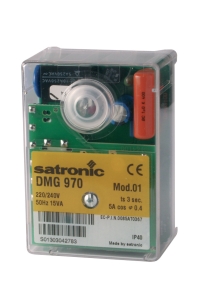
Flame Monitoring and Control Integration: Modern burner control relays like the Satronic Relay DMG 970-N MOD.01 integrate flame detection (UV or ionization-based) with safety interlocks and combustion control logic. Flame detection confirms stable combustion; if combustion becomes unstable (detected through flame signal fluctuation), the control relay can adjust fuel flow or ignition timing to restore stability before CO-rich exhaust reaches the stack. This real-time optimization supports both safety and emission compliance.
Practical Implementation: Specification and Commissioning for Singapore Facilities
Achieving compliant, efficient burner operation requires coordinated effort across specification, installation, and ongoing maintenance.
Specification Phase—Right-Sizing and Technology Selection:
Begin with accurate thermal load calculation (peak and part-load profiles). Oversizing burners forces operation at part-load, wasting capacity and often increasing specific emissions (g/kWh). Select burners offering adequate turndown (3:1 to 5:1 is standard for staged units) to match facility load profile. Require CE certification and obtain emission test reports from manufacturers; Singapore regulatory authorities increasingly request third-party test data during facility audits.
For dual-fuel applications (natural gas and heavy oil switchover capability), burner selection matters critically. The FBR KN 350/M (465–4070 kW, dual-fuel capability) provides this flexibility, but emission performance differs between fuels. Natural gas combustion inherently produces lower NOx; heavy oil combustion generates higher particulate and NOx. Specify control logic that acknowledges fuel type, using leaner air/fuel ratios for natural gas and richer settings for oil to ensure complete combustion without sacrificing flame stability.
Installation and Commissioning:
Fuel supply pressure, air supply temperature, and ignition electrode alignment are critical commissioning variables. Incorrect pressure causes off-design operation; incorrect air supply temperature increases NOx generation (warm combustion air increases flame temperature); misaligned ignition electrodes delay pilot flame establishment, causing transient CO spikes during startup.
Commissioning should include combustion analysis: measure flue gas O₂, CO, and NOx using portable gas analyzers. Target O₂ levels: 3–5% for natural gas (indicating complete combustion with modest excess air), 2–4% for heavy oil. CO levels should remain below 100 ppm; if CO exceeds 200 ppm, combustion is incomplete and efficiency/emissions are both compromised.
Maintenance and Compliance Verification:
Industrial facilities should establish quarterly burner inspections and annual combustion analysis. Fouled burner nozzles increase pressure drop, forcing burner control systems to reduce fuel flow and increase air flow to maintain stable operation—this lean condition can drive NOx up by 10–20%. Nozzle cleaning, air shutter adjustment, and combustion analysis should be performed annually or after any operational incidents.
Maintenance records demonstrating compliance with commissioning settings and emission limits provide critical documentation for regulatory inspections. Singapore's Environmental Public Health Act permits authorities to require emissions testing; facilities with documented maintenance history and annual combustion verification face lower inspection frequency and lower compliance risk.
Emissions Standards, Testing Protocols & Regional Compliance Pathways
Singapore's regulatory framework references EU Directive 2010/75/EU (Industrial Emissions Directive) and ISO 9614 series for burner testing. Key emission limits for industrial boilers and heaters:
- NOx: 150–200 mg/m³ (dry, 3% O₂ reference) depending on fuel and burner type
- CO: <100 mg/m³ during normal operation; <150 mg/m³ during transient phases
- Particulate Matter (PM): <50 mg/m³ for liquid fuel (heavy oil) burners
Third-party testing for CE marking must follow EN 676 (gas burners) or EN 267 (oil burners). Manufacturers provide test reports detailing thermal efficiency, burner turndown, and emission performance across the operating range. When procuring through 3G Electric, request complete technical documentation including these test reports; they form the basis for facility compliance demonstration.
Singapore's National Environment Agency (NEA) increasingly coordinates with PUB (Public Utilities Board) on energy efficiency requirements. Efficient burners reduce both operational cost and emission intensity, creating dual compliance incentives. Facilities demonstrating 85%+ thermal efficiency with compliant NOx levels may qualify for regulatory recognition and reduced compliance audit frequency.
Conclusion
Burners & Combustion system selection profoundly influences industrial environmental compliance, operational efficiency, and long-term cost of ownership. Singapore's regulatory environment demands modern, staged-combustion burner technology with integrated control systems and rigorous commissioning. 3G Electric's 35+ years of industrial equipment distribution experience encompasses specification guidance, technical commissioning support, and documentation assistance for facilities navigating Singapore's emission standards.
Modern burner technology—such as the dual-stage FBR HI-GAS and KN series units supported with modern control relays—provides industrial professionals the tools to achieve regulatory compliance while maintaining thermal performance and operational reliability. Success requires informed specification, rigorous commissioning, and committed maintenance; this combination protects both regulatory compliance and operational economics.