Understanding Burners & Combustion Air Supply Fundamentals
Burners & Combustion systems require precise air-to-fuel ratios to achieve complete combustion, stable flames, and maximum thermal efficiency. When air supply fails, fuel cannot burn completely—resulting in smoke, carbon buildup, thermal loss, and nuisance safety lockouts. Plant managers in Singapore's industrial sector increasingly face combustion air problems due to equipment aging, environmental contamination, and tropical operating conditions that accelerate filter saturation and fan bearing degradation.
With over 35 years of experience distributing industrial combustion equipment across Southeast Asia, 3G Electric recognizes that air supply faults account for 30-40% of burner failures in tropical climates. Unlike spark ignition or fuel pressure issues—which often generate dramatic shutdown events—combustion air problems develop progressively, causing creeping efficiency loss that goes undetected until operators notice higher fuel consumption or incomplete flame patterns.
This troubleshooting guide addresses the most common combustion air supply faults affecting industrial burners in Singapore, providing plant managers with diagnostic procedures, measurement protocols, and corrective actions to restore flame quality and operational reliability.
Section 1: Diagnosing Combustion Air Supply Failures
Air Fan Performance Assessment
The combustion air fan is the foundation of stable burner operation. When fan output drops below design specification, the burner receives insufficient air, resulting in fuel-rich combustion, visible smoke, and unstable flame patterns.
Field diagnostic procedure:
1. Measure static pressure at burner inlet: Install a digital manometer at the burner's air inlet. Record static pressure reading during steady-state operation. Compare against equipment nameplate specification (typically 5-25 mmWC for industrial burners). Readings below 80% of specification indicate fan degradation or ductwork obstruction.
2. Inspect fan impeller and housing: Stop the burner and visually examine the fan wheel and interior casing for dust accumulation, moth infestation (common in tropical environments), or corrosion. Singapore's coastal humidity accelerates aluminum oxidation in fan housings, reducing impeller clearances and restricting airflow.
3. Check fan motor amperage: While the fan runs, measure motor current draw with a clamp ammeter. Compare reading to motor nameplate rated current. Readings 10-15% below nameplate indicate reduced fan speed (worn bearings or contaminated windings); readings above nameplate suggest bearing friction or impeller obstruction.
4. Verify fan bearing condition: Feel the fan motor bearing housing (caution: high temperature in direct sunlight). Excessive heat indicates bearing wear. In tropical climates, bearing lubrication degrades within 18-24 months; premature failure occurs if preventive maintenance intervals are exceeded.
Air Duct and Intake Obstruction Detection
Air intake blockages are particularly prevalent in Singapore's industrial zones, where marine salt spray, construction dust, and atmospheric particulates accumulate rapidly.
Diagnostic steps:
- Visual inspection of intake screens: Remove burner intake air filter(s) and inspect for mud, salt deposits, or insect nests blocking airflow.
- Differential pressure across filter: Install a dual-gauge manometer across the air intake filter. Normal clean filter differential is 2-5 mmWC. Readings above 10 mmWC indicate urgent filter replacement; above 20 mmWC causes complete combustion failure.
- Ductwork obstruction check: Trace the air supply duct from intake to burner. Look for collapsed sections, bird nests, or debris accumulation inside horizontal ducts. Horizontal ductwork in tropical environments frequently collects moisture condensation and subsequent mold growth, restricting airflow by 15-25%.
Burner Register and Air Damper Misalignment
The burner's register (movable air control band) and air damper control the air swirl pattern and distribution into the combustion chamber. Misalignment causes flame instability, even when fan output is adequate.
Diagnostic procedure:
1. Observe flame pattern: Light the burner and examine flame shape. Proper combustion produces a well-defined, stable flame cone with blue color at the root and orange in the secondary zone. Air starvation creates a short, orange-yellow flame that clings to the burner gun or drifts within the firebox.
2. Measure air register position: Note the register's physical position relative to the burner's adjustment scale. Most industrial burners have calibrated register scales (0-100%). Compare current position to commissioning records or original setup documentation. Drift beyond ±10% of original setting indicates register slippage due to vibration or operator error.
3. Check air damper actuator response: For modulating burners, manually move the air damper linkage from minimum to maximum air position. Record any binding, lag, or incomplete travel. Friction in the actuator mechanism prevents proper air flow modulation, creating flame instability during load changes.
Section 2: Combustion Quality Analysis and Flame Stability Diagnosis
Smoke and Emission Testing
Visible smoke from the burner stack is the most obvious indicator of incomplete combustion caused by air deficiency. Quantifying smoke severity helps plant managers prioritize corrective action urgency.
On-site assessment:
- Ringelmann smoke chart evaluation: Use a standard Ringelmann chart (available from Singapore NEA or international standards bodies) to rate stack smoke opacity on a scale 0-5. Smoke reading of 2 or higher indicates incomplete combustion requiring immediate investigation. Rating of 3+ typically triggers compliance violations under Singapore's Environmental Protection and Management Act.
- Flue gas oxygen measurement: Use a portable flue gas analyzer to measure O₂ concentration in the burner exhaust. Proper combustion requires 3-5% excess oxygen in the flue gas. Readings below 2% confirm fuel-rich combustion from insufficient air supply. Readings above 8% indicate excessive air (separate concern but also reduces efficiency).
Flame Color and Stability Observation
Flame color provides immediate visual feedback on combustion air adequacy without requiring instruments.
Flame quality indicators:
- Blue flame root (0-2 cm from burner gun tip): Indicates stoichiometric air-fuel mixture and complete primary combustion. This is the target condition.
- Orange or yellow flame root (>3 cm from gun tip): Suggests delayed combustion due to insufficient air. Combustion is occurring further downstream in the firebox, reducing thermal efficiency and creating unburned fuel deposits.
- Flickering or swirling flame: May indicate air starvation (flame hunts for oxygen) or excessive air turbulence from register misalignment. Observe whether flickering correlates with air fan speed changes; if yes, fan bearing wear is likely.
- Flame detachment or blowoff: Occurs when combustion air velocity is excessive, pushing the flame away from the burner tip. This is the opposite problem (too much air) but still indicates air system malfunction.
Flame Detection System Response During Air Starvation
When air supply is inadequate, the flame may still ignite but becomes unstable, triggering nuisance shutdowns via the flame detection relay—even if fuel and spark systems are functioning correctly.
Diagnostic method:
1. Operate burner on low fire (minimum modulation setting if available). Intentionally restrict the combustion air damper by 10-15% (do not exceed 20% restriction, as this may cause unsafe conditions). Observe whether the flame detection system trips within 10-30 seconds.
2. Restore normal air setting and record response time. The flame relay should detect stable flame within 5-10 seconds of air restoration. Delayed response (>15 seconds) suggests either flame detection cell fouling (separate issue) or hesitant flame establishment due to marginal air conditions.
3. Correlate flame detection trips with air fan speed. If the burner shuts down exclusively when air fan speed drops—such as during morning startup when outdoor air is cooler and denser—the problem is likely inadequate fan capacity relative to design ambient conditions. Singapore's tropical heat (28-35°C) reduces air density by ~5-8%, requiring fan specification reviews for year-round adequacy.
Section 3: Practical Corrective Actions and System Optimization
Air Filter and Intake Maintenance Protocol
Establish a monthly preventive maintenance routine appropriate for Singapore's high-dust environment:
- Weekly visual inspection: Check intake filter for visible dust or salt spray accumulation. Clean filter weekly during dry season (November-March) and twice weekly during humid monsoon periods (May-September).
- Quarterly replacement: Replace combustion air filters every 3 months (or sooner if differential pressure exceeds 8 mmWC). Tropical humidity accelerates filter paper degradation; salt spray-exposed filters require monthly replacement.
- Ductwork cleaning: Every 6 months, disconnect the burner intake duct and brush interior surfaces to remove accumulated salt deposits, dust, and mold growth. In coastal industrial zones near the Straits, consider quarterly ductwork cleaning.
Fan Motor and Bearing Maintenance
- Monthly bearing temperature check: During routine rounds, feel the fan motor bearing housing with your hand (safely, after confirming motor is running and stable). Excessive heat (>60°C above ambient) indicates bearing wear requiring immediate lubrication or replacement.
- Biannual bearing relubrication: Most industrial burner fan motors use grease-lubricated ball bearings. Refer to motor nameplate for relubrication interval (typically 6-12 months in tropical climates, often shorter than the manufacturer's temperate-zone recommendation). Over-lubrication creates drag and heat; under-lubrication causes rapid wear.
- Annual fan vibration assessment: Use a simple vibration meter or smartphone vibration app to measure fan motor vibration during normal operation. Increased vibration amplitude compared to baseline (taken at commissioning) indicates bearing wear, impeller imbalance, or ductwork resonance. Vibration >3-5 mm/s requires bearing replacement.
Air Register and Damper Adjustment
1. Establish baseline setting: With the burner operating at design firing rate, observe stable blue flame color at the burner gun root. Note the exact register position on the adjustment scale (example: register at 35 on 0-100 scale). Record this baseline in the burner logbook.
2. Create adjustment reference marks: Use a paint pen or tape to mark the register position at baseline. This prevents accidental drift and allows operators to quickly identify if the register has shifted due to vibration.
3. Verify air damper linkage: For modulating burners, confirm that the air damper moves in synchrony with fuel modulation controls. Linkage slack or binding prevents proper air-fuel ratio maintenance during load changes, causing temporary flame instability during turndown.
Flame Detection Optimization with Air Supply Corrections
Once air supply is restored to design specification, verify that the flame detection system responds reliably. A common error is commissioning burners with marginal air supply and then blaming flame detector sensitivity for nuisance trips.
- UV flame detector placement: The UV sensor should have direct, unobstructed line-of-sight to the blue combustion flame root. Soot buildup on the detector window (from prior air-starved operation) reduces sensitivity by 20-30%. Clean the detector window annually or quarterly if the burner has a history of incomplete combustion.
- Flame relay response time: After air supply restoration, confirm that the Combutech Flame relay CF1 (or equivalent safety relay) detects flame within 10 seconds of ignition. If response time exceeds 15 seconds, the Combutech UV1p detection cell may require cleaning or replacement. The UV1p's 20 µS recovery time supports fast flame detection; slow response typically indicates optical fouling, not detector malfunction.
Section 4: Integration with Burner Selection and Equipment Matching
Right-Sizing Combustion Air Fans for Tropical Climates
Singapore's consistently hot environment (mean temperature 24-28°C year-round) reduces atmospheric air density by ~5% compared to standard reference conditions (15°C, sea level). Industrial burners that are adequately sized for temperate climates often suffer chronic air starvation in Singapore.
Corrective measure: When selecting replacement burners or fan upgrades, specify air capacity based on tropical ambient conditions. For example:
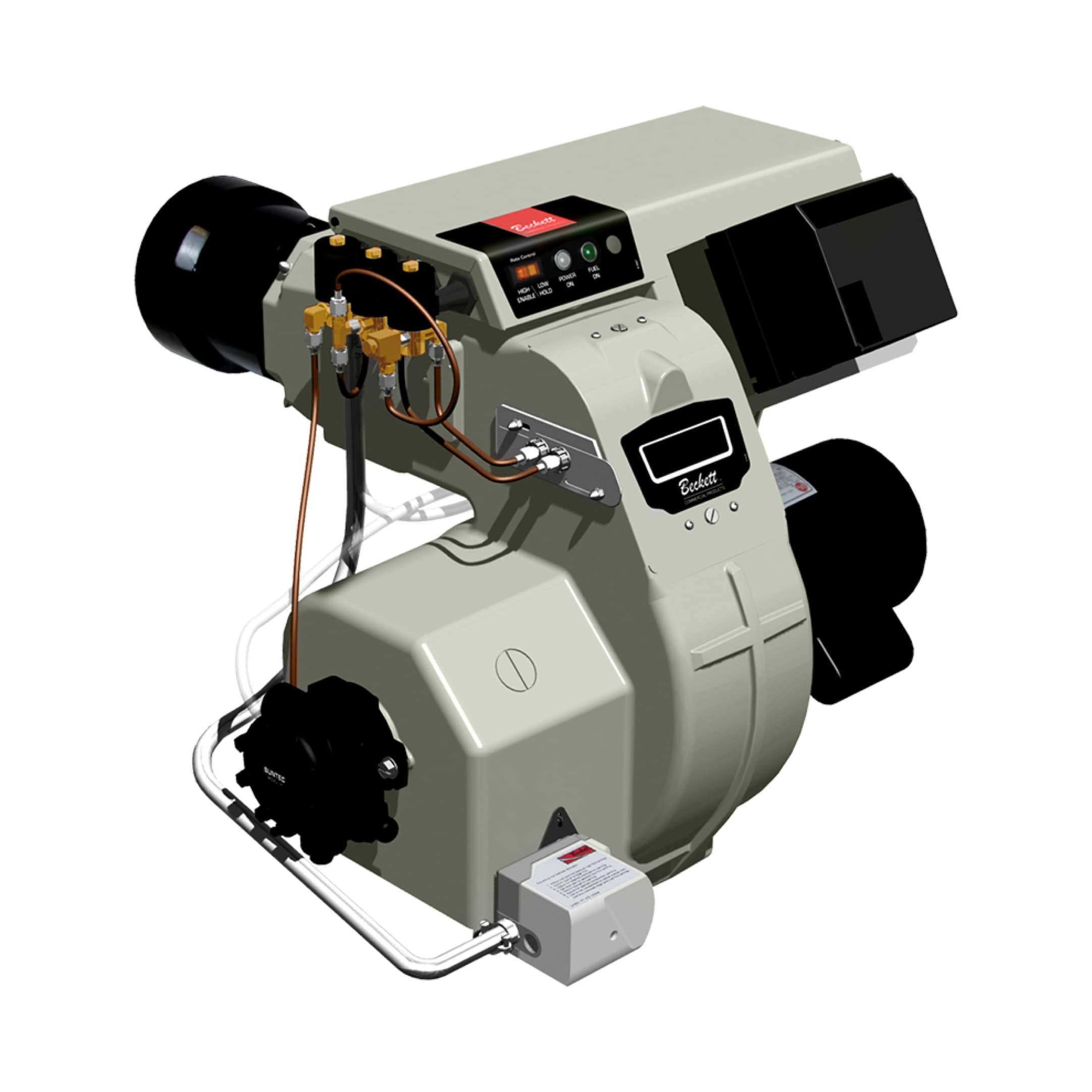
- Oil burners: The Beckett CF3500 Oil Burner rated 17-35 GPH requires ~2,200-4,800 CFM of combustion air (varies by fan design). Verify that the selected fan model has CFM rating confirmed at 30°C ambient, not standard 15°C reference. This typically requires requesting derating curves from the manufacturer.
- Gas burners: The FBR HI-GAS P550/M CE TL (2325-6395 kW) and FBR GAS/M CE D2\"S-F-50 (485-4070 kW modulating variant) require proportionally larger air supplies in tropical installations. Request air supply design calculations that account for reduced air density at 30°C, 75% relative humidity—the typical Singapore operating envelope.
Commissioning Protocol for Air Supply Verification
When a new burner is installed or an existing burner is serviced, commission the air supply system explicitly:
1. Measure static pressure at design firing rate and confirm it meets equipment specification at tropical ambient conditions.
2. Document flame color and stability during initial 30-minute operation. Establish baseline observations for future comparison.
3. Record flue gas O₂ concentration at full load and minimum load (turndown). O₂ should remain 3-5% across the full firing range. Trending O₂ data over months reveals gradual air supply degradation before it causes operational problems.
4. Test flame detection response at baseline air supply conditions. If flame detection response is slow (>15 seconds) at correct air supply, the detector or relay requires service—not the air system.
Maintenance Log Recommendations
Plant managers should maintain a burner maintenance log documenting:
- Monthly: Air filter visual inspection result, fan bearing temperature, any visible smoke or flame discoloration.
- Quarterly: Air filter differential pressure measurement, flame color observation during full-load operation, flue gas O₂ reading.
- Annually: Air ductwork inspection and cleaning, fan motor vibration measurement, complete flame detection system checkout (detector window cleaning and relay response time verification).
This log enables trend analysis; for example, gradually increasing O₂ readings indicate progressive air filter saturation requiring more frequent changes. Increasing fan motor temperature suggests bearing wear requiring proactive maintenance before failure.
Conclusion
Burners & Combustion air supply faults are among the most underdiagnosed equipment problems in Singapore's industrial sector. Because air starvation develops gradually and manifests as efficiency loss rather than dramatic shutdown, plant managers often attribute symptoms to fuel quality or spark system faults, missing the true root cause.
With 35+ years of experience supporting burner operations across tropical Southeast Asia, 3G Electric's technical team has seen how climate-specific maintenance protocols—shorter filter change intervals, enhanced bearing lubrication schedules, and air supply derating for ambient conditions—extend burner service life and eliminate recurring nuisance shutdowns.
The diagnostic procedures in this guide enable plant managers to confidently identify whether combustion problems originate in the air supply system, and to implement targeted corrective actions. Combining these field diagnostics with proper equipment selection for tropical climates creates a foundation for stable, efficient industrial burner operation.