Rotational Speed & Displacement in Industrial Pumps: Optimizing RPM Selection for Singapore HVAC Systems
Selecting the right industrial pump for HVAC applications in Singapore requires understanding more than just pressure and flow ratings. The rotational speed (RPM) and displacement characteristics of a pump fundamentally determine its efficiency, noise profile, maintenance requirements, and compatibility with your drive system. Many contractors overlook these parameters until performance issues emerge on-site. This technical guide explains how RPM and displacement interact, why different pump families operate at different speeds, and how to align these specifications with your specific system requirements.
Understanding Pump Rotational Speed and Displacement
Pump rotational speed, measured in revolutions per minute (RPM), directly affects how quickly a pump's internal chambers cycle through their intake and discharge phases. Displacement, typically expressed in cubic centimeters per revolution (cc/rev) or liters per minute (L/min) at a given RPM, defines the volumetric output per complete rotation. Together, these parameters determine the actual flow rate delivered by the pump—a relationship expressed as: Flow (L/min) = Displacement (cc/rev) × RPM ÷ 1000.
Industrial pumps commonly operate at two primary speed ranges in Singapore's HVAC sector: 1,450–1,750 RPM (typically paired with 50 Hz electrical systems) and 3,400–3,600 RPM (higher-speed designs). Lower-speed pumps deliver higher displacement per revolution, meaning fewer rotations are needed to achieve target flow rates. This reduces mechanical stress, extends bearing life, and minimizes noise—critical advantages in noise-sensitive commercial and residential environments. Higher-speed pumps achieve their flow targets through faster rotation with smaller displacement, creating a different efficiency and durability profile suited to specific applications.
The choice between low-speed and high-speed designs reflects a fundamental trade-off: low-speed pumps excel in continuous-duty, high-pressure applications where energy efficiency and longevity matter most, while high-speed pumps offer compact, lightweight designs ideal for space-constrained installations or intermittent-duty scenarios. Understanding this distinction helps contractors avoid costly mismatches between pump design intent and actual system demands.
Technical Specifications: Low-Speed vs. High-Speed Pump Families
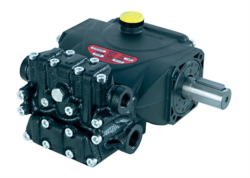
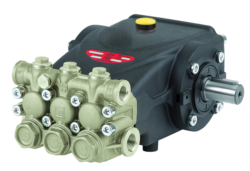
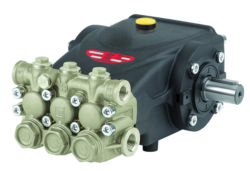
To illustrate these principles with real equipment, consider the Interpump E3C series—a family of low-speed, high-displacement pumps commonly specified for HVAC circulation and oil-fired heating systems across Singapore. The Interpump E3C1218 L operates at 1,750 RPM with a displacement delivering 18 L/min flow at 120 bar pressure. At this modest rotational speed, the pump generates only 4.12 kW of power while achieving a pressure rating of 1,750 PSI—demonstrating the efficiency advantage of low-speed design. The 265 × 223 × 140 mm footprint and 9.5 kg weight make it suitable for compact installations without sacrificing thermal or mechanical reliability.
For applications requiring higher pressure with similar flow characteristics, the Interpump E3C1515 L operates at the same 1,750 RPM speed but delivers 15 L/min at 150 bar, consuming 4.26 kW. This slight reduction in flow—achieved by adjusting internal displacement rather than increasing speed—illustrates how pump families scale within their operational envelope. Both pumps maintain the same rpm to preserve the efficiency and noise benefits of the lower-speed platform.
Contrast this with the Interpump E3B2515I R, which represents a higher-displacement, higher-pressure design. Delivering 15 L/min at 250 bar pressure (3,625 PSI), this pump requires 7.13 kW but operates at 1,450 RPM—an even lower speed than the E3C series. This lower rotational speed, paired with greater displacement per revolution, demonstrates how manufacturers optimize for maximum pressure capability while maintaining reasonable speed. At 1,450 RPM with 265 mm length, this pump suits high-pressure circulation and oil-transfer applications where durability under sustained load is non-negotiable.
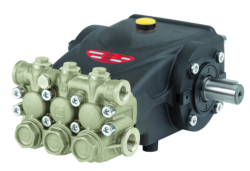
The Interpump E3C1021 DX*V.DX*NO.C/J adds another perspective: operating at 1,750 RPM with 21 L/min at 100 bar, this pump delivers the highest flow rate in this comparison while maintaining the lowest pressure specification. The 5.5 hp power requirement reflects efficient operation at moderate pressure—ideal for low-pressure circulation systems such as chilled-water loops or open-system cooling applications common in Singapore's tropical climate.
Real-World Application Examples in Singapore's HVAC Sector
Singapore's building density and climate create distinct HVAC pump requirements. High-rise commercial buildings often employ chilled-water systems requiring large flow volumes at moderate pressures—scenarios where low-speed, high-displacement pumps minimize energy consumption and operational noise. A building management team specifying a chiller loop pump would likely prefer the 1,750 RPM platform with its lower acoustic signature, critical for tenant comfort in office environments.
Conversely, oil-fired boiler systems—still present in many industrial facilities and institutional campuses across Singapore—demand reliable, sustained high-pressure performance. The Interpump E3B2515 L operating at 1,450 RPM delivers 250 bar continuously, ensuring consistent fuel atomization regardless of ambient temperature or seasonal demand variations. This reliability justifies the slightly higher power consumption.
Retrofitting older HVAC systems in Singapore's aging building stock requires careful RPM matching to existing motor infrastructure. Many 1960s–1990s installations use 1,450 RPM motors coupled to 50 Hz, three-phase electrical supplies standard across the island. Selecting pumps from the low-speed family ensures drop-in compatibility without requiring motor replacement or variable-frequency drive (VFD) retrofits—reducing project cost and installation time significantly.
Selection Criteria: Matching RPM to Your Application
Duty Cycle and Operating Hours: Continuous-duty applications (16+ hours daily) benefit from low-speed pumps due to superior bearing longevity and lower heat generation. Intermittent systems can tolerate higher speeds if space or performance constraints demand it.
Noise Sensitivity: Office buildings, hotels, and residential developments require acoustic consideration. Low-speed pumps generate less mechanical noise and vibration—a regulatory advantage under Singapore's Building and Construction Authority (BCA) environmental guidelines.
Motor Availability: Verify that standard 1,450 or 1,750 RPM motors are available for your application. Specialty speeds complicate spare-parts logistics, particularly critical in Singapore's service-driven industrial environment.
System Pressure and Flow Balance: Use the displacement-RPM-flow relationship to confirm that a candidate pump's speed aligns with your required pressure and flow combination. A pump designed for 3,400 RPM cannot be safely operated at 1,450 RPM on the same system without redesigning internal displacement.
Energy Cost: Over a system's 15–20 year lifespan, the power consumption difference between a 4.1 kW and 7.1 kW pump compounds significantly. In Singapore's industrial zones with elevated electricity tariffs, low-speed pumps often deliver superior lifetime cost profiles despite higher initial expense.
Conclusion
Rotational speed and displacement form the mechanical foundation of pump selection—parameters equally important as pressure and flow ratings. HVAC contractors and installers in Singapore benefit from understanding how RPM choices cascade through system reliability, noise, efficiency, and maintenance costs. The Interpump product family demonstrates how manufacturers scale low-speed designs (1,450–1,750 RPM) across pressure and flow ranges, offering solutions optimized for the continuous-duty, reliability-critical demands of Singapore's commercial and industrial HVAC sector.
Whether you're upgrading an existing chiller loop, specifying an oil-fired heating system, or designing a new circulation application, evaluating RPM alongside pressure and flow ensures your pump selection maximizes performance and longevity. Contact 3G Electric's technical team to discuss your specific application requirements and access detailed pump specifications, compatibility guidance, and availability for immediate delivery across Singapore. With over three decades of industrial equipment distribution experience, we help contractors make informed decisions that translate to reliable, efficient systems in the field.