Pump Flow Rate vs. Pressure: Understanding Performance Trade-offs in Industrial Pumps & Compressors
Industrial pump selection in Southeast Asia requires balancing competing performance requirements. Flow rate and pressure represent the two fundamental parameters that define pump capability, yet they operate in inverse relationship to one another. Understanding this trade-off is essential for engineers, maintenance professionals, and facility managers selecting equipment for applications ranging from high-pressure cleaning systems to general industrial fluid transfer. This technical guide explores the physics behind flow-pressure relationships, provides real-world selection examples using industry-standard equipment, and offers practical criteria for optimizing pump performance within your operational constraints.
The Fundamental Physics: Flow Rate and Pressure Relationships
Flow rate (measured in liters per minute, gallons per minute, or cubic meters per hour) represents the volume of fluid a pump moves per unit time. Pressure (measured in bar, PSI, or MPa) indicates the force per unit area that the pump applies to the fluid. These parameters are not independent; they exist in a dynamic relationship determined by pump displacement, rotational speed, and system resistance.
For positive displacement pumps—the predominant type in industrial applications across Southeast Asia—the theoretical flow rate depends directly on displacement volume and rotational speed. The formula is straightforward: Flow (L/min) = Displacement (cc/rev) × Speed (rpm) ÷ 1000. This means that for a fixed pump displacement, doubling the rotational speed doubles the flow rate. However, increasing speed typically increases power consumption and heat generation, which creates practical operational limits.
Pressure, conversely, is determined by system resistance rather than pump design alone. A pump rated for 250 bar can deliver full flow at low pressure (where system resistance is minimal) or reduced flow at maximum pressure (where system resistance is highest). This is because the pump's prime mover—typically an electric motor—has finite power output (measured in kilowatts or horsepower). The power equation Power = Pressure × Flow ÷ 600 (with pressure in bar and flow in L/min) reveals the constraint: as pressure increases, available flow decreases proportionally if power remains constant.
In tropical Southeast Asian climates, this relationship becomes even more critical. Higher ambient temperatures reduce motor cooling efficiency and increase fluid viscosity changes, both of which compress the operating envelope where full performance can be maintained. System designers must account for these environmental factors when specifying pumps intended for long-term operation in Singapore, Malaysia, Thailand, and Indonesia.
Technical Specifications: Comparing Interpump Model Performance Envelopes
Real-world pump selection requires comparing how different models handle the flow-pressure trade-off across their rated operating ranges. The Interpump product line demonstrates this diversity clearly. Consider two distinct categories within their range:
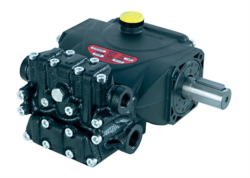
High-Pressure, Lower-Flow Systems: The Interpump E3B2515I R exemplifies this configuration, delivering 15 L/min (3.96 US GPM) at a maximum operating pressure of 250 bar (3,625 PSI / 25 MPa). Operating at 1,450 rpm with 7.13 kW (9.7 hp) input, this pump is optimized for applications demanding sustained high pressure—such as high-pressure washing, waterjet cutting, or precision hydraulic systems. The low flow rate at maximum pressure is the trade-off; if you need both high flow AND high pressure simultaneously, this pump cannot deliver both. However, for systems where peak pressure is the limiting requirement and flow is secondary, this specification is ideal.
Similarly, the Interpump E3B2515 L and Interpump E3B1515 DX with Gearbox RS500H operate within this high-pressure envelope, making them suitable for identical application families where integrated valve or gearbox functionality adds operational flexibility.
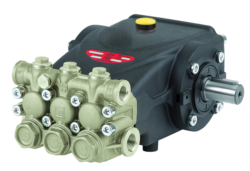
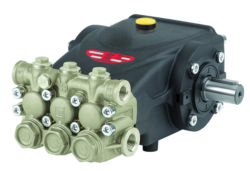
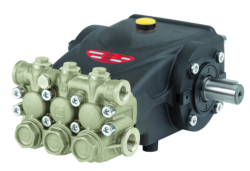
Moderate-Pressure, Medium-Flow Systems: By contrast, the Interpump E3C1021 DX prioritizes flow delivery, producing 21 L/min (5.55 US GPM) at a moderate 100 bar (1,450 PSI / 10 MPa) maximum pressure. Running at 1,750 rpm with 4.04 kW input, this pump suits applications requiring sustained volume transfer at lower pressures—cooling systems, circulation loops, or general hydraulic supply where pressure spikes are uncommon. The trade-off is pressure capacity; you cannot simply increase system demand to 250 bar and expect this pump to maintain rated flow.
The Interpump E3C1515 L occupies the middle ground, delivering 15 L/min at 150 bar (2,175 PSI), making it suitable for general-purpose applications requiring balanced flow-pressure performance. All E3C series pumps operate at 1,750 rpm, reflecting their design focus on sustained medium-pressure operation rather than peak pressure delivery.
Power Consumption Correlation: Notice that the E3B series (high-pressure) consumes 7.13 kW for 15 L/min at 250 bar, while the E3C1021 consumes only 4.04 kW for 21 L/min at 100 bar. This reflects the power equation directly: higher pressures demand proportionally more power to move the same or lesser volumes. In energy-constrained Southeast Asian facilities where electricity costs are significant, this distinction affects both operational expense and system sizing requirements.
Real-World Application Examples: Matching Flow-Pressure to Industrial Tasks
Scenario 1: High-Pressure Industrial Cleaning Systems
A Singapore-based manufacturing facility requires an automated surface cleaning system for precision parts. The application demands 250 bar operating pressure to remove industrial contaminants effectively, but flow requirements are modest—approximately 12-15 L/min is sufficient for the nozzle array. The Interpump E3B2515I R matches this requirement precisely: it delivers the required 15 L/min at 250 bar without oversizing. Selecting a pump rated for higher flow at this pressure would waste energy, generate excess heat in tropical ambient conditions, and require larger piping—all unnecessary costs. The 7.13 kW power requirement also fits standard industrial 10 kW motor supplies common throughout Southeast Asia.
Scenario 2: Hydraulic System for Material Handling Equipment
A Thailand-based logistics operation deploys hydraulic lifting systems across multiple loading docks. The typical load requires 150 bar to lift safely, but the system must lower and raise loads frequently, meaning circulation flow becomes the primary performance driver. Here, the Interpump E3C1515 L proves optimal. Its 15 L/min at 150 bar provides smooth, responsive lift-lower cycles while its 4.26 kW input allows operation on standard 5.5-7.5 kW motors with headroom for other equipment. If this facility had specified the E3B2515I R instead, they would pay significantly more in electricity per cycle while gaining unnecessary pressure capacity that the application never uses.
Scenario 3: Cooling and Circulation Systems in Food Processing
An Indonesia-based food processing plant requires large-volume fluid circulation through heat exchangers and product cooling tanks. Operating pressures remain low (typically 5-30 bar to overcome piping friction), but sustained flow volume is essential—40+ L/min across multiple circuits. The Interpump E3C1021 DX with its 21 L/min capacity can be deployed in parallel configurations or as a primary pump for lower-flow duty. The 100 bar rated maximum provides safe headroom if system resistance temporarily increases due to filter clogging, yet the pump remains efficient at the lower actual operating pressures, extending equipment life in high-humidity tropical environments.
Selection Criteria and Best Practices for Industrial Pump Specification
Step 1: Determine Actual System Requirements, Not Theoretical Maximums
Begin by identifying the sustained operating point, not peak transient conditions. Most systems operate at 60-80% of theoretical maximum pressure. Specifying a pump for worst-case scenario pressure while ignoring flow requirements results in undersized flow capacity during normal operation. Conversely, oversizing flow while meeting peak pressure wastes energy daily across thousands of operating hours.
Step 2: Account for Environmental and Climate Factors
Southeast Asia's tropical climate—high humidity, temperatures regularly exceeding 35°C, and seasonal monsoon variations—affects pump derating requirements. Fluid viscosity changes with temperature; warmer hydraulic oil becomes thinner, requiring higher pressure to maintain seal integrity. Motor cooling deteriorates in high ambient heat. Conservative practice recommends derating pump flow capacity by 5-10% and derate power by 10-15% for sustained tropical operation. This means selecting a pump with rated capacity exceeding your requirements by these margins.
Step 3: Evaluate Power Availability Against Total System Demand
Do not consider pump power in isolation. Calculate total motor power including pump input, then add safety margin (typically 15-25%). Southeast Asian industrial facilities often operate multiple pumps and compressors on shared electrical infrastructure; undersizing motor capacity forces equipment to run continuously loaded, reducing service life. Verify motor frame size compatibility and electrical supply capacity before finalizing pump selection.
Step 4: Consider Future Operational Changes
Industrial facilities evolve. Production lines are modified, flow demands increase, or pressure requirements change. Where feasible, specify pumps with capacity headroom—typically 20-30% above calculated requirements—to accommodate future modifications without complete system replacement.
Optimizing Performance Through Proper Application Matching
The flow-pressure trade-off is not a design flaw; it is a fundamental physical constraint that, when understood correctly, becomes a tool for optimization. Selecting a pump matched precisely to your application's actual requirements—not theoretical peaks—reduces energy consumption, minimizes heat generation in tropical climates, extends equipment service life, and reduces total cost of ownership across the system's operational lifespan. Industrial pumps and compressors span a wide range of specifications precisely because different applications have different optimal operating points along the flow-pressure curve.
When evaluating pumps and compressors in Singapore and across Southeast Asia, resist the temptation to specify based on single parameters. Instead, map your system's duty cycle across time—the actual pressure and flow demanded during normal operation, temporary peaks, and low-load periods. Match pump selection to this map, and your system will deliver superior performance with reduced operating cost.
For detailed technical consultation on pump selection for your specific application, or to discuss how different Interpump models perform within your system constraints, contact 3G Electric's technical team. With over three decades serving Southeast Asian industrial operations, our engineers understand the unique environmental and operational challenges of this region and can recommend pump configurations optimized for your facility's actual requirements.