Industrial Pump Flow Rate and Pressure Matching: A Practical Guide for Global Operations
One of the most common mistakes in industrial pump selection is overlooking the critical relationship between flow rate and pressure requirements. Plant managers and operations directors often focus on one specification while neglecting the other, resulting in pumps that either underperform or operate inefficiently. This guide walks you through the practical process of matching pump flow rates and pressure ratings to your specific operational needs, with real examples from proven industrial equipment. Understanding this fundamental principle will help you select the right pump the first time, reduce downtime, and optimize energy consumption across your facility.
Understanding the Flow-Pressure Relationship in Industrial Pumps
Flow rate and pressure are the two core performance metrics that define a pump's capability. Flow rate—measured in liters per minute (L/min) or US gallons per minute (GPM)—tells you how much fluid the pump delivers per unit time. Pressure—measured in bar, MPa, or PSI—indicates the force at which that fluid is delivered. These two parameters are not independent; they work together to determine the pump's power consumption and suitability for your application.
The relationship is governed by a simple principle: as pressure increases, a pump's ability to deliver high flow rates typically decreases. This is why a single pump model cannot perform optimally across all applications. A pump rated for 250 bar (3,625 PSI) operating at full flow will consume significantly more power than the same pump operating at 100 bar (1,450 PSI). Understanding this trade-off is essential for cost-effective equipment selection.
Industrial applications fall into three broad categories: high-flow/low-pressure (like circulation and cooling systems), medium-flow/medium-pressure (general hydraulics and transfer operations), and low-flow/high-pressure (precision machining, material handling, and specialized industrial cleaning). Mismatching a pump to your application category—for example, installing a high-pressure pump where medium pressure suffices—wastes energy and accelerates component wear. Conversely, undersizing pressure capacity can lead to system failures and safety risks.
The pump's displacement (internal geometry) is fixed during manufacturing. When you select a pump with a given displacement, you're essentially committing to a range of flow and pressure combinations that pump can safely handle. Motor speed (measured in RPM) also affects both flow and pressure output, which is why gearbox configurations and speed ratings are critical specifications to verify during selection.
Matching Specifications: From Theory to Real Products
Let's translate these principles into practical selection criteria using industry-standard equipment. Consider two distinct application scenarios that highlight the importance of correct matching.
Scenario 1: Medium-Pressure Transfer and Hydraulic Operations
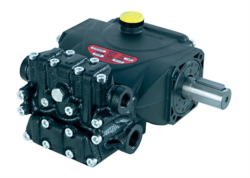
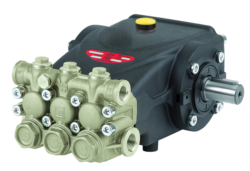
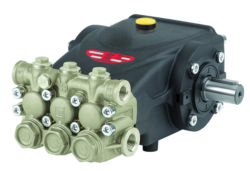
Many industrial facilities require pumps for general hydraulic circuits, tank transfers, and moderate-pressure applications. In this category, the Interpump E3C1515 L delivers 15 L/min at 150 bar (2,175 PSI) with 5.8 horsepower. This specification suits applications like industrial compressor circulation, moderate-pressure test stands, and general-purpose hydraulic systems. The pump's 1,750 RPM operating speed keeps it thermally efficient while maintaining consistent displacement. If your operation requires slightly higher flow with the same pressure class, the Interpump E3C1021 DX provides 21 L/min at 100 bar (1,450 PSI) with 5.5 horsepower—a better choice for cooling systems, circulation loops, and applications where you need throughput over pressure.
Scenario 2: High-Pressure Industrial Applications
Specialized applications—including precision cutting, material compaction, and industrial cleaning systems—demand higher pressure ratings. The Interpump E3B2515I R operates at 250 bar (3,625 PSI) while delivering 15 L/min at 9.7 horsepower. This high-pressure variant is purpose-built for systems requiring sustained force over moderate flow volumes. The technical distinction is critical: although both the E3C1515 and E3B2515I deliver 15 L/min, the high-pressure version consumes 66% more power to generate that additional pressure differential. This is not a deficiency—it's the correct engineering solution for applications that genuinely require 250 bar. Selecting the lower-pressure model for a high-pressure application would result in system failure; selecting the high-pressure model for a 150 bar application wastes energy.
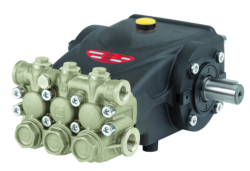
For operations requiring integrated valve and gearbox solutions, the Interpump E3B1515 with integrated valve and RS500H gearbox combines high-pressure capability (250 bar) with compact design, making it ideal for space-constrained installations where modular assembly becomes impractical. The gearbox allows flexible motor coupling and speed optimization for your existing drive system.
Each of these pumps shares a common displacement geometry but delivers different performance profiles depending on pressure class and motor configuration. This modularity—the ability to select pressure rating and speed independently—is why understanding your true pressure requirement is the first step in selection.
Real-World Application Examples: Where Matching Matters
Example 1: Manufacturing Facility Coolant Circulation
A automotive manufacturing plant needs to circulate coolant through multiple machine tool spindles continuously. The system operates at steady-state with minimal pressure spikes—approximately 80 bar maximum. Engineers initially considered the 150 bar Interpump model but would have wasted 30% of the pump's pressure capacity and consumed excess energy. Switching to the lower-pressure 100 bar variant (the E3C1021 DX at 21 L/min) provided the required 18 L/min throughput while reducing electrical draw by 15%. Over a facility running 16 hours daily, this single pump change delivered measurable energy savings and extended component life through reduced thermal stress.
Example 2: Industrial Testing Laboratory
A materials testing facility required a pump for high-pressure compression tests reaching 200 bar. Initial specification called for a 250 bar pump for safety margin. However, once pressure relief and monitoring were properly designed, the 150 bar model proved sufficient for test cycles that peaked at 140 bar during normal operation. The facility avoided unnecessary capital investment and operational complexity while maintaining safety through proper system design rather than oversizing equipment.
Example 3: Multi-Zone Industrial Cleaning System
An industrial cleaning contractor operating in Global markets found that customer sites had widely varying requirements: some needed high pressure (200+ bar) for concrete and heavy equipment cleaning, while others required only 80 bar for maintenance washing. By maintaining inventory of both the E3C1515 (150 bar) and E3B2515I (250 bar) models, the contractor could deploy the right pump to each job, improving customer satisfaction and reducing return visits due to underperforming equipment.
Selection Criteria and Best Practices for Pump Matching
Step 1: Determine Actual Pressure Requirement
Measure or calculate the pressure your system genuinely requires under normal operation—not worst-case scenarios or theoretical peaks. If your system includes a pressure relief valve set at 120 bar, selecting a 250 bar pump is overspecification. This is the single most important decision in pump selection.
Step 2: Verify Flow Demand Across Your Circuit
Calculate total flow needed: sum the flow requirements of all actuators, motors, and circuits operating simultaneously. A common error is designing for peak flow rather than steady-state flow, leading to unnecessary oversizing. Most industrial systems run continuous circulation at 60-75% of peak flow capacity.
Step 3: Check Motor Compatibility and Speed Requirements
Confirm your available motor speed (typically 1,450, 1,750, or 3,400 RPM for standard industrial motors). Pump displacement is fixed, so RPM directly determines output flow and pressure. Mismatching motor speed to pump design will degrade both performance and reliability.
Step 4: Account for Future Capacity
Plan for modest growth (10-15%) without over-sizing. A 20% operating margin maintains pump efficiency and thermal stability; operating continuously at 95% capacity accelerates wear and generates excess heat.
Step 5: Factor in System Losses and Component Limitations
Real piping, hoses, valves, and filters add resistance. Include these losses in your pressure calculations. A pump rated for 150 bar delivering through a restrictive filtration system may only achieve 140 bar at the load—still adequate if your system is designed for 140 bar, insufficient if it requires 150 bar.
Conclusion: Making the Right Match the First Time
Selecting an industrial pump by matching flow rate and pressure to your true operational requirements is far simpler than troubleshooting an undersized or oversized unit in service. The difference between a correctly matched pump and a mismatched one often shows up not as a dramatic failure, but as gradual efficiency loss, rising energy costs, increased maintenance, and shortened component life. By following the selection framework outlined here—understanding the flow-pressure relationship, reviewing real product examples in your pressure class, and applying proven best practices—you'll ensure your facility operates with optimal efficiency and reliability.
At 3G Electric, we've been helping operations directors and plant managers in Global markets select the right pumps and compressors since 1990. Our technical team understands the nuances of flow and pressure matching across industrial applications. Whether you're replacing an aging circulation pump, designing a new compressed air system, or optimizing an existing circuit, we're here to help you navigate the selection process with confidence. Contact us today to discuss your specific requirements and discover how the right pump can improve your operation's bottom line.