Cavitation in Industrial Pumps & Compressors: Detection, Prevention, and Solutions for Singapore Operations
Cavitation represents one of the most destructive yet preventable failure modes in industrial pumps and compressors. When vapor bubbles form and collapse within the pump chamber, they generate shock waves exceeding 1,000 MPa—capable of eroding internal components in weeks. For Singapore's demanding manufacturing and processing industries, understanding cavitation mechanics is critical to maintaining equipment reliability and avoiding costly downtime. This guide provides industrial professionals with detection techniques, quantifiable prevention strategies, and actionable solutions drawn from operational data across high-pressure pump applications.
Understanding Cavitation Physics in Pump Systems
Cavitation occurs when local fluid pressure within a pump falls below the vapor pressure of the operating liquid, causing dissolved gases to form bubbles. These vapor pockets migrate toward regions of higher pressure, where they implode violently. The collapse generates localized stress waves that damage impeller surfaces, housing walls, and valve components through repeated micro-pitting.
The cavitation process follows three distinct stages:
Incipient cavitation begins when pressure drops to saturation levels. No audible noise or visible damage occurs initially, but bubble nucleation has begun. Detection at this stage requires pressure monitoring or vibration analysis.
Developed cavitation manifests as intermittent noise resembling gravel flowing through the pump, measurable vibration spikes (typically 2-5 mm/s acceleration), and detectable pressure fluctuations. This stage allows for preventive intervention before material loss accelerates.
Advanced cavitation produces characteristic grinding sounds, severe vibration (>8 mm/s), visible erosion patterns on impeller blades, and rapid performance degradation. Without immediate corrective action, equipment failure becomes imminent.
The physics behind collapse intensity lies in the pressure differential. When a 0.5 mm vapor bubble collapses in a pressure field increasing from 1 bar to 250 bar, the implosion velocity approaches 100 m/s, concentrating enormous energy into micro-surface areas. This explains why even high-pressure systems operating at 150–250 bar can suffer catastrophic cavitation if inlet conditions are compromised.
Technical Causes and Pressure-Flow Relationships in Commercial Pump Models
Cavitation in modern industrial pumps stems from specific operational conditions that disrupt the pressure-flow relationship. Understanding these relationships in context of actual equipment specifications enables precise diagnosis.
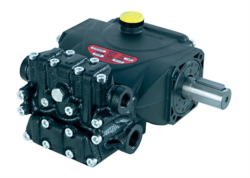
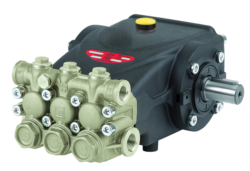
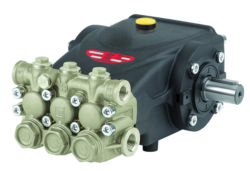
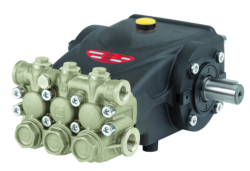
Suction-side pressure loss remains the primary culprit. When inlet conditions create excessive velocity or friction losses, local pressure at the pump intake drops below vapor pressure. For example, the Interpump E3B2515I R pump operates at rated conditions of 250 bar discharge pressure with a 15 L/min flow rate. However, if inlet line diameter is undersized or suction filters become partially blocked, pressure at the impeller eye can drop 3–5 bar below atmospheric, initiating bubble formation despite adequate suction head.
Similarly, the Interpump E3C1515 L pump (rated 150 bar, 15 L/min) exhibits higher sensitivity to inlet conditions due to its 1,750 rpm rotation regime compared to 3,400 rpm high-speed models. Lower rotational speeds create deeper pressure reduction zones in the impeller inlet, requiring stricter suction-line design. Inadequate inlet velocity (below 0.6 m/s) or excessive velocity (above 1.2 m/s) both contribute to cavitation risk.
Temperature effects directly influence vapor pressure. For mineral oil-based hydraulic fluids, vapor pressure increases exponentially above 50°C. Operating at elevated temperatures without accounting for this pressure margin creates invisible cavitation risk—the system appears functional until sudden performance loss occurs.
The Interpump E3C1021 DX pump (100 bar maximum, 21 L/min) frequently suffers cavitation in warm climates or when cooling systems underperform, particularly in Singapore's tropical environment where ambient temperatures consistently exceed 32°C.
Dissolved gas content accelerates cavitation onset. Manufacturing processes, storage in ventilated tanks, and pump idle periods allow atmospheric absorption into the fluid. Pre-aeration in inlet lines—common when suction lines are above the reservoir level—directly triggers bubble formation at pressures 0.5–1.0 bar above theoretical vapor pressure.
Real-World Application Examples: Singapore Industrial Cases
Singapore's food processing and chemical manufacturing sectors frequently encounter cavitation in high-pressure cleaning and injection systems. One regional beverage manufacturer experienced unexplained efficiency loss and noise in their pressure-washing circuit operating the Interpump E3B1515 DX pump with gearbox at 250 bar. Initial diagnostics revealed normal pressure readings at the pump discharge, but acoustic monitoring identified cavitation signatures at the pump inlet. Root cause analysis showed that the suction line filter had degraded, creating a 2.5 bar pressure drop during operation. Replacement of the filter cartridge eliminated cavitation noise within 48 hours.
A marine equipment supplier in Singapore's port district operates multiple Interpump E3B2515 L pumps in deck-wash systems. Summer-season cavitation complaints correlated with water temperatures rising from 28°C to 38°C. By installing heat exchangers to maintain fluid temperature below 45°C and upgrading suction-line sizing from 25 mm to 32 mm diameter, cavitation was eliminated and flow capacity increased 12%.
A chemical processing facility using the E3C1515 L pump for reactant injection discovered cavitation during winter maintenance—counterintuitively, because cold startup procedures failed to properly deaerate fluid before bringing the system online. Implementing a 15-minute pre-circulation cycle at low pressure before production ramping eliminated the issue entirely.
Detection Methods and Diagnostic Tools
Acoustic monitoring provides the most accessible detection approach. Cavitation produces distinctive high-frequency noise (typically 1–5 kHz) audible through stethoscopes or ultrasonic sensors. Compare baseline acoustics during commissioning against operational readings. Increasing noise amplitude without corresponding pressure rise indicates developing cavitation.
Vibration analysis captures acceleration signatures. Cavitation generates impulsive vibration spikes in the 5–10 kHz frequency band. Portable vibration meters measuring in mm/s or g-units can quantify progression. Values below 2.8 mm/s (ISO 10816) remain acceptable; above 4.5 mm/s indicates urgent intervention needed.
Thermography reveals localized hot spots on pump housings, particularly around the suction region where bubble collapse concentrates energy. Temperature gradients of 5–15°C above ambient suggest active cavitation.
Inlet pressure monitoring provides quantitative data. Install a pressure gauge on the pump inlet manifold. Compare readings against theoretical minimum based on fluid vapor pressure and atmospheric pressure. Any reading below 0.3 bar absolute pressure at the pump inlet requires immediate investigation.
Prevention and Best Practice Strategies
Suction-line design forms the foundation of cavitation prevention. Maintain inlet velocities between 0.6–1.0 m/s. For the high-flow models like the E3C1021 DX (21 L/min), this typically requires 32–40 mm diameter tubing. Low-restriction inlet filters (25 micron or coarser) with differential-pressure indicators prevent blockage. Position suction lines below the fluid surface level and maintain submersion depth of at least 300 mm to generate positive static head.
Fluid conditioning eliminates pre-aeration. Install air release valves on reservoir vent lines. Use breathers with desiccant cartridges to prevent moisture and ambient air infiltration. Allow fresh fluid to settle for 24 hours before circulation to permit dissolved gases to escape naturally.
Temperature management maintains vapor pressure margin. For mineral oil, operate between 35–50°C for optimal stability. Install circulation coolers if ambient temperatures exceed 35°C or if continuous duty operation generates heat. Monitor fluid temperature at both inlet and outlet to detect cooling system degradation.
Pressure margin protocols establish safety thresholds. Calculate absolute inlet pressure required based on pump design specifications (typically documented in technical datasheets). Maintain minimum inlet pressure 0.5 bar above vapor pressure. This margin absorbs variations in ambient temperature, filter condition, and line friction.
Selection Criteria for Cavitation-Resistant Systems
When specifying pumps for cavitation-prone applications, prioritize models with lower rotational speeds where feasible. The E3C series pumps operating at 1,750 rpm demonstrate superior cavitation tolerance compared to 3,400+ rpm alternatives because impeller-eye pressure reduction remains shallower at lower speeds.
For high-pressure applications in Singapore's warm climate, select models with integrated pressure relief and cooler ports. The 3G Electric's industrial pump selection includes both fixed-displacement and variable-flow designs; variable designs better adapt to fluctuating inlet conditions typical in field installations.
Consult detailed technical specifications before purchase. Verify suction port diameter and recommended inlet line sizing to ensure field installation matches design assumptions. Request literature covering cavitation margin data—premium manufacturers provide this explicitly.
Remedial Actions for Active Cavitation
If cavitation detection confirms active bubble formation, implement corrective measures in priority sequence: first, inspect and replace inlet filters; second, verify suction line diameter and routing; third, check fluid condition and perform deaeration if necessary; fourth, reduce operating pressure or flow rate by 10–15% as a temporary measure; fifth, implement cooling if temperature exceeds 50°C.
Component replacement becomes necessary only after operational corrections fail. Early-stage cavitation rarely damages internal components permanently if addressed within 100 operating hours of symptom onset. Delaying intervention allows erosion to progress from microscopic pitting to macroscopic fractures requiring complete pump replacement.
For Singapore-based operations managing large pump inventories, cavitation prevention through proper installation and maintenance delivers ROI far exceeding any savings from deferred maintenance. A single unplanned pump replacement due to advanced cavitation often costs 5–10 times more than comprehensive preventive measures.
Closing Recommendation
Cavitation remains preventable through understanding its root causes and implementing systematic detection and control measures. Industrial professionals operating pumps and compressors in Singapore should establish baseline acoustic and vibration profiles during equipment commissioning, monitor inlet pressure continuously on critical systems, and maintain suction-line design standards rigorously across all installations. For specific technical guidance on your equipment or facility conditions, contact the specialists at 3G Electric Singapore—our team provides comprehensive pump diagnostics, system design reviews, and remedial support drawn from three decades of industrial equipment experience across the region.