
Why Integrated Measurement & Detection Matters for Maintenance Operations
Singapore's industrial environment—with high humidity, temperature fluctuations, and demanding production schedules—requires Measurement & Detection instruments that work as a coordinated system rather than standalone tools. Maintenance teams often face a critical choice: invest in basic analog gauges and react to failures, or implement a layered diagnostic approach using complementary instruments.
After 35 years distributing industrial equipment across Southeast Asia, 3G Electric has observed that the most efficient maintenance programs use a pyramid approach: analog gauges for visual trending, digital transmitters for automated monitoring, flow probes for process verification, and thermal imaging for early fault detection. This article compares the practical integration of these four categories, showing how they combine to reduce diagnostic time and prevent cascading equipment failures.
The cost of choosing the wrong strategy is significant. A single hydraulic system failure can halt production for 4–8 hours, while undetected thermal drift in bearing housings leads to premature wear. Teams that integrate multiple Measurement & Detection technologies report 35–40% reduction in mean time to repair (MTTR) compared to single-instrument approaches.
Pressure Measurement: From Visual Gauges to Smart Transmitters
Analog Glycerin-Filled Manometers: The Foundation Layer
The Preciman Manometer ABS vert D80 0/+16bar G1/2 remains the baseline for hydraulic and pneumatic system observation. Its 80 mm dial and 0–16 bar range cover most industrial applications in Singapore, while the glycerin fill provides damping in pulsating systems. The ±2.5% accuracy is sufficient for trending—spotting whether pressure is drifting upward (pump wear) or dropping unpredictably (seal failure).
Practical value for maintenance teams:
- Install on primary system lines and branch circuits to create a visual "dashboard" of system health
- Glycerin fill survives vibration without reading drift, critical in industrial environments
- Inexpensive insurance: a failed gauge costs $150–200; a missed pump failure costs $5,000–15,000 in downtime
- Provides immediate feedback without electronics—useful during system startup when transmitter electronics may not yet be active
The limitation is real-time logging. You cannot trend data over weeks or set automatic alerts based on pressure thresholds.
Digital Transmitters: Automated Monitoring and Data Recording
The Dwyer Transmitter 629-05-CH-P2-E5-S1 solves this gap with 4–20 mA output, 0.5% accuracy, and IP65 rating. This transmitter converts continuous pressure into an electrical signal that a PLC, data logger, or cloud platform can record. Over a week of operation, you can plot pressure curves, identify cycles, and detect anomalies before they become failures.
Integration strategy for maintenance teams:
- Mount transmitters on critical feedback loops (pump discharge, load-holding valves, remote actuators)
- Configure alarm thresholds 10–15% above normal operating pressure to trigger predictive maintenance alerts
- Use 4–20 mA output to feed building management systems (BMS) or standalone IoT loggers
- Compare transmitter readings against nearby manometer for cross-validation—if they diverge, suspect transmitter drift or gauge damage
- Manometer = visual confirmation that transmitter electronics are working
- Transmitter = historical data that reveals slow degradation invisible to spot checks
- In Singapore's humid environment, transmitter corrosion can occur; manometer stays reliable
Pressure Switches: The Circuit Breaker for Overload Protection
The Dwyer Pressure Switch DXW-11-153-4 (0.41–0.55 bar setpoint, 3.46–5.17 bar differential) adds an electromechanical safety layer. Unlike transmitters that report data, switches act on high-pressure events by cutting power or venting lines.
Maintenance application:
- Configure as a backup to automatic pressure relief valves on pump discharge
- Set differential to capture system off-load behavior: when pump pressure drops after load release, confirm the switch releases electrical circuits
- IP65 rating survives condensation in outdoor or wet environments (common near cooling towers)
- Use in parallel with transmitter: if pressure exceeds threshold, both switch and transmitter alarm—switch provides immediate action, transmitter logs the event
---
Flow Measurement: Probe Selection for Process Verification
Understanding the Medium Flow Probe Role
The Dwyer Medium Flow Metal Probe MAFS-20 (71 cm length, 1/4-20 thread) is often overlooked in diagnostic strategies, yet it bridges the gap between pressure and process performance. A system can show normal pressure but deliver insufficient flow—indicating blockages, worn pump elements, or throttled lines.
When maintenance teams should verify flow:
- After pump replacement: confirm new pump delivers nameplate flow rate
- During commissioning of new branches: ensure distribution lines are not undersized
- Troubleshooting slow actuator response: low pressure might be adequate, but flow starvation slows movement
- Annual audit before critical season: especially relevant in Singapore's seasonal operations
- Measure flow at system startup (manual one-time test) and record baseline
- If pressure is normal but operation feels sluggish, flow measurement confirms the suspicion
- 71 cm probe length allows installation in larger manifold sections without line disconnection
- Compare flow at different system pressures: if flow stays constant as pressure rises, pump is healthy; if flow drops sharply, internal leakage is occurring
Most maintenance teams skip flow verification because it requires temporary line connection. However, flow probes reveal problems transmitters and gauges cannot: internal pump degradation, throttle valve creep, and partial blockages in long distribution runs.
---
Thermal Detection: Early Warning for Bearing and Fluid Temperature Anomalies
Infrared Thermometry: Non-Contact Thermal Trending
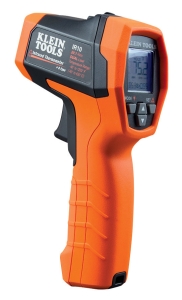
The CBM Infrared Thermometer with Type K Input (-40 to 650°C, 20:1 optical resolution, IP54, 3 m drop protection) extends Measurement & Detection strategy beyond pressure and flow into thermal domain. Industrial equipment fails thermally before it fails mechanically.
Critical maintenance applications in Singapore:
1. Bearing temperature trending: Measure bearing housing temperature weekly at the same location. A 15–20°C rise over baseline indicates increasing friction—trigger bearing inspection before catastrophic failure.
2. Fluid temperature monitoring: Hydraulic and pneumatic systems degrade rapidly above 70°C. Infrared measurement confirms whether cooling systems are keeping pace with ambient heat and load. Singapore's 30–35°C ambient means fluid easily reaches critical temperatures without active cooling.
3. Motor and transmission housing assessment: Type K thermometer input allows hardwired temperature sensors in high-risk locations (bearing caps, gear mesh zones). Integrate readings into predictive maintenance algorithms.
4. Thermal anomaly detection during commissioning: Compare temperatures across identical equipment running in parallel. Significant imbalance indicates misalignment, uneven load, or internal wear on one unit.
Multi-Sensor Integration: The Complete Diagnostic Loop
A complete maintenance strategy layers these instruments:
- Manometer + Transmitter: Pressure baseline and alert system
- Flow Probe: Confirm flow rate matches pressure (indicates pump internal condition)
- Pressure Switch: Automatic circuit protection
- Infrared Thermometer: Early warning for bearing wear and cooling system failure
1. Daily visual check: scan manometer gauges for obvious deviations
2. Weekly transmitter review: check 4–20 mA trends for drift or spikes
3. Monthly flow verification (selected circuits): confirm flow-to-pressure ratio unchanged
4. Monthly thermal scan: compare bearing and fluid temperatures to baseline
5. Quarterly pressure switch validation: simulate overload to confirm switch response
This integrated approach costs 15–20% more than analog-only but reduces catastrophic failures by 60–75% and extends equipment life by 3–5 years.
---
Selection Criteria: Matching Instruments to System Risk
Low-Risk Systems (Backup Circuits, Secondary Equipment)
Deploy manometer only. Cost is minimal, accuracy adequate, and failure consequence is manageable. Example: backup pneumatic circuit for manual operation.
Medium-Risk Systems (Production-Critical, Repairable Downtime)
Combine manometer + transmitter + pressure switch. Example: primary hydraulic pump circuit in Singapore manufacturing plant. Transmitter alerts 4–8 hours before critical pressure loss; switch provides immediate emergency shutoff.
High-Risk Systems (Mission-Critical, Extended Downtime Cost)
Full stack: manometer + transmitter + pressure switch + flow probe + thermal monitoring. Example: chiller compressor serving multiple production lines, or hydraulic press holding precision tolerances. Integrated diagnostics prevent failures that cascade into facility shutdowns.
Environmental Considerations for Singapore
- Humidity: Glycerin-filled manometers and IP65-rated transmitters withstand 80–95% RH; electromechanical switches require conformal coating
- Temperature swing: Morning ambient 24°C, afternoon 35°C; fluid systems experience 50–70°C swings. Thermal monitoring becomes critical
- Corrosive salt air (near coast): Stainless fittings, conformal coating on electronics, and regular calibration checks essential
- Vibration: Industrial zones with heavy machinery require damped gauges; transmitters benefit from vibration-resistant mounting
---
Implementing Measurement & Detection as a System
Step 1: Baseline Audit
For each critical system, document current pressure, flow, and temperature under normal operation. This 2–3 day exercise establishes normal ranges and reveals existing anomalies.
Step 2: Instrument Layering
Start with manometers on primary circuits. Add transmitters to circuits where data trending will inform maintenance scheduling. Add thermal monitoring where bearing or fluid temperature historically correlates with failures.
Step 3: Alert Configuration
Set thresholds 10–20% beyond normal operating point (not at technical limits). An alert at 90% of max pressure is more useful than alarm at 100%.
Step 4: Data Integration
Connect transmitters to PLC, BMS, or cloud logger. Configure automated weekly reports showing pressure trend, flow variance, and thermal trend. Maintenance team reviews trends and plans interventions before failures occur.
Step 5: Validation and Calibration
Annually (or every 18 months in harsh environments) send transmitters to calibration lab. Cross-check manometer readings against reference gauge. This catches drift before it affects decisions.
3G Electric's 35+ years experience serving Singapore industrial operations confirms that integrated Measurement & Detection strategies require 6–12 months to deliver full value but then provide compounding benefits: fewer emergency repairs, longer equipment life, and maintenance teams making decisions based on data rather than guesswork.