Introduction: Predictive Diagnostics in Burners & Combustion Systems
Maintenance teams managing industrial burners & combustion equipment face a critical challenge: distinguishing between minor operational anomalies and serious safety failures before unplanned shutdowns occur. Over 35 years as a distributor of industrial equipment across Southeast Asia, 3G Electric has supported countless maintenance operations in identifying combustion system faults early.
This guide focuses on practical diagnostic methodologies specifically designed for maintenance teams responsible for gas, oil, and dual-fuel burner systems in Singapore's industrial environment. Rather than covering general maintenance protocols already detailed in existing resources, this article concentrates on the diagnostic layer—how to interpret control signals, pressure readings, flame sensor outputs, and relay states to accurately identify root causes.
Section 1: Understanding Burner Control Relay Architecture and Fault States
The Control Relay as Diagnostic Hub
Modern burner safety systems rely on control relays to manage ignition sequences, monitor flame presence, and enforce safety interlocks. The Kromschroder Relay BCU 570WC1F1U0K1-E exemplifies EN 746-2 and EN 676 compliant design, supporting direct ignition and intermittent/continuous pilot modes. For maintenance teams, understanding the internal logic of this relay directly translates to faster fault isolation.
Control relays operate in discrete states: standby, purge, ignition, flame stabilization, and normal run. Each transition point presents diagnostic opportunities. When a burner fails to fire, the relay's internal timers and safety interlocks determine whether the fault is electrical, fuel-supply related, or combustion-related.
Diagnostic Workflow: From Symptom to Root Cause
When a burner shutdown occurs, maintenance teams should follow this sequence:
1. Verify electrical power and control signals
- Check 24V DC supply to the relay (typically required)
- Confirm combustion air pressure switch activation
- Test ignition transformer output voltage (typically 8–10 kV)
- Verify gas or oil pressure at the burner nozzle
- Confirm solenoid valve actuation (listen for audible click)
- Check for fuel leakage at valve seats
- Test UV sensor (if equipped) for optical path obstruction
- Measure ionization electrode resistance (typically 1–5 MΩ in flame)
- Verify flame monitoring electrode positioning relative to flame envelope
- Most modern relays (including the BCU 570WC1F1U0K1-E) output diagnostic signals via terminal blocks or visual indicators
- Document the exact fault code sequence and timing
- Compare against the relay's programming card specifications
Pressure Switch Integration in Diagnostics
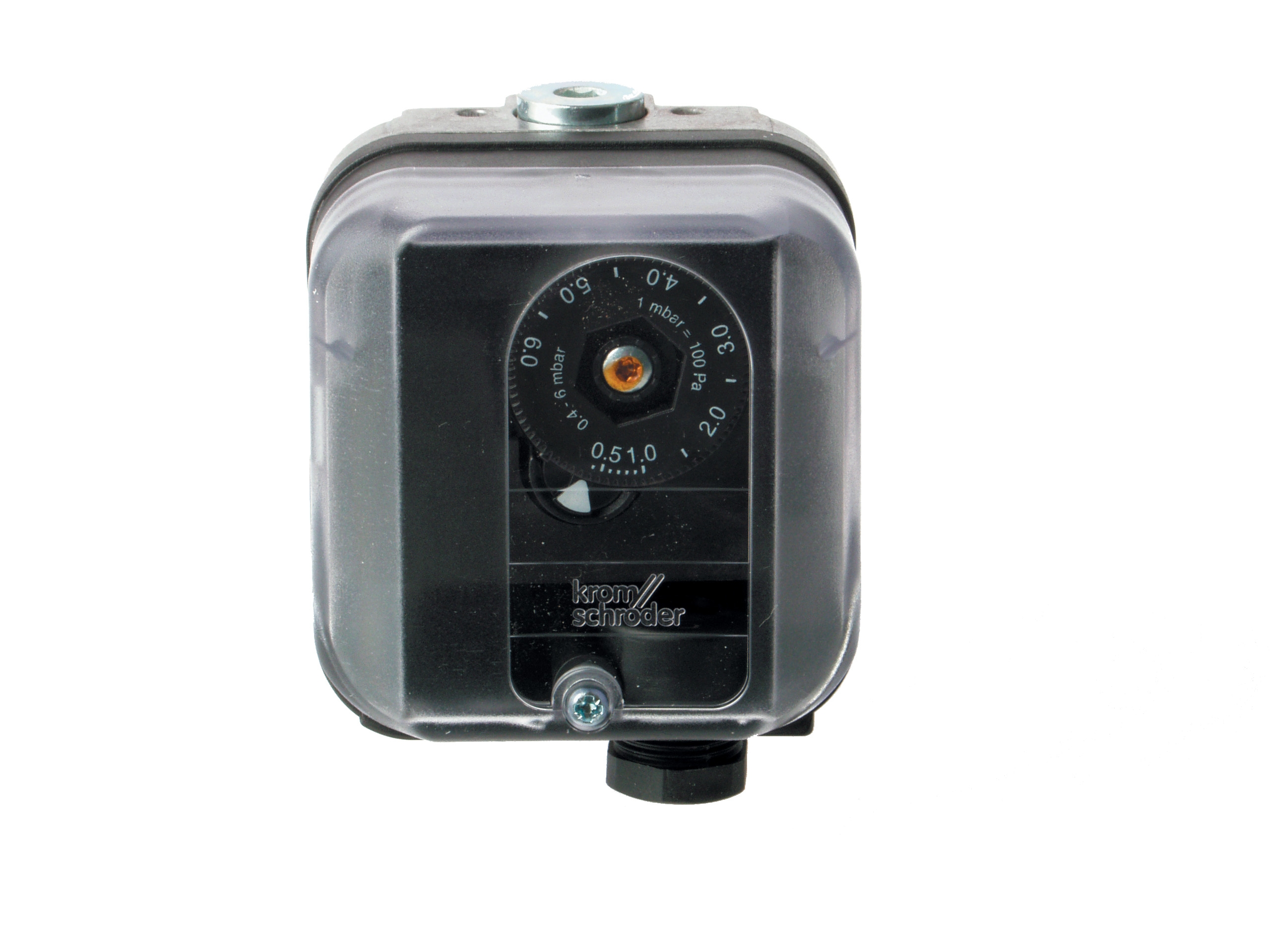
The Kromschroder Pressure Switch DG 50U/6 (SIL 3, Performance Level e) serves as a critical diagnostic node. This switch validates air supply adequacy before ignition and during operation. A typical diagnostic approach includes:
- Normal operation: DG 50U/6 closes at approximately 10–50 mmWC depending on application
- Fault condition: Switch fails to close despite burner startup attempt → indicates blocked air intake or fan failure
- Intermittent operation: Switch cycling on/off during run phase → suggests air damper instability or ductwork leakage
Maintenance teams should establish baseline pressure readings during commissioning, then monitor for trends. A gradual pressure increase (indicating accumulating dust on heat exchanger fins) can trigger premature safety shutdowns if not addressed proactively.
Section 2: Flame Monitoring Systems and Sensor Diagnostics
Dual-Sensing Architecture in Modern Relays
The Siemens Relay LFL 1.622 incorporates both UV and ionization flame monitoring, allowing the system to operate reliably across varying flame characteristics and fuel types. For maintenance diagnostics, this dual sensing provides redundancy clues:
- UV sensor failure: System typically reverts to ionization monitoring; if both fail simultaneously, a safety lockout occurs
- Ionization electrode drift: Slow response to flame changes; system may exhibit hunting or oscillation in modulated mode
- Cross-sensing mismatch: UV detects flame but ionization doesn't (or vice versa) → indicates electrode fouling or positioning drift
Predictive Indicators in Flame Monitoring
Maintenance teams can intercept failures before safety lockouts by monitoring these predictive signals:
1. Ignition delay increase
- Baseline: Flame detection within 2–4 seconds of ignition spark
- Warning: Delay extending to 5–7 seconds
- Failure risk: Delay exceeding 8 seconds (relay may shut down prematurely)
- Root cause analysis: Spark plug erosion, electrode gap drift, fuel atomization degradation, or air/fuel ratio misalignment
- Monitor the DC signal output from flame sensors during normal run
- A gradual decrease in signal strength (e.g., from 8V to 4V over weeks) indicates sensor fouling
- Maintenance action: Schedule cleaning before signal falls below the relay's sensitivity threshold
- Unstable flame signals (flickering within ±2V) suggest combustion instability
- Often precedes visible flame oscillation or complete extinction
- Diagnostic focus: Air inlet blockage, fuel line restrictions, or nozzle partial obstruction
Electrode Positioning and Calibration
Many flame detection faults originate from electrode position drift caused by thermal cycling or vibration. The standard procedure includes:
- Electrode gap measurement (typically 4–6 mm for ionization types)
- Visual inspection under bright light for surface contamination (carbon buildup, rust)
- Continuity testing of spark lead insulation
- Comparative testing: Replace suspected electrode with known-good unit and observe flame signal recovery
Section 3: Burner Application-Specific Diagnostics
Gas Burner Control in Two-Stage Systems
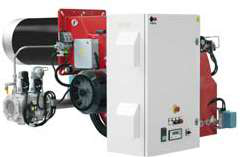
The FBR GAS XP 60/2 CE TC EVO is a two-stage industrial gas burner delivering 116–630 kW. Maintenance diagnostics for this burner type include:
Stage 1 (Low-fire) operation
- Verify gas pressure at nozzle: typically 5–15 bar depending on specific application
- Confirm air damper position in low-fire setting (usually 40–60% open)
- Monitor flame stability for 5+ minutes; any flicker indicates air/gas ratio drift
- Observe smooth step increase in fuel flow (< 2 second ramp)
- Verify proportional control valve response if modulation is enabled
- Check for flame extinction during transition (indicates damper lag or pressure overshoot)
Heavy Oil Burner Diagnostics
The FBR KN 1300/M TL EL delivers 1700–11500 Mcal/h in dual-fuel mode with modulating control. Oil burner diagnostics require additional attention to fuel conditioning:
Oil pathway validation
- Confirm oil pre-heater outlet temperature (typically 80–100°C for heavy oil)
- Measure oil pressure at nozzle (20–30 bar common for atomizing-type nozzles)
- Check nozzle spray pattern visually (should be fine mist, not coarse droplets or pencil-like stream)
- Verify secondary air pressure supply (typically 2–4 bar)
- Confirm solenoid valve on atomizing air line cycles with burner start
- Monitor for oil carryover into air lines (indicates nozzle seal failure)
Section 4: Data Logging and Trending for Predictive Maintenance
Establishing Baseline Parameters
Systematic predictive maintenance begins during the commissioning phase. Maintenance teams should document:
- Air supply pressure (static reading at burner air inlet)
- Fuel line pressure at burner inlet
- Flame sensor DC signal voltage during normal run
- Ignition spark timing (delay from signal to flame detection)
- Flue gas O₂ content (if analyzable) or CO/CO₂ ratio
- Control relay response times (documented in relay specifications)
These baselines become the reference against which all subsequent measurements are compared.
Trending and Anomaly Detection
Maintenance teams managing multiple burner units can apply simple statistical methods:
1. Moving average monitoring
- Plot weekly average fuel pressure readings across a 12-week window
- Any reading falling > 10% below the moving average triggers investigation
- Common causes: fuel filter clogging, pump wear, or valve creep
- Calculate standard deviation of ignition delay times
- An increasing variance (e.g., sometimes 2.5s, sometimes 4.5s) indicates incipient spark plug wear
- Maintenance action: Schedule spark plug replacement before variance exceeds ±1 second
- Monitor burner case temperature using thermal imaging (if applicable)
- Abnormal hot spots may indicate localized combustion instability or refractory damage
- Gradual temperature increase across the entire burner suggests declining efficiency
Integration with CMMS Systems
Maintenance Management Software (CMMS) platforms should capture:
- Date and time of each burner startup/shutdown cycle
- Any fault codes generated (linked to relay manual for quick reference)
- Duration of operation in each mode (low-fire vs. high-fire for modulating systems)
- Manual interventions (nozzle cleaning, electrode replacement, etc.)
Over 12–24 months, patterns emerge: certain units may require cleaning every 6 weeks, while others run 6 months between maintenance events. This data drives optimized maintenance intervals.
Maintenance Team Best Practices for Burner Diagnostics
- Create a fault code reference guide specific to your relay models (BCU 570WC1F1U0K1-E, LFL 1.622, etc.) and post it in the maintenance workshop
- Perform weekly visual inspections during normal operation to catch flame instability early
- Maintain spare sensors and electrodes on-site to minimize downtime during diagnostics
- Use a pressure gauge set (0–100 mmWC and 0–30 bar) dedicated to burner testing
- Document all interventions in your CMMS, building a facility-specific knowledge base over time
- Cross-train team members on relay operation; no single person should be the only flame safety expert
Conclusion
Burners & Combustion system diagnostics transform from reactive troubleshooting into predictive science when maintenance teams implement systematic measurement protocols and data analysis. By understanding control relay architecture, monitoring pressure and flame sensor behavior, and establishing facility-specific baselines, you reduce unplanned shutdowns and extend equipment life.
3G Electric's 35+ years supporting industrial operations across Southeast Asia has shown that maintenance teams using predictive diagnostics achieve 30–40% fewer emergency repairs. Start with one burner system as a pilot: establish baselines, trend key parameters, and gradually expand the program across your facility.
Contact 3G Electric for commissioning support, training on your specific control relay models, or replacement components when diagnostics indicate component failure.