Introduction: Burners & Combustion Efficiency in Singapore's Industrial Landscape
Burners and combustion systems are the thermal backbone of Singapore's manufacturing, food processing, chemical, and petrochemical sectors. However, efficiency losses often cost operators thousands of dollars annually while creating environmental and regulatory complications. Since 1990, 3G Electric has supplied industrial heating equipment to facilities across Southeast Asia, and we consistently observe that combustion efficiency—the percentage of fuel energy successfully converted to useful heat—remains poorly optimized in many plants.
Singapore's strict environmental standards, combined with rising fuel costs and workforce constraints, demand a systematic approach to burner performance management. This guide addresses the practical aspects of combustion efficiency and emissions control that maintenance teams and facility managers must understand to operate competitively.
Section 1: Understanding Combustion Efficiency Losses and Performance Baseline
Key Efficiency Metrics
Combustion efficiency is measured as the percentage of fuel energy converted to usable heat. Most industrial burners in Singapore operate at 75–85% efficiency under normal conditions, meaning 15–25% of fuel energy is lost to exhaust gases, radiation, and incomplete combustion. In continuous-duty applications (boilers, furnaces, dryers), these losses compound dramatically.
Practical efficiency loss occurs through three primary mechanisms:
- Exhaust gas sensible heat loss: Hot combustion products exit the system before transferring their energy. A 50°C rise in flue gas temperature can reduce efficiency by 2–3%.
- Incomplete combustion: Insufficient air-fuel mixing or flame temperature variations produce carbon monoxide (CO) and unburned hydrocarbons, wasting 5–10% of fuel energy.
- Radiation and convection losses: Heat escapes through furnace walls and piping. Proper insulation and refractory management can recover 2–5% efficiency.
Baseline Assessment Procedure
Before implementing optimization measures, establish your current performance level:
1. Fuel consumption tracking: Record weekly or daily fuel usage (m³ gas, kg oil) against actual heat output (steam production, product temperature, or thermal load).
2. Flue gas analysis: Use portable combustion analyzers to measure CO, CO₂, O₂, and stack temperature. Conduct sampling at three representative operating loads.
3. Air-fuel ratio verification: Calculate the stoichiometric ratio for your fuel type and compare measured combustion air against theoretical requirements.
4. Thermal imaging: Identify hot spots on furnace exterior indicating refractory deterioration or insulation gaps.
Document baseline data weekly for four weeks to account for load variations and seasonal factors.
Section 2: Air-Fuel Ratio Management and Combustion Tuning
The Air-Fuel Ratio Principle
Complete combustion requires precise stoichiometric air-fuel mixing. For natural gas, the ratio is approximately 1 kg fuel : 17.2 kg air by mass. Operating outside this window directly reduces efficiency and increases emissions.
Running lean (excess air):
- Increases CO₂ and reduces flame temperature
- Raises flue gas mass flow, increasing sensible heat losses
- Reduces NOx emissions but wastes 0.5–1% efficiency per 1% excess air above optimal
- In Singapore's humid climate, excess air increases risk of flue gas condensation and corrosion
- Produces CO, soot, and unburned hydrocarbons
- Reduces flame temperature and heat transfer efficiency
- Creates carbon deposits on heat exchanger surfaces, insulating them
- Can trigger emergency shutdown on sensitive flame detection systems
Practical Tuning Procedure
Step 1: Measure current combustion air entry
Use anemometer readings across all burner air ports and sum total CFM (cubic feet per minute) entering. Compare against burner manufacturer specifications for your load range.
Step 2: Conduct flue gas sampling
With the system at stable 75% thermal load, measure:
- O₂ concentration (target: 3–4% for gas burners; 2–3% for oil)
- CO concentration (target: <100 ppm; alarm if >400 ppm)
- CO₂ concentration (indicates fuel type and combustion completeness)
- Stack temperature (record in °C)
Most burners have adjustable air dampers or register plates. Make incremental changes (10–15% adjustments) and allow 5 minutes stabilization before re-sampling.
Step 4: Document and lock settings
Once optimal readings are achieved, photograph air register positions, note damper settings, and install witness marks to prevent drift.
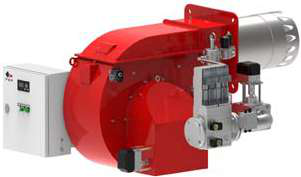
For higher-capacity systems requiring precision, consider FBR HI-GAS P550/M CE TL and FBR HI-GAS P650/M CE TL models, which offer dual-stage modulation that maintains near-optimal air-fuel ratios across their operating range.
Section 3: Emissions Compliance and Environmental Monitoring
Singapore's Emission Standards
The National Environment Agency (NEA) enforces strict emissions limits under the Clean Air Act. Industrial burners in Singapore must meet:
- NOx limits: 200–300 mg/Nm³ depending on burner type and application
- CO limits: Generally <100 mg/Nm³ for proper operation
- Particulate matter: <50 mg/Nm³ for fuel oil burners
- SO₂ limits: Dependent on fuel sulfur content; fuel oil burners must use low-sulfur grades
Non-compliance carries penalties ranging from $5,000 to $20,000 per violation, plus mandatory equipment retrofits.
Monitoring Strategy for Compliance
Quarterly stack testing: Hire certified testing services to measure and document all regulated pollutants. Maintain records for three years. This protects your facility against regulatory audits.
Real-time NOx reduction: For facilities exceeding limits, consider burner upgrades featuring:
- Staged combustion (primary flame produces CO₂/H₂O; secondary flame oxidizes remaining carbon)
- Flue gas recirculation (introduces 10–15% of exhaust back into combustion zone, cooling flame and reducing NOx formation)
- Premix burner designs (pre-blend fuel and air before combustion zone)
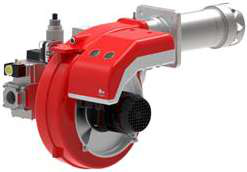
The FBR GAS X3/2 CE-LX4 TL Cl. 4 delivers low-emission performance across its 23–174 kW range with NOx production typically 40–50% below unoptimized burners, making it suitable for compliance-sensitive applications.
Fuel quality verification: For oil burners, confirm your supplier provides fuel meeting EN 590 (diesel) or EN 11015 (heavy fuel oil) standards. Contaminated fuel increases emissions and accelerates nozzle wear.
Section 4: Heat Recovery and System Integration for Maximum Efficiency Gains
Heat Recovery Opportunities
After optimizing burner combustion, capture exiting heat:
Economizers: Install tube-and-shell heat exchangers in the exhaust stream to preheat incoming combustion air or feedwater. A well-sized economizer recovers 3–7% of fuel energy and typically pays for itself within 18–24 months in continuous-duty applications.
Recuperators: Direct flame contact with a ceramic or metal matrix preheats inlet air to 200–400°C, enabling higher flame temperatures and faster heat transfer to the load. Effective for high-temperature furnaces operating above 800°C.
Integration with burner modulation: Use multi-stage burners like the FBR HI-GAS P1500/M CE TL and FBR KN 350/M that automatically adjust thermal output to match actual load. Oversized burners running at part-load waste significant energy through excessive air flow and combustion losses.
System-Level Optimization
- Insulation maintenance: Replace damaged refractory linings and thermal insulation every 5–7 years. In Singapore's humid environment, prioritize moisture barriers to prevent refractory saturation.
- Combustion air supply: Ensure intake is located away from rejected heat sources. Cold, dry air improves combustion efficiency by 1–2% compared to warm, humid air.
- Load profiling: Analyze your thermal demand patterns over 4–8 weeks. If loads vary significantly, a two-burner system (one at partial load, one for peaks) often outperforms a single oversized burner.
Conclusion
Burners and combustion system optimization requires systematic measurement, controlled adjustments, and continuous monitoring. Over 35 years, 3G Electric has supported Singapore's industrial sector through equipment supply and technical guidance. Modern burners like our FBR product range incorporate design features enabling 85–92% efficiency when properly commissioned and maintained.
The financial return on optimization is compelling: a facility consuming 100,000 m³ natural gas annually at current Singapore utility rates can save $8,000–$15,000 annually through a combination of air-fuel tuning, heat recovery, and load matching. Regulatory compliance and equipment longevity provide additional returns.
Begin with a baseline assessment, implement air-fuel ratio optimization, verify emissions compliance, and explore heat recovery opportunities aligned with your facility's operating profile.