Understanding Pumps & Compressors Failure Modes
Pumps & Compressors are mission-critical assets in Singapore's industrial, manufacturing, and HVAC sectors. Yet most maintenance teams lack structured troubleshooting frameworks for the moment systems fail. Over 3G Electric's 35+ years as a global equipment distributor, we've documented that 70% of pump and compressor failures result from preventable causes: inadequate fluid maintenance, improper installation, cavitation, and thermal stress.
Understanding failure modes is essential before you can diagnose problems. Centrifugal pumps typically fail through bearing degradation, seal leakage, and impeller cavitation. Positive displacement pumps (like gear and vane types) fail through volumetric loss, internal leakage, and mechanical wear. Compressors commonly experience valve failure, unloader malfunction, thermal runaway, and moisture accumulation. Each failure mode presents distinct symptoms that guide your diagnostic approach.
The cost of unplanned downtime in Singapore's competitive manufacturing environment reaches SGD 5,000–15,000 per hour for many operations. Implementing rapid troubleshooting protocols reduces emergency repair cycles from days to hours, protecting both equipment and production schedules.
Diagnostic Framework: From Symptom to Root Cause
Step 1: Symptom Recognition and Data Collection
When a Pumps & Compressors system underperforms, begin with systematic observation. Document these critical parameters:
- Flow rate and pressure readings: Compare against nameplate specifications. The Pratissoli KF30 high-performance pump delivers 106 L/min at 200 bar—any deviation signals degradation.
- Abnormal noise patterns: Grinding, squealing, or cavitation noise indicates different root causes requiring distinct remedies.
- Vibration levels: Measure with portable vibration analyzers (ISO 10816 standards). Elevated vibration often precedes catastrophic failure by 2–3 weeks.
- Temperature monitoring: Track discharge fluid temperature. Exceeding 65°C for most industrial pumps signals thermal distress or excessive internal friction.
- Fluid condition: Sample oil/coolant for viscosity, contamination, water content, and acid number. Fluid degradation cascades into seal failure and bearing wear.
- Electrical parameters: Monitor motor current draw, voltage balance, and power factor. Rising current draw indicates mechanical resistance increasing.
Step 2: Decision Tree Methodology
Once you've collected baseline data, follow this structured decision process:
For Low Flow/Pressure Output:
- Is suction pressure within range? If negative, check inlet strainer clogging, cavitation, or suction line leaks.
- Compare volumetric efficiency using {{discharge flow ÷ theoretical displacement × speed}}. Efficiency below 85% indicates internal leakage—worn impellers, damaged seals, or bypass valve creep.
- Test with a known-good fluid sample. Contaminated or degraded fluid causes viscosity breakdown and seal ineffectiveness.
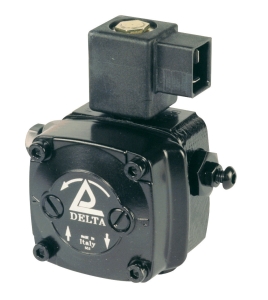
- Consider the Delta VM1 LL 2.4 oil pump as a replacement reference; its 35 L/min specification at 20 bar helps establish performance baselines.
- Cavitation produces distinctive crackling/popping sounds. Verify NPSH (Net Positive Suction Head) availability; if inadequate, increase suction pressure or reduce flow.
- Mechanical looseness creates low-frequency rumble. Inspect shaft couplings, foundation bolts, and bearing housings for movement.
- Bearing wear generates high-frequency squealing. Measure bearing temperature; if >80°C, replace bearings immediately—they're near failure.
- Cavitation damage appears as metal pitting; once visible, pump replacement is often more economical than repair.
- High-pressure systems like the Interpump E1B1614 industrial pump (160 bar, 4.26 kW) naturally run warm. Verify cooling system function first.
- Measure case drain flow and return line backpressure. Excessive backpressure creates internal heating.
- Test relief valve setting with an independent pressure gauge. Stuck relief valves force excessive flow through internal leakage paths.
- Inspect heat exchanger effectiveness. In Singapore's tropical climate, fouling reduces cooling capacity by 30–50% within 6 months without maintenance.
- Monitor oil particle count (ISO 4406 codes). Target ≤17/15/12; anything higher accelerates seal wear by 50× per ISO severity level above target.
- Measure bearing temperature trends. A 10°C rise over baseline signals incipient failure—plan replacement within 2–4 weeks.
- Inspect seal flush/drain lines. Blocked or reversed flush flows destroy seals within days.
- Test shaft runout at bearing locations using dial indicators. Runout >0.05mm requires shaft realignment or replacement.
Emergency Response Protocols and Temporary Repairs
Immediate Actions (First 30 Minutes)
1. Stop the system safely: Engage emergency stops, isolate electrical power, and bleed pressure using manual relief valves.
2. Document the incident: Photograph equipment condition, record all gauge readings, note time of failure, and identify recent operational changes (pressure spikes, temperature shifts, load increases).
3. Inspect for safety hazards: Check for fluid leaks near electrical equipment, hot surfaces, or pressurized lines. Isolate hazardous areas.
4. Notify stakeholders: Alert plant management, quality assurance, and downstream processes of production impact.
Temporary Containment (30 Minutes to 4 Hours)
Fluid leaks: Small seal leaks (drips) can be temporarily managed by:
- Increasing case drain backpressure slightly (5–10 bar) to reduce seal bypass
- Wrapping leak points with absorbent material and sump-draining into collection containers
- Never ignore leaks—they progress exponentially; plan replacement within 24 hours
- Close discharge isolation valves
- Open vent plugs on pump casing
- Fill pump casing with clean fluid matching system specification
- Operate manual hand priming pump if equipped
- Slowly open discharge isolation valve and bleed air from high points
- Monitor flow carefully on startup—inadequate priming causes catastrophic cavitation damage
- Pressure gauge malfunction—install a secondary gauge to verify
- Relief valve chatter—temporarily increase pilot drain backpressure 2–3 bar and retest
- Cavitation—reduce flow 15–20% and increase inlet pressure to restore stability
- Pulsating systems (gear pumps) may require accumulator pre-charge adjustment; reduce pre-charge 10 psi to improve smoothness
Equipment Substitution Strategies
When pump failure requires immediate replacement to restore production, 3G Electric's 35+ years of industry relationships enable rapid equipment sourcing:
- For high-pressure injection applications: The Interpump WS 162 L pump (18 L/min at 160 bar, 5.51 kW) provides proven reliability for manufacturing systems requiring precision pressure control.
- For agricultural and medium-duty applications: The Interpump PUMP AB80 delivers 75 L/min at 60 bar and suits farm and light industrial duty requiring robust durability.
- For precision hydraulic systems: The Pratissoli KF30 provides Italian-engineered performance (106 L/min, 200 bar, 40 kW) meeting demanding industrial specifications across Singapore operations.
Keep compatibility matrices documenting:
- Inlet/outlet connection sizes and thread types
- Displacement and theoretical flow rates
- Pressure ratings and relief valve settings
- Shaft coupling specifications and power requirements
- Fluid type compatibility (mineral oil, synthetic, biodegradable)
Root Cause Analysis and Preventive Strategies
Once emergency response stabilizes the situation, conduct formal root cause analysis to prevent recurrence. Use the "Five Why" methodology:
Example failure sequence:
- Why did the pump lose prime? Suction strainer clogged.
- Why was the strainer clogged? Inlet filter not changed on schedule.
- Why was maintenance skipped? No automated work order system.
- Why no automated system? Maintenance relies on manual scheduling.
- Why not improve scheduling? Root cause found—implement condition-based monitoring.
Implement corrective actions addressing systemic weaknesses:
- Contamination control: Establish fluid sampling intervals (monthly for critical systems). Target ISO 17/15/12 cleanliness. Install high-efficiency return and filler breathers.
- Monitoring automation: Deploy pressure and temperature sensors feeding SCADA systems. Configure alerts 10% below failure thresholds.
- Seal and bearing management: Establish replacement intervals based on operating hours and duty cycles, not calendar time. High-pressure systems (>150 bar) require seal replacement every 12–18 months.
- Operator training: Educate operators on normal operating ranges for pressure, flow, temperature, and noise. Empower them to stop systems showing abnormal behavior.
- Maintenance planning: Schedule major maintenance during low-production periods. Maintain spare bearing and seal kits on-site for rapid field replacement.
- Fluid management program: Rotate fluid analysis results into predictive maintenance models. Use trending data to forecast seal wear and plan replacements before failures occur.
Singapore's competitive manufacturing environment rewards proactive maintenance planning. Systems operating continuously (24/7 production) require quarterly condition assessment and semi-annual preventive component replacement. Systems with seasonal or variable duty can extend intervals to semi-annual reviews.
Leveraging 3G Electric's Technical Support
With more than 35 years supplying industrial equipment globally, 3G Electric maintains technical databases covering pump and compressor specifications across manufacturers. When emergency troubleshooting reaches critical decision points, 3G Electric's team provides:
- Cross-reference documentation matching legacy equipment to modern alternatives
- Performance specification validation ensuring replacement units match system duty
- Supply chain access for rapid parts delivery across Singapore and Southeast Asia
- Technical consultation on application-specific challenges
Maintenance teams facing unfamiliar equipment, ambiguous failure modes, or urgent replacement decisions benefit from direct consultation with 3G Electric's technical staff.