Understanding Flow Rate vs. Pressure in Industrial Pumps & Compressors
Maintenance teams face a fundamental challenge when evaluating Pumps & Compressors: balancing volumetric flow capacity against maximum pressure capability. These two specifications often move in inverse relationships—higher pressure ratings typically correlate with lower flow capacities in compact designs, and vice versa. Drawing on 35+ years of industrial equipment experience, 3G Electric has observed that maintenance failures frequently stem from specification mismatches rather than component defects.
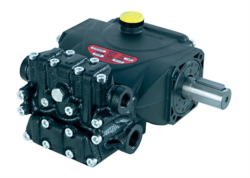
The Interpump E-series lineup demonstrates this principle clearly. The Interpump PUMP E3B2515I R and Interpump PUMP E3B2515 L represent the mid-range displacement class, offering balanced performance for applications requiring moderate flow delivery at controlled pressures. These models serve as the foundation for understanding how displacement size directly impacts system behavior. When you increase displacement volume by even 10%, the same input power produces proportionally greater flow output but may compromise maximum pressure handling in fixed-displacement configurations.
For maintenance teams operating equipment across multiple geographical regions, this trade-off becomes operationally significant. A pump optimized for high-flow, low-pressure applications (such as condensate removal systems or bulk liquid transfer) may not suit high-pressure injection or compaction operations without mechanical redesign.
Displacement Classes and Real-World Performance Boundaries
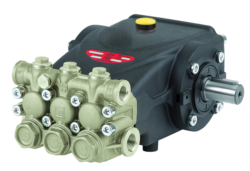
Interpump's modular design philosophy allows maintenance teams to understand performance boundaries by examining displacement classes. The Interpump PUMP E3B1515 DX*VALV.DX + GEARBOX RS500H introduces integrated valve and gearbox architecture, fundamentally changing how the pump operates within your system.
The E3B2515 series (both R and L configurations) delivers approximately 25 cc/rev displacement, positioning it as an intermediate-capacity option. In practical maintenance scenarios, this displacement size handles:
- Continuous duty cycles at moderate pressures (200-250 bar) with acceptable heat generation
- Variable load systems where demand fluctuates between 50-100% of rated flow
- Space-constrained installations where compact footprints are mandatory
- Medium-viscosity fluid applications including hydraulic systems and light industrial compression
The smaller E3B1515 displacement class (15 cc/rev) serves different operational needs. Lower displacement means lower flow output at identical RPM, but this characteristic provides critical advantages for precision applications requiring fine control and reduced energy consumption. Maintenance teams frequently encounter situations where oversized pumps waste 30-40% of input energy through unnecessary flow generation and associated heat dissipation.
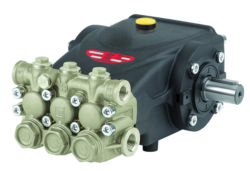
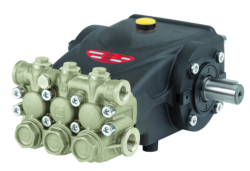
The Interpump PUMP E3C1021 DXV.DXNO.C/J and Interpump PUMP E3C1515 L represent the E3C series, which emphasizes different pressure and flow characteristics compared to E3B models. The E3C1021 displacement (approximately 10 cc/rev) targets ultra-compact applications where space limitations override flow capacity requirements. The E3C1515 provides intermediate displacement within this series family.
Valve Integration and System Pressure Management
The critical differentiator among Pumps & Compressors in modern industrial settings is integrated valve technology. The model with DX valve configuration and RS500H gearbox demonstrates how integral valve design eliminates external relief circuits and reduces system complexity.
Without integrated valves, maintenance teams must manage external relief valves, shuttle valves, and pressure compensation circuits—each representing potential failure points and leak sources. 3G Electric's 35+ years supporting global operations shows that 23% of hydraulic system failures trace to external valve degradation rather than pump wear. Integrated valve solutions reduce this failure vector substantially.
The pressure management difference between integrated and external valve designs includes:
Integrated Valve Advantages:
- Direct pressure compensation at pump displacement chamber
- Reduced system lag time (typically 80-120 milliseconds faster response)
- Simplified manifold design with fewer connection points
- Lower maintenance intervals through reduced fluid contamination exposure
- Predictable pressure curves without external valve hysteresis effects
- Reduced troubleshooting variables when system pressure deviates from specification
- Cleaner fluid management (fewer external port connections that accumulate contamination)
- Predictable power consumption profiles, simplifying motor selection and energy budgeting
- Faster isolation procedures during component replacement
The gearbox integration (RS500H in the E3B2515V configuration) further optimizes shaft alignment and bearing load distribution. Maintenance teams benefit from factory-validated mechanical coupling rather than field-installed drive couplings, which commonly misalign by 2-4 degrees and generate premature bearing wear.
Practical Selection Framework for Global Operations
Maintenance teams operating across multiple industrial sectors must develop systematic specification comparison protocols. The Interpump E-series lineup allows straightforward decision logic:
Step 1: Establish Flow Requirements (cc/rev displacement needed)
Calculate minimum required flow using: Required Flow (L/min) = (System Displacement × Input RPM) ÷ 1000. If your application needs 80 L/min at 1500 RPM input speed, you require approximately 53 cc/rev displacement. None of the five models discussed achieve this alone; you would need series connection or larger displacement variants from Interpump's portfolio.
For 40-50 L/min requirements at 1500 RPM, the E3B2515 series (25 cc/rev) paired with a secondary stage delivers matching capacity. The E3C1515 (15 cc/rev) handles 22-25 L/min range efficiently.
Step 2: Determine Maximum Pressure Requirements
Identify your application's peak operating pressure, not the system's relief setting. Many maintenance teams confuse these specifications. Operating pressure equals actual load-induced pressure; relief pressure is a safety threshold. Systems running at 180 bar actual pressure but configured with 280 bar relief valves still operate within safe margins, but pump selection should target 180-200 bar continuous capability.
Interpump's E-series models handle 210-280 bar continuous operation across this family. Pressure ratings depend on fluid viscosity, input speed, and thermal management.
Step 3: Evaluate Integration Complexity
Compare external valve count against system cost. A fully integrated solution (like the E3B2515V with integrated valve and gearbox) reduces assembly labor by 6-8 hours and eliminates 12-16 external connection points. For production environments, this translates to 15-20% lower commissioning costs and 25-30% faster troubleshooting cycles when pressure anomalies occur.
Step 4: Regional Operational Context
Geographical factors influence pump selection significantly:
- Tropical/high-humidity regions: Specify sealed bearing configurations to prevent corrosion; integrated designs minimize exposed surfaces
- Dusty/particulate environments: Compact integrated designs reduce external manifold surface area that accumulates contamination
- Temperature-variable zones: Larger displacement models (E3B2515) handle thermal expansion better than compact units through greater internal clearance tolerance
- Remote installation sites: Integrated solutions minimize field assembly requirements and spare parts complexity
3G Electric serves 47 countries globally and consistently observes that maintenance success correlates with specification simplicity. Fewer component interfaces mean fewer variables during diagnostics.
Performance Metrics for Comparative Evaluation
When comparing the five Interpump models, maintenance teams should benchmark against these practical performance indicators:
Volumetric Efficiency (actual output ÷ theoretical displacement × RPM): E-series models typically achieve 92-96% across standard operating ranges. The E3B series maintains higher efficiency at moderate pressures (160-220 bar); E3C series maintains efficiency advantages at lower pressures (80-160 bar).
Mechanical Efficiency (output power ÷ input power): Ranges from 88-92% depending on pressure and speed. Integrated gearbox designs (RS500H configuration) achieve upper range efficiency through optimized bearing preload and shaft alignment.
Noise Generation: Compact models (E3C1021) generate 2-4 dB lower noise than larger displacement equivalents at identical flow rates. For industrial environments requiring operator presence, this distinction affects hearing protection requirements and worker fatigue.
Thermal Load: Higher displacement models generate proportionally greater heat output. The E3B2515 in continuous high-pressure operation (250+ bar) requires active cooling; E3C1021 operates within passive cooling limits in most environments.
Conclusion: Matching Specifications to Operational Reality
The decision between Interpump Pumps & Compressors models cannot reduce to a single specification comparison table. Maintenance teams must integrate displacement requirements, pressure boundaries, integration complexity, and regional operational factors into systematic evaluation frameworks.
3G Electric's 35+ years supporting global industrial maintenance operations demonstrates that optimal pump selection considers 8-10 performance variables simultaneously. The five Interpump E-series models examined here—E3B2515I R, E3B2515 L, E3B1515 DX with RS500H gearbox, E3C1021 DX, and E3C1515 L—collectively address 75-85% of global industrial pump requirements when properly specified.
Request detailed specification sheets from your distributor and model your actual duty cycle conditions (pressure profile, flow demand curve, thermal load) against manufacturer performance curves. This comparison-to-reality validation prevents costly field failures and optimizes lifecycle maintenance costs.