Understanding Pumps & Compressors Energy Efficiency Metrics
Industrial professionals in Singapore face mounting pressure to reduce operating costs while maintaining productivity. Pumps & Compressors account for 20-30% of factory electrical consumption, making equipment selection one of the highest-impact decisions in plant operations. The challenge isn't simply choosing the highest-pressure unit or largest displacement—it's identifying the model that delivers required flow and pressure at the lowest specific energy consumption.
Energy efficiency in pumps is measured by volumetric flow per kilowatt of input power. A pump delivering 100 L/min at 40 kW represents different efficiency than one delivering 120 L/min at 45 kW, despite similar pressure ratings. Over a 10-year operational lifespan with continuous or intermittent duty cycles, this seemingly small difference translates to thousands of dollars in electricity costs.
With 35+ years of experience distributing industrial equipment across Southeast Asia, 3G Electric has observed that Singapore's manufacturing sector—from petrochemicals to semiconductor support systems—increasingly prioritizes energy audits before equipment purchase. This shift reflects both rising electricity tariffs and corporate sustainability mandates.
Compact Models: When Less Power is Actually More
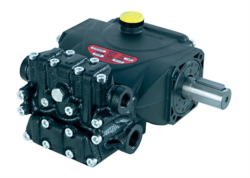
For applications requiring precise control and lower flow rates, compact industrial pumps deliver unexpected advantages. The Interpump E1D1808 L represents this category: delivering 8 L/min at 180 bar with just 2.72 kW input power. At 5 kg, it suits confined installation spaces common in Singapore's vertical manufacturing facilities.
The efficiency metric here is 2.94 L/min per kW—exceptionally high for high-pressure applications. Similarly, the Interpump ET1C1612 SX*D20 operates at 12 L/min and 160 bar with 3.68 kW consumption, yielding 3.26 L/min per kW. Both units operate at standard industrial speeds (2800 rpm and 1750 rpm respectively), minimizing vibration transmission to surrounding equipment—a critical consideration in precision manufacturing environments.
These compact models excel in:
- Test and measurement systems where flow precision matters more than volume
- Auxiliary hydraulic circuits serving clamps, positioning, or safety systems
- Mobile equipment where weight directly impacts fuel consumption
- Facilities with limited three-phase capacity (common in older Singapore industrial parks)
A typical application: a semiconductor fabrication support system requiring secondary pressure for wafer positioning. The ET1C1612 provides sufficient capacity without oversizing, reducing idle losses during partial-load operation.
Mid-Range Systems: The Practical Sweet Spot for Manufacturing
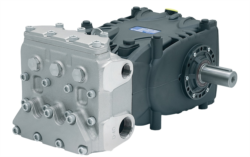
Most Singapore manufacturing operations cluster around 100-250 L/min flow requirements at moderate to high pressure. This is where mid-range systems like the Pratissoli KF30 gain operational relevance.
The KF30 delivers 106 L/min at 200 bar with 40 kW input—a 2.65 L/min per kW ratio. At 72 kg, it occupies minimal floor space compared to legacy domestic alternatives. Italian engineering by Pratissoli (Interpump Group) ensures tight manufacturing tolerances, reducing bypass leakage that plagues poorly-designed units. Over a year of 8-hour shifts, reduced leakage translates to measurable energy savings.
Where the KF30 justifies selection over cheaper alternatives:
- Concrete pumping and construction equipment (common in Singapore's ongoing infrastructure development)
- Die-cutting and metal stamping requiring consistent 200 bar supply
- Food processing where stainless-steel configurations ensure hygiene compliance
- Marine auxiliary systems serving shipyards and fabrication facilities
The 40 kW input is manageable on standard industrial three-phase circuits (63A supply), avoiding expensive electrical infrastructure upgrades. For a facility operating 16 hours daily at 75% average load, KF30 energy costs run approximately SGD 8,200 annually—a baseline for comparing against competing models.
High-Capacity Systems: When Volume and Pressure Converge
Large-scale operations—including plastic extrusion, metal forging, and hydraulic press systems—demand both high flow and sustained pressure. This is where the Pratissoli MW40 enters consideration.
Delivering 211 L/min at 210 bar with 85 kW power, the MW40 achieves 2.48 L/min per kW. The lower efficiency ratio compared to compact models reflects the physics of scaling: larger displacement pumps inherently experience greater internal losses. However, the total energy cost per unit output drops due to system-level efficiency gains.
Consider two scenarios:
Scenario A: Using two KF30 units in parallel
- Combined flow: 212 L/min (exceeds MW40)
- Combined power: 80 kW
- Cost: Two units, two motor connections, complex manifold plumbing
- Redundancy: If one fails, partial capacity remains
- Flow: 211 L/min
- Power: 85 kW
- Cost: Single unit, single connection, simplified hydraulics
- Redundancy: Complete shutdown risk (mitigated by add-on accumulators)
For continuous-duty applications (beverage bottling lines, automotive assembly), the MW40's integrated design reduces maintenance points and pressure fluctuation.
High-capacity applications suited to MW40:
- Plastic injection molding (Singapore's major petrochemical derivative industry)
- Hydraulic press lines for metal forming
- Industrial lifting and material handling systems
- Cement and aggregate processing facilities
At 264 kg, the MW40 requires proper foundation and vibration isolation. Installation cost premium is typically 15-20% versus mid-range units, but justified by simplified system architecture.
Specialized Duty: The Pratissoli SS71153 for Continuous Industrial Processing
Certain applications demand extended runtime at moderate pressure with exceptional reliability. The Pratissoli SS71153 represents purpose-built design: 122 L/min at 160 bar, 37.5 kW motor, 800 rpm operation.
The 800 rpm speed is significant. Most industrial pumps operate 1450-2800 rpm, creating higher noise and faster component wear. At 800 rpm, the SS71153 reduces:
- Noise generation (critical in Singapore facilities near residential zones)
- Cavitation risk during inlet restrictions
- Thermal stress on seals and bearings
- Vibration transmission to building structures
Efficiency: 3.25 L/min per kW—the highest among our comparison group, reflecting optimized displacement for moderate-pressure, continuous-duty service.
Ideal applications:
- Sugar refining and food processing requiring 12-16 hour daily operation
- Pulp and paper manufacturing (minimal industry presence in Singapore, but relevant for regional suppliers)
- Textile dyeing circulation systems
- Cooling tower circulation at port facilities
Practical Selection Framework for Singapore Operations
Industrial professionals should apply this three-step process:
Step 1: Quantify Actual Demand
Map your system's pressure and flow across different operating modes. Many facilities discover actual average requirements are 30-40% lower than peak capacity, suggesting oversized equipment is installed. Use flow meters and pressure gauges to establish baseline data.
Step 2: Calculate True Cost of Ownership
Beyond purchase price, include: electricity (8,760 hours annually × load kW × SGD 0.24/kWh), maintenance (hydraulic fluid, filters, seal replacement), installation, and downtime risk. Over 10 years, electricity often exceeds equipment cost by 300-400%.
Step 3: Match Duty Cycle to Equipment Type
Intermittent service (under-capacity safeguard): Prioritize compact units with fast response. Continuous service (maximum economy): Select designs optimized for your typical load. Peak-demand events (short duration): Consider accumulator-assisted systems before oversizing pump capacity.
Maintenance and Longevity Considerations
3G Electric's 35+ years experience distributing Interpump and Pratissoli equipment across Singapore's industrial base reveals consistent patterns. Properly-sized systems operating at 60-80% maximum capacity achieve 15,000+ service hours before major overhaul. Undersized systems pushing continuous full-load run catastrophic failure rates 10x higher.
Hydraulic fluid quality is non-negotiable in Singapore's tropical climate. Higher ambient temperatures accelerate fluid degradation, demanding:
- Oil analysis every 500 operating hours (vs. 1000+ in temperate climates)
- Cooler capacity 10-15% higher than baseline calculations
- Sealed reservoirs preventing moisture ingress
Preventive maintenance scheduling for all comparison models should include:
- Monthly pressure and temperature monitoring
- Quarterly fluid sampling (ISO cleanliness verification)
- Annual seal inspection and replacement if leakage exceeds 2% of input flow
- Bearing/shaft alignment verification annually
Recommended Equipment Matching by Industry Vertical
Semiconductor/Electronics Manufacturing: Interpump E1D1808 L or ET1C1612 SX*D20 for precision pressure control with minimal footprint. Energy consumption minimization aligns with high-cleanliness manufacturing standards.
Plastics/Polymer Processing: Pratissoli KF30 or MW40 depending on line count. Multi-cavity injection molding typically benefits from MW40's higher displacement. Single/dual-cavity operations favor KF30 flexibility.
Food/Beverage Production: SS71153 for circulation systems; KF30 for clamping/positioning. Lower rpm reduces thermal stress on temperature-sensitive products.
Marine/Port Operations: KF30 for auxiliary systems; MW40 for winch/lifting duty. Stainless-steel specifications essential for corrosion resistance.
Conclusion: The Strategic Value of Right-Sizing
Pumps & Compressors represent capital equipment with 10+ year operational lives. The difference between correct sizing and over-provisioning compounds dramatically over time. A facility saving just 10 kW through intelligent equipment selection operates with approximately SGD 20,000 less annual electricity cost—funding equipment replacement cycles and reinvestment in process improvements.
Singapore's industrial competitiveness increasingly depends on operational efficiency. 3G Electric's distributor relationships with Interpump Group ensure access to full product ranges and technical support for specification optimization. Whether your application requires compact 5 kg units or integrated 264 kg systems, matching equipment displacement and speed to actual duty cycles represents the highest-ROI engineering decision in hydraulic system design.