Introduction: Understanding Cavitation in Pumps & Compressors
Pumps and compressors operate across a spectrum of pressures, temperatures, and flow regimes. Among the most destructive yet preventable failures is cavitation—the formation and collapse of vapor bubbles within the fluid stream. When these bubbles implode near pump surfaces, they release shockwaves that erode metal, degrade seals, and trigger catastrophic component failure.
With over 35 years of experience distributing industrial equipment to Southeast Asian operations, 3G Electric has observed that cavitation-related downtime accounts for 15–25% of preventable pump failures in tropical environments. Procurement engineers in Singapore often overlook cavitation risk during equipment selection, focusing instead on rated pressure and flow capacity. This article addresses the technical mechanisms, specification strategies, and product selection criteria that prevent cavitation damage before it starts.
Section 1: Cavitation Mechanics and Risk Factors in High-Pressure Systems
What Triggers Cavitation?
Cavitation occurs when the absolute pressure within a pump's inlet or discharge path drops below the vapor pressure of the working fluid. When pressure falls below this threshold, dissolved gases and fluid molecules vaporize, forming bubbles. As these bubbles move into higher-pressure zones, they collapse violently, creating microjets and shockwaves that pit and erode pump internals.
The risk is heightened in specific operational conditions:
- Inlet starvation: Insufficient suction head or clogged inlet filters reduce inlet pressure below vapor pressure.
- High-speed operation: Rotational speeds above 1800 rpm increase local velocity and pressure drops across impeller vanes.
- Elevated fluid temperature: Higher temperatures lower fluid viscosity and increase vapor pressure, narrowing the margin to cavitation onset.
- Low system pressure relief: Systems operating near minimum rated pressures experience larger local pressure fluctuations.
- Inadequate system priming: Air in inlet lines reduces effective pressure transmission to pump inlets.
For procurement engineers, these factors mean that a pump rated at 160–210 bar with nominal flow capacity may still cavitate if inlet conditions, fluid temperature, or rotational speed are not carefully managed.
Vapor Pressure and Fluid Selection
Different hydraulic fluids have different vapor pressures. Mineral-based ISO 46 fluids commonly used in Singapore industrial applications have vapor pressures around 0.001–0.1 bar at 20°C, but this rises significantly at elevated temperatures. In tropical environments where ambient temperatures regularly exceed 30°C, and compressor discharge oils reach 60–80°C, vapor pressure can double or triple.
The practical implication: a pump selected for 40°C operation may cavitate when fluid temperature rises to 60°C in a fully loaded system. This is why fluid cooling and thermal load matching (covered in thermal management literature) intersect directly with cavitation prevention.
Section 2: Inlet Conditions and System Architecture for Cavitation Prevention
Net Positive Suction Head (NPSH) Fundamentals
NPSH is the critical metric for preventing inlet cavitation. It represents the absolute pressure available at the pump inlet above the fluid's vapor pressure.
NPSH Available (NPSHa) is determined by system design:
NPSHa = (Patm − Pvapor) + (ρ × g × h) − hf
Where:
- Patm = atmospheric pressure at sea level (101.325 kPa)
- Pvapor = fluid vapor pressure at operating temperature
- ρ × g × h = hydrostatic pressure from fluid column height
- hf = friction losses in inlet line
Rule of thumb for procurement: NPSHa must exceed NPSHr by at least 0.5 bar safety margin. In tropical applications, where fluid temperatures are higher and vapor pressure increases, this margin should be increased to 1.0 bar minimum.
Practical Inlet Design for Singapore Industrial Operations
For procurement engineers specifying pump systems in Singapore's warm, humid environment:
1. Suction line sizing: Inlet pipe diameter should be selected to maintain inlet velocity below 0.6 m/s for oil systems. Higher velocities increase friction loss (hf), which directly reduces NPSHa.
2. Reservoir height and location: Elevating the reservoir above the pump inlet provides positive hydrostatic head. In ground-level installations, this head is lost. Specification should mandate minimum 1.5 m elevation differential for high-speed pumps.
3. Filter selection and maintenance: Inlet strainers or filters create backpressure. High-efficiency filters can reduce NPSHa by 0.3–0.8 bar when partially clogged. Maintenance contracts must specify filter change intervals based on fluid contamination rates.
4. Inlet line insulation and cooling: In high-ambient environments, insulating inlet lines reduces fluid temperature rise during suction phase. Alternatively, specifying a cooled reservoir (not just cooled discharge) maintains lower vapor pressure.
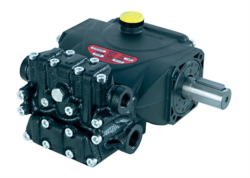
The compact Interpump E1D1808 L (8 L/min, 180 bar, 2.72 kW, 2800 rpm) is particularly vulnerable to inlet starvation due to its high rotational speed. Procurement specifications must emphasize inlet geometry optimization before ordering these high-speed units.
Section 3: Detection, Monitoring, and Compressor-Specific Cavitation Modes
Acoustic and Vibration Signatures
Cavitation produces distinctive acoustic signatures—a rough grinding or crackling noise distinguishable from normal pump operation. Procurement engineers should require baseline vibration and noise measurements at commissioning, then establish monitoring protocols for early detection.
Modern condition monitoring uses:
- Ultrasonic sensors to detect bubble collapse frequencies (typically 20 kHz–100 kHz), which are masked by low-frequency pump noise but reveal cavitation onset.
- Accelerometers on pump housing to capture burst energy from imploding bubbles.
- Temperature sensing at pump discharge to detect cavitation-induced heat generation (cavitation collapses generate local temperatures exceeding 1000 K).
Compressor-Specific Cavitation Dynamics
While centrifugal pumps cavitate at inlet, rotary screw compressors experience cavitation during fluid injection cooling (if present). Cavitation in compressor discharge lines occurs when:
- Discharge pressure oscillations from valve flutter dip below vapor pressure temporarily.
- High-speed rotors (3600–5000 rpm) induce local pressure drops in discharge passages.
- Thermostatic expansion valves create throttling and pressure drops without corresponding velocity reduction.
For compressor procurement, this means discharge line design requires careful attention to backpressure stability. Specifications should define maximum allowable discharge line resistance and require pressure-pulsation analysis for variable-displacement or load-unload compressors.
Monitoring Best Practices
Procurement engineers should require vendors to:
1. Provide cavitation coefficient (σ) curves showing pressure margin requirements at various speeds and flows.
2. Include NPSH requirement documentation with sensitivity to temperature and viscosity changes.
3. Specify recommended inlet and discharge line configurations in installation manuals, not just general guidelines.
4. Supply baseline acoustic and vibration signatures from factory testing so field comparisons are valid.
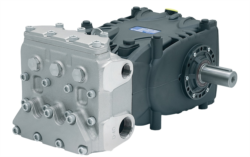
The Pratissoli SS71153 (122 L/min, 160 bar, 37.5 kW, 800 rpm) operates at lower rotational speed, providing inherent cavitation resistance. Conversely, Interpump ET1C1612 SX*D20 (12 L/min, 160 bar, 3.68 kW, 1750 rpm) requires conservative inlet design due to 1750 rpm operation.
Section 4: Specification Strategy and Total Cost of Ownership Impact
Selecting Cavitation-Resistant Equipment Architectures
Procurement engineers face a trade-off between performance density and cavitation robustness:
High-speed units (1750–2800 rpm) deliver higher flow-to-displacement ratios and compact footprints, but demand stricter inlet conditions.
Low-speed units (800–1200 rpm) tolerate inlet starvation better and are more forgiving in harsh environments, but require larger displacement or higher power input for equivalent flow.
In tropical Singapore operations with variable load conditions and inconsistent maintenance, specifying lower-speed pumps often provides better lifecycle economics despite higher initial cost.
Life-Cycle Impact of Cavitation Damage
Unchecked cavitation causes:
- Impeller pitting and erosion: Reduces flow capacity by 5–15% annually until replacement (typically 2–3 years).
- Seal degradation: Cavitation-induced vibration stresses dynamic seals; replacement intervals shrink from 3 years to 1 year.
- System contamination: Erosion debris increases fluid contamination, triggering accelerated wear in motors, valves, and accumulators.
- Unplanned downtime: Sudden cavitation-induced failure halts production; average Singapore industrial downtime costs exceed SGD 2,000–5,000/hour.
The ROI for investing in proper inlet design, fluid cooling, and condition monitoring typically exceeds 300% over a 5-year equipment lifecycle.
Procurement Checklist for Cavitation Prevention
When specifying pumps and compressors through 3G Electric or other distributors:
- Request NPSH curves at minimum, nominal, and maximum flow conditions.
- Specify inlet line diameter and material explicitly in purchase orders; don't rely on vendor defaults.
- Mandate factory cavitation testing or acceptance test under simulated tropical ambient (35°C, 85% RH) before shipping.
- Include baseline vibration and acoustic signatures in commissioning documentation.
- Require maintenance intervals tied to fluid contamination levels, not just calendar time.
- Establish quarterly condition-monitoring program using ultrasonic detection to identify cavitation onset within first 6 months of operation.
Conclusion
Cavitation remains the least-understood cause of pump and compressor failures in tropical industrial operations. Procurement engineers who move beyond simple pressure and flow specification to address inlet conditions, fluid temperature, and rotational speed dynamics can extend equipment life from 3–5 years to 7–10 years—a 40–50% improvement in total cost of ownership.
3G Electric's 35+ years of experience in the region demonstrates that early-stage cavitation prevention through proper specification is far more cost-effective than reactive replacement strategies. By applying NPSH analysis, selecting appropriate pump speed classes, and implementing condition monitoring, procurement teams reduce both capital expenditure and operational risk.