Pump Pressure & Flow Rate Optimization: Matching Industrial Specifications to Singapore Operations
Selecting the correct pump for Singapore's demanding industrial environment requires more than checking model numbers—it demands a systematic understanding of how pressure, flow rate, and power consumption interact across real-world operating conditions. Maintenance teams and service engineers face constant challenges: equipment underperforming in high-humidity coastal environments, pressure spikes during peak operational hours, and unexpected downtime due to specification mismatches. This technical guide breaks down the critical relationship between pump pressure ratings, volumetric flow output, and power requirements, equipping you with practical frameworks to evaluate, select, and optimize pump systems that deliver consistent performance. We'll examine real industrial pump specifications, explore selection criteria backed by technical data, and demonstrate how to match equipment to specific operational demands across Singapore's diverse manufacturing, petrochemical, and facilities management sectors.
Understanding Pressure & Flow Rate Fundamentals in Industrial Pump Selection
The foundation of effective pump selection lies in understanding two interconnected hydraulic principles: operating pressure and volumetric flow rate. Pressure (measured in bar, MPa, or PSI) represents the force the pump generates per unit area, determining the pump's ability to overcome system resistance and drive fluid through restrictive passages. Flow rate (measured in litres per minute or gallons per minute) quantifies how much fluid the pump delivers per unit time—a critical factor in cycle speed, production throughput, and system efficiency.
In Singapore's industrial context, these parameters must be evaluated against real operational constraints. Tropical humidity and salt-air corrosion accelerate component degradation, while 24/7 production schedules demand pumps operating at sustained high pressures without degradation. The relationship between pressure and flow creates a fundamental trade-off: increasing pressure typically reduces flow capacity at a given power input, while maximizing flow often requires sacrificing maximum pressure capability.
Power consumption emerges as the third critical variable linking pressure and flow. Hydraulic power (measured in kilowatts or horsepower) is calculated as the product of pressure and flow: Power = Pressure × Flow ÷ 600 (when pressure is in bar and flow in L/min). This means that selecting a pump rated for 250 bar at 15 L/min requires substantially more power than a 100 bar pump at 21 L/min, even though the latter delivers greater volumetric output. Understanding these relationships enables maintenance engineers to assess whether available motor infrastructure can support specified pump duty, avoiding costly upgrades or performance shortfalls.
Real-World Pump Specifications: Pressure Classes and Performance Comparison
Industrial pumps operate across distinct pressure classes, each suited to specific applications. Entry-level systems typically operate between 90–150 bar, ideal for general circulation, cooling applications, and low-resistance transfer duties. Mid-range industrial systems operate at 200–300 bar, supporting precision machining, industrial washing, and moderate-pressure hydraulic systems. High-pressure specialist applications demand 400+ bar, reserved for cutting-edge machining, water jet systems, and extreme-duty industrial processes.
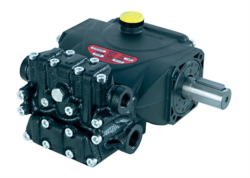
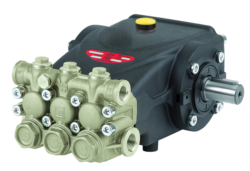
The Interpump PUMP E3C1021 DX exemplifies entry-level industrial pumping, delivering 21 L/min at 100 bar pressure with a 5.5 hp (4.04 kW) motor. This configuration suits circulation duties and moderate-flow applications where pressure demands remain constrained. The rotational speed of 1750 rpm reflects a slower, more efficient operation typical of entry-level systems, minimizing mechanical stress and extending component life in 24/7 Singapore operations.
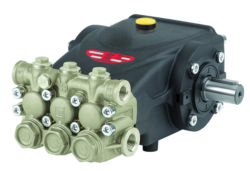
Mid-range systems, represented by the Interpump PUMP E3C1515 L, operate at 150 bar while maintaining 15 L/min flow at 5.8 hp (4.26 kW)—a balanced configuration suitable for precision industrial cleaning, moderate hydraulic applications, and sustained production environments. The identical 265 mm frame dimensions and 1750 rpm operation indicate compatibility with standard motor mounting while maintaining conservative component loading.
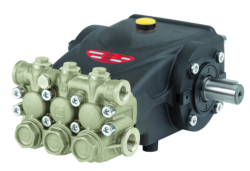
High-pressure industrial applications rely on systems like the Interpump PUMP E3B2515I R, which delivers 250 bar at 15 L/min using 9.7 hp (7.13 kW)—nearly double the power consumption of the E3C1515, reflecting the energy intensity of high-pressure operations. The elevated 3400 rpm rotation regime increases throughput and pressure generation, though at the cost of higher mechanical wear in tropical industrial environments. Engineers selecting this class must verify motor availability, cooling infrastructure, and maintenance schedules to sustain performance across Singapore's demanding operational tempo.
Real-World Application Scenarios: Matching Specifications to Singapore Industrial Sectors
Singapore's petrochemical and manufacturing clusters present diverse pumping demands that exemplify specification-matching challenges. Consider a precision automotive machining facility requiring coolant circulation at high flow volume but moderate pressure. The Interpump E3C1021 at 21 L/min / 100 bar delivers sufficient flow for effective coolant distribution across multiple spindles while respecting electrical infrastructure designed for 5.5 hp motors. The conservative 100 bar pressure ensures compatibility with standard coolant system hoses and fittings, reducing capital expenditure on system upgrades.
Contrast this with a food processing facility requiring high-pressure sanitary washing systems. Here, the Interpump E3C1218 R at 120 bar / 18 L/min represents an optimized middle ground—sufficient pressure to strip residues from equipment surfaces while maintaining flow rates that justify installation across multiple wash stations. The 5.7 hp requirement fits standard facility electrical distribution, and the 1750 rpm operation minimizes mechanical stress during extended daily washing cycles.
High-pressure industrial cutting or surface treatment applications—increasingly common in Singapore's advanced manufacturing sector—demand systems like the Interpump PUMP E3B2515 L at 250 bar. This specification enables precise material cutting, deep-surface treatment, and specialized hydraulic applications where system pressure directly correlates with cutting quality and production speed. The 250 bar rating represents a critical threshold: exceeding it requires specialized hose, manifold, and valve infrastructure; falling short compromises cutting precision and throughput.
Selection Criteria: Engineering the Optimal Specification Match
Step 1: Define System Pressure Requirement – Identify the minimum pressure needed to overcome system resistance (line friction, manifold pressure drops, load resistance). Add 10–15% safety margin and verify this against available pump pressure ratings. Document pressure variations during peak vs. idle conditions.
Step 2: Calculate Required Flow Rate – Determine cycle time requirements and multiply by component chamber volumes or system displacement. Account for multiple simultaneous operations. For example, if five workstations each require 3 L/min circulation, specify a pump delivering ≥15 L/min minimum.
Step 3: Verify Power Availability – Calculate power requirement using the formula above. Confirm facility electrical infrastructure supports motor sizes required. In Singapore's industrial estates, 7–10 kW motors are standard; higher ratings require advance notification to utilities.
Step 4: Assess Operating Environment – Tropical humidity, salt corrosion near coastal zones, and temperature fluctuations demand corrosion-resistant materials and more frequent maintenance. Specify stainless steel or nickel-plated components for extended life. Plan quarterly maintenance intervals rather than annual schedules typical in temperate climates.
Step 5: Evaluate Control & Monitoring Needs – Select pumps compatible with pressure transducers, flow meters, and alarm systems. The Interpump E3B1515 DX with integral valve and gearbox exemplifies integrated control architecture, reducing custom integration work and potential leak points.
Optimizing Pump Selection for Singapore's Industrial Environment
Beyond base specification selection, several optimization strategies enhance reliability and operational continuity. Implement redundant pressure monitoring with local gauges and remote telemetry—Singapore's industrial estates experience occasional power anomalies that trigger unexpected pressure swings. Specify pumps with integral pressure relief valves or compatible valve manifolds to prevent over-pressure transients during emergency shutdowns.
Temperature management becomes critical in high-pressure systems; elevated ambient temperatures in tropical environments can reduce hydraulic fluid viscosity, affecting pump efficiency. Specify cooling circuits or heat exchangers when pump duty cycles exceed 4 hours continuous operation. Document fluid change intervals—Singapore's humidity accelerates water absorption in hydraulic oils, necessitating more frequent fluid analysis and replacement than mainland facilities.
Finally, establish relationships with local distributors like 3G Electric who maintain spare parts inventory specific to Singapore's dominant industrial pump models. Downtime in automotive or petrochemical production costs thousands per hour; local parts availability and rapid technical support directly impact operational profitability.
Connecting Technical Specification to Maintenance & Long-Term Performance
Optimal pump performance extends beyond initial selection—it requires disciplined maintenance aligned with technical specifications. Maintenance teams should establish baseline pressure and flow readings immediately after commissioning, documenting these metrics monthly to detect gradual degradation. Pressure decline below specification indicates seal wear; flow reduction suggests internal leakage or cavitation. Both signal imminent failure and enable planned replacement before catastrophic breakdown.
Pressure gauge selection warrants equal attention. Specify gauges rated for 1.3× maximum system pressure (e.g., 0–400 bar gauge for a 300 bar system) to ensure readable accuracy across the operating range. In Singapore's corrosive environment, glycerin-filled gauges resist humidity-induced pointer lag and salt creep better than oil-filled alternatives.
Singapore's leading industrial pump specialists offer comprehensive technical support for pressure and flow optimization. Whether you're evaluating a new installation, troubleshooting existing underperformance, or planning major system upgrades, contact 3G Electric's technical team to access detailed specification analysis, on-site assessment, and performance modeling tailored to your specific operational demands. With three decades' experience serving Singapore's manufacturing, petrochemical, and facilities sectors, 3G Electric provides not just equipment—but engineered solutions matched to your precise pressure, flow, and power requirements.