Pressure Pump Performance Metrics: Selection & Sizing for Industrial Operations in Singapore
Selecting the right pressure pump for industrial applications requires understanding the relationship between flow rate, pressure rating, power consumption, and operational efficiency. In Singapore's competitive manufacturing and industrial sector, downtime and equipment failure translate directly to lost productivity and revenue. This guide provides technical professionals with the knowledge to evaluate pressure pump specifications, compare performance metrics across equipment categories, and make informed purchasing decisions that align with system requirements and budget constraints.
Understanding Pressure Pump Performance Fundamentals
Pressure pumps are classified by their operating pressure range, volumetric flow capacity, and power input requirements. The fundamental relationship between these variables determines whether a pump can deliver the volume of fluid required at the pressure your system demands. Unlike centrifugal pumps designed for high-flow, low-pressure applications, positive displacement pumps maintain consistent flow rates across varying pressure conditions—a critical advantage for precision industrial systems.
Flow rate is measured in liters per minute (L/min) or US gallons per minute (US GPM), representing the volume of fluid the pump can move per unit time. Pressure is expressed in bar, megapascals (MPa), or pounds per square inch (PSI), indicating the force the pump can generate. Power consumption, measured in kilowatts (kW) or horsepower (hp), reflects the motor energy required to drive the pump at rated conditions. These three metrics form an interdependent system: increased pressure typically requires increased power input, while higher flow rates demand larger displacement pumps.
The efficiency of this relationship varies based on pump design. Gear-driven pumps, swashplate designs, and piston configurations each deliver different efficiency curves across their operating ranges. Understanding where your application sits within a pump's optimal operating envelope ensures you're not forcing the equipment to work outside its design parameters—a common cause of premature wear and reduced service life in Singapore industrial facilities.
Technical Specifications: Comparing Modern Industrial Pressure Pumps
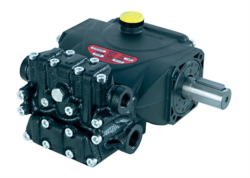
The Interpump E3B2515I R pressure pump exemplifies high-performance specifications suitable for demanding industrial applications. This model delivers 15 L/min (3.96 US GPM) at a maximum pressure rating of 250 bar (25 MPa / 3,625 PSI), consuming 7.13 kW (9.7 hp) at 1,450 RPM. The compact footprint of 265mm length with a 9.5 kg weight profile makes it ideal for space-constrained mounting configurations common in Singapore manufacturing environments where floor space commands premium value.
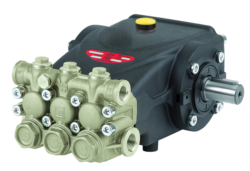
For applications requiring slightly lower pressure specifications, the Interpump E3C1515 L pump provides 15 L/min flow capacity at 150 bar (15 MPa / 2,175 PSI) pressure rating, operating at 1,750 RPM with 4.26 kW (5.8 hp) power consumption. This represents a meaningful reduction in electrical demand—approximately 40% lower power draw—compared to the E3B2515I R, making it the preferred choice when system pressure requirements allow. The weight and dimensional profile remain identical, ensuring compatibility with existing mounting infrastructure.
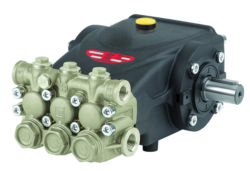
The Interpump E3C1021 DX pump operates at even lower pressure (100 bar / 10 MPa / 1,450 PSI) while maintaining 21 L/min output—40% higher flow than the E3C1515 model. This variant consumes only 4.04 kW (5.5 hp), demonstrating how pressure reduction enables significant flow capacity increases without proportional power escalation. For high-volume, moderate-pressure applications—such as circulation systems, transfer operations, or spray cooling—this specification profile delivers superior energy efficiency. All three models share the standardized 265mm dimensional footprint and 9.5 kg weight, facilitating retrofit installations and system upgrades in operational facilities.
Comparing these specifications reveals a critical insight: the relationship between pressure, flow, and power is non-linear. Doubling pressure does not double power consumption—instead, it enables lower flow rates at higher power efficiency. Conversely, reducing pressure by 40% (from 250 bar to 150 bar) allows approximately 33% lower power consumption while maintaining identical flow capacity. This relationship must guide your selection process toward the lowest pressure rating that satisfies system requirements.
Real-World Industrial Applications in Singapore
Singapore's petrochemical, food processing, and precision manufacturing sectors rely heavily on pressure pump systems for hydraulic power transmission, material handling, and process control. Refineries and chemical plants frequently operate multiple pump systems in series or parallel configurations, where each unit handles specific pressure and flow requirements across different process stages.
In high-pressure hydraulic systems supporting industrial presses, injection molding equipment, and metal stamping operations, the Interpump E3B2515 L series pumps provide the 250 bar pressure necessary for effective force multiplication. A single 250 bar pump driving a 100 cm² hydraulic cylinder generates 25 tonnes of linear force—sufficient for most commercial-scale material processing. By specifying the lower-flow E3B series rather than oversized alternatives, manufacturers reduce energy consumption and heat generation, critical factors in Singapore's tropical climate where cooling costs represent significant operational expense.
Food and beverage processing facilities frequently employ lower-pressure, higher-flow systems for liquid transfer, ingredient mixing, and packaging line operation. These applications benefit from the E3C1021 pump's 21 L/min capacity at 100 bar specifications. The lower pressure rating reduces component fatigue in long piping runs, while higher flow capacity supports multiple downstream work stations from a single pump source. Lower electrical draw also translates to reduced operating temperature, improving food safety compliance in temperature-sensitive processes.
Maintenance and serviceability considerations strongly favor standardized specifications available through local Singapore distributors. The Interpump pump series' compatibility with common motor frames, shaft standards (DIN 24220, EN 225), and industry-standard flange sizes simplifies replacement procedures and reduces downtime when equipment service becomes necessary.
Selection Criteria and Best Practices for Pressure Pump Sizing
Establish Actual System Requirements First: Many installations are oversized due to specification uncertainty rather than genuine technical necessity. Determine minimum pressure required (not maximum the system can tolerate) and actual flow demand under full production conditions. Excessive pressure ratings waste energy; excessive flow capacity creates backpressure and heat generation.
Account for Duty Cycle and Ambient Conditions: Continuous-duty applications require different pump selection than intermittent or peak-demand scenarios. Singapore's tropical climate—with ambient temperatures frequently exceeding 32°C—accelerates hydraulic fluid degradation and increases cooling load. Lower pressure specifications generate less waste heat and extend fluid service intervals.
Evaluate Total Cost of Ownership: Initial equipment cost represents only 15-20% of pump lifetime expense. Electrical consumption, maintenance, fluid replacement, and downtime risk dominate long-term costs. A 4 kW pump operating 8 hours daily for 5 years consumes approximately 73,000 kWh—at Singapore's industrial electricity rates, this represents substantial operational expense favoring energy-efficient specifications.
Prioritize Standardization: Standardizing pump models across facility operations simplifies inventory management, training, and spare parts provisioning. The Interpump E3C and E3B series' modular design enables configuration flexibility within a consistent platform, reducing overall system complexity.
Integration with Industrial Equipment Supply in Singapore
3G Electric's 34-year history as an experienced industrial equipment distributor in Singapore positions us to support pressure pump selection across the full spectrum of industrial applications. Our technical team understands local operating conditions, regulatory requirements, and equipment compatibility within Singapore's manufacturing ecosystem. Whether you're specifying pressure pumps for new facility construction or upgrading existing systems, our expertise ensures equipment selections that optimize performance, efficiency, and operational reliability.
Contact 3G Electric today to discuss your pressure pump requirements. Our technical professionals will evaluate your system specifications, compare available options, and recommend equipment that delivers optimal balance between performance, energy efficiency, and total cost of ownership for your Singapore industrial operations.