Shaft Configuration & Valve Integration: Comparing Interpump Industrial Pump Designs for Global Applications
When specifying industrial pumps for your facility, most maintenance teams focus on pressure ratings and flow rates—but the mechanical details often make the difference between seamless integration and costly downtime. Shaft configuration, valve placement, and drive coupling compatibility represent critical design variables that directly affect installation complexity, maintenance accessibility, and long-term operational reliability. This article examines how Interpump's E3B and E3C series differ in these fundamental mechanical characteristics, providing maintenance engineers and service technicians with the technical foundation needed to select pumps that fit both performance requirements and installation constraints across global industrial applications.
Understanding Pump Shaft Design: Mechanical Foundations
Industrial pump shafts serve as the critical mechanical interface between drive motors and pump impellers, but their design—whether solid or hollow, keyed or splined—dramatically influences how the pump integrates into your system. The shaft configuration affects not only the initial installation process but also the long-term maintainability of the equipment.
Solid shafts with key drives represent the traditional design found in many industrial applications. These configurations use a mechanical key (a metal insert that prevents relative rotation between shaft and coupling) to transfer torque from the motor to the pump. This design is robust, forgiving of minor misalignment, and relatively inexpensive to manufacture. However, solid shafts require precise radial coupling alignment and can be more challenging to remove and replace during maintenance because the entire coupling and key assembly must be disassembled.
Hollow shaft designs, by contrast, allow for direct coupling or cartridge-style mounting, reducing the number of components requiring assembly and potentially lowering installation time. Hollow shafts are particularly valuable in compact installations where space is constrained, as they eliminate the need for a separate coupling hub. The trade-off: hollow shaft systems typically require tighter manufacturing tolerances and more careful alignment during installation.
Interpump's product line incorporates both configurations to serve different application requirements. Understanding which design suits your operational environment—whether your facility requires rapid pump changeovers, operates in space-constrained environments, or prioritizes minimal assembly complexity—is essential for long-term cost optimization and reliability.
Technical Comparison: E3B vs. E3C Shaft & Valve Architecture
Interpump's E3B and E3C series represent distinct engineering philosophies, with shaft configuration and valve integration serving as key differentiators.
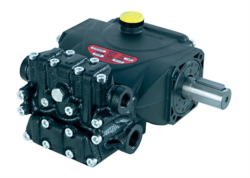
The Interpump E3B2515I R and E3B2515 L pumps feature male solid shafts with key drives (Ø25.4mm designation), operating at 1,450 rpm and delivering 250 bar pressure capacity. These high-pressure units are designed for direct motor coupling with minimal additional components. The solid shaft provides excellent torque transmission reliability and is particularly suited to applications where pump and motor are tightly integrated into a single assembly. The E3B series operates at lower rotational speeds compared to comparable flow rates, meaning fewer vibrations and extended bearing life in high-duty-cycle operations.
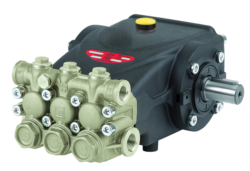
The Interpump E3C1021 DX, E3C1515 L, and related E3C variants feature hollow shafts (Ø22.2mm) and integrated valve heads. These mid-range pressure units (100–150 bar) rotate at 1,750 rpm and include factory-integrated VH (valve head) systems that eliminate the need for external check valves or pressure relief components. The hollow shaft design supports cartridge-style mounting and reduces overall assembly footprint, making E3C pumps ideal for modular, space-constrained industrial environments.
A critical distinction: the Interpump E3B1515 DX with GEARBOX RS500H represents a hybrid approach, combining the E3B's high-pressure capability (250 bar) with an integral gearbox for applications requiring reduced rotational speed or torque multiplication. This configuration adds mechanical complexity but enables applications where direct motor speed would exceed pump design limits.
Real-World Installation & Maintenance Implications
Consider a scenario common in global industrial facilities: a high-pressure washing or industrial fluid circulation system requires pump replacement. If your original specification was an E3B-series solid-shaft unit, maintenance personnel must secure the pump to a mounting surface, disconnect the motor coupling, extract the mechanical key, and remove the impeller assembly. The process is straightforward but time-consuming, particularly in environments where the pump is tightly integrated into surrounding equipment.
By contrast, an E3C-series installation with hollow shaft and integrated valve head can often be serviced modularly. The pump cartridge slides into a standardized manifold connection, and the integrated valve system means no external relief or check valve components to troubleshoot separately. In Singapore's fast-paced manufacturing and HVAC sectors, this modularity translates to reduced downtime and lower maintenance labor costs.
Another practical consideration: shaft configuration influences vibration characteristics. The E3B's lower 1,450 rpm operation generates less vibration than the E3C's 1,750 rpm baseline, which matters significantly in noise-sensitive environments or facilities where vibration-induced equipment fatigue is a concern. Maintenance teams managing facilities with stringent vibration monitoring protocols often prefer the E3B for this reason, despite its higher pressure requirements necessitating more robust mounting structures.
Technical Specification Comparison Table
| Specification | E3B Series (E3B2515I R / L) | E3C Series (E3C1021 / E3C1515 L) |
|---|---|---|
| Shaft Type | Solid (male, Ø25.4mm with key) | Hollow (Ø22.2mm, cartridge-compatible) |
| Valve Configuration | External (requires separate relief/check valve) | Integrated VH valve head (factory-installed) |
| Pressure Rating | 250 bar (3,625 psi) | 100–150 bar (1,450–2,175 psi) |
| Rotation Speed | 1,450 rpm | 1,750 rpm |
| Flow Rate (E3C1021 / E3B2515) | 15 L/min (3.96 US gpm) | 15–21 L/min (3.96–5.55 US gpm) |
| Power Consumption | 7.13 kW (9.7 hp) | 4.04–4.26 kW (5.5–5.8 hp) |
| Installation Complexity | Moderate (coupling assembly required) | Low (modular, cartridge-style mounting) |
| Weight | 9.5 kg | 9.5 kg |
| Ideal Application Profile | High-pressure, low-vibration environments; integrated motor-pump units | Modular systems, space-constrained installations, low-to-mid pressure circuits |
Selecting the Right Configuration for Your Facility
Choosing between E3B and E3C shaft architectures depends on three primary factors: your system's pressure requirements, available installation space, and maintenance accessibility.
Choose E3B if: Your application demands sustained pressures above 200 bar, your facility can accommodate a motor-pump assembly with solid coupling connections, and you prioritize low vibration operation (critical in precision manufacturing or sensitive measurement environments). The E3B's robust solid shaft and lower rotational speed make it ideal for continuous-duty, high-pressure applications across global industrial sectors including hydraulic systems, pressure testing rigs, and intensive fluid circulation circuits.
Choose E3C if: Your system operates in the 100–150 bar range, space constraints limit your installation options, and you value modular, rapid-swap maintenance capabilities. The E3C's integrated valve head and hollow shaft design eliminate component assembly complexity and enable quick pump replacement without disassembling external valve manifolds. This is particularly valuable in industrial pump applications across Singapore and other global markets where facility reconfiguration is frequent and downtime costs are high.
For applications requiring both high pressure and gearbox integration, the E3B1515 DX with GEARBOX RS500H offers a specialized solution, though it trades simplicity for capability.
Maintenance Team Best Practices
Regardless of which Interpump configuration your facility operates, several maintenance protocols optimize reliability:
- Document shaft specifications: Maintain records identifying whether your pumps use solid or hollow shafts, including key dimensions. This prevents specification errors during emergency replacement scenarios.
- Valve inspection cycles: For E3C pumps with integrated valve heads, inspect the VH valve assembly annually. Integrated valves are convenient but inaccessible without partial pump disassembly, so preventive maintenance is more cost-effective than reactive repair.
- Coupling alignment: E3B solid-shaft installations require precise motor-pump coupling alignment. Verify alignment every six months, particularly in facilities with vibration monitoring systems.
- Spare parts inventory: Stock replacement keys, seals, and shaft sleeves specific to your installed pump type. Hollow-shaft E3C spares differ significantly from solid-shaft E3B components.
Global Availability & Technical Support
Both E3B and E3C series are available globally through experienced industrial equipment distributors. Understanding the technical differences between shaft configurations ensures you can communicate precise requirements to your supplier, accelerating procurement and reducing specification errors. Whether you operate facilities in Singapore's manufacturing corridor, across Asia-Pacific industrial zones, or in other global markets, the ability to specify the correct shaft type and valve configuration prevents costly compatibility issues.
Conclusion: Aligning Mechanical Design with Operational Reality
Shaft configuration and valve integration represent critical but often-overlooked technical specifications that directly impact your pump's performance, maintainability, and total cost of ownership. The Interpump E3B series delivers high-pressure reliability with traditional solid-shaft robustness, while the E3C series offers modular flexibility with integrated valve simplicity. Neither is universally superior—the correct choice depends on your specific pressure requirements, spatial constraints, and maintenance accessibility priorities.
By understanding how these mechanical differences translate into installation complexity, downtime implications, and long-term reliability, your maintenance team can make data-driven pump selections that align with both technical performance requirements and operational realities.
Ready to specify the right pump configuration for your facility? Contact 3G Electric's technical team to discuss your system requirements. Our experienced engineers can help you evaluate whether E3B solid-shaft, E3C hollow-shaft integrated-valve, or hybrid gearbox configurations best suit your application. Reach out today for personalized guidance on industrial pumps and compressors tailored to your global operations.