Industrial Pump Pressure Classification in Singapore: Selecting the Right Interpump for Your Application
When specifying industrial pumps for high-demand applications across Singapore's manufacturing, marine, and hydraulic sectors, pressure rating becomes a critical technical differentiator. The Interpump E3B and E3C series represent two distinct pressure classifications that fundamentally change how and where a pump can be deployed. Unlike flow-rate comparisons alone, pressure classification determines equipment compatibility, system safety, and long-term operational reliability. This guide breaks down the engineering logic behind these pressure tiers, helping industrial professionals make informed procurement decisions aligned with real application requirements.
Understanding Pump Pressure Classification: The Engineering Foundation
Industrial pump pressure ratings define the maximum sustained pressure a pump can safely deliver without component failure or excessive wear. Pressure classification is not arbitrary—it reflects fundamental design choices in displacement, materials, and rotational speed that cascade through the entire pump architecture.
The Interpump E3B series operates at ultra-high pressure ratings up to 250 bar (25 MPa / 3,625 psi), while the E3C series tops out at 150 bar (15 MPa / 2,175 psi) in its most robust configuration. This 100-bar differential represents more than a numerical difference; it reflects distinct internal geometries, component tolerances, and material specifications. Higher-pressure pumps require tighter internal clearances, stronger materials, and more robust shaft designs to withstand repeated pressure cycling without fatigue failure.
In Singapore's humid, corrosion-prone industrial environment, pressure classification also influences material selection and protective coatings. Higher-pressure components often demand premium alloys and surface treatments to resist saltwater spray in marine applications or chemical exposure in processing plants. Understanding this relationship helps procurement teams anticipate lifecycle costs and maintenance intervals that extend far beyond the initial purchase price.
Pressure classification also governs system architecture decisions. Ultra-high-pressure systems (250 bar and above) require reinforced hose assemblies, specialized fittings, and pressure relief valves rated for sustained duty. Mid-range systems (100–150 bar) allow greater flexibility in component selection and reduce installation complexity, which can translate to faster deployment and lower integration costs for retrofit applications common in Singapore's aging industrial infrastructure.
Technical Specifications: E3B vs. E3C Pressure Profiles
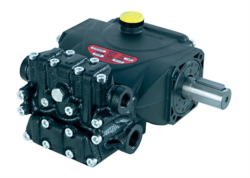
The Interpump PUMP E3B2515I R and Interpump PUMP E3B2515 L represent Interpump's ultra-high-pressure tier. Both models deliver 15 L/min (3.96 US GPM) at 250 bar while drawing 9.7 hp (7.13 kW) of motor power. Operating at 1,450 rpm, these pumps achieve extraordinary pressure density—the engineering term for maximum pressure output from a given displacement. This high-pressure concentration makes E3B models ideal for confined-space installations where footprint matters, such as onboard marine equipment or integrated plant control systems.
The technical advantage becomes apparent when comparing displacement-to-pressure ratios. The E3B series' compact 265 mm length and 9.5 kg weight deliver pressure levels that would require significantly larger or more complex systems in the E3C range. For applications requiring both power and spatial efficiency—common in Singapore's space-constrained urban manufacturing zones—the E3B becomes the logical engineering choice despite higher component costs.
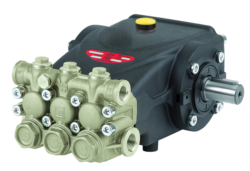
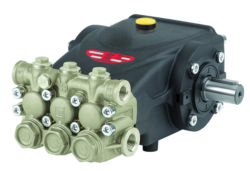
By contrast, the Interpump PUMP E3C1515 L and Interpump PUMP E3C1021 DX represent the mid-pressure classification. The E3C1515 L delivers the same 15 L/min flow as the E3B series but at a moderate 150 bar (15 MPa / 2,175 psi). Its 5.8 hp (4.26 kW) power consumption reflects the reduced pressure workload—approximately 45% less energy input for the same volumetric output. This efficiency advantage becomes significant in continuous-duty applications where energy costs accumulate over months of operation.
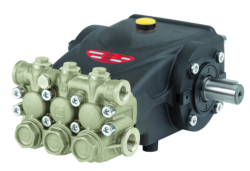
The E3C1021 variant pushes flow output to 21 L/min (5.55 US GPM) while maintaining 100 bar pressure. At 5.5 hp (4.04 kW), it represents the lowest-energy option in the comparison set, suitable for high-volume, lower-pressure applications such as cooling loops, filtration systems, or adaptation circuits requiring gentle flow characteristics. Operating at 1,750 rpm (versus 1,450 rpm for E3B models), the E3C series achieves its pressure modulation through different rotational mechanics—a design choice that affects pump longevity and noise profiles in laboratory and clean-room environments.
Real-World Application Mapping in Singapore's Industrial Sectors
Ultra-high-pressure pumps (E3B classification) dominate Singapore's marine equipment retrofitting and hydraulic machinery sectors. Offshore supply vessels require deck-mounted pumping systems capable of sustaining 250+ bar loads during cargo transfer operations. The compact E3B series fits seamlessly into pre-existing mechanical spaces while delivering the pressure density required for modern fast-action hydraulic couplings and check valves.
Manufacturing plants processing industrial lubricants or viscous compounds frequently specify E3B pumps for injection and distribution circuits. In Singapore's advanced manufacturing corridors around Jurong and Tuas, precision metal fabrication shops depend on ultra-high-pressure systems for coolant delivery under load. A 250 bar system guarantees adequate pressure head across long hose runs and complex manifold networks without proportional increases in pump displacement or motor size.
Mid-pressure E3C systems excel in building services and HVAC integration—sectors where retrofit compatibility and energy efficiency drive specification decisions. Singapore's extensive building stock requires constant upgrades to plant rooms and mechanical spaces. The E3C1515 L and E3C1218 variants integrate readily into existing hydraulic architectures designed for 150 bar systems, reducing redesign costs and certification delays. Energy consumption becomes a secondary advantage; a facility operating multiple E3C pumps across chilled-water circuits and pressure-boost systems realizes measurable utility cost reductions over a 10-year lifecycle.
Performance Comparison Table: E3B and E3C Series at a Glance
| Model | Pressure (bar) | Flow (L/min) | Power (kW) | RPM | Weight (kg) |
|---|---|---|---|---|---|
| E3B2515I R | 250 | 15 | 7.13 | 1,450 | 9.5 |
| E3B2515 L | 250 | 15 | 7.13 | 1,450 | 9.5 |
| E3C1515 L | 150 | 15 | 4.26 | 1,750 | 9.5 |
| E3C1021 DX | 100 | 21 | 4.04 | 1,750 | 9.5 |
Key Insights: The E3B series sacrifices flow output to achieve 250 bar pressure at moderate power consumption. When equal flow is required (E3B2515 vs. E3C1515), pressure differential demands 67% more power input. The E3C1021 demonstrates the inverse relationship: by reducing pressure to 100 bar, flow capacity increases 40% while power consumption decreases 43%. Pressure selection must align precisely with application requirements to avoid over-specification and wasted energy or under-specification and system failure.
Selection Methodology: Matching Pressure Class to Application Demands
Begin specification by documenting actual system pressure requirements from process data, equipment manufacturer ratings, or system design calculations. In Singapore's regulated industrial environment, this documentation becomes essential for insurance compliance and HSE audits. Never assume that higher-pressure pumps provide a safety margin; over-specification increases component stress, reduces system efficiency, and accelerates wear on downstream equipment not designed for excess pressure.
Next, evaluate space constraints and motor availability. If your installation footprint limits pump size to <300 mm length, the E3B series becomes obligatory for high-pressure applications. Conversely, if space permits and energy cost reduction is a procurement priority, the E3C series offers superior lifecycle economics for mid-range pressure demands (100–150 bar).
Finally, assess supply-chain and maintenance support availability in Singapore. Both Interpump E3B and E3C series benefit from regional distributorship networks, but E3C models dominate retrofit and replacement markets due to broader historical installation base. Confirm spare-parts availability and technician certification before finalizing purchase decisions.
Why Pressure Classification Matters More Than Flow Alone
Industrial procurement teams often default to flow-rate specifications because they appear intuitive—higher flow means faster output. Pressure classification, however, determines system safety, component longevity, and operational economics. A 250 bar system operating at 100 bar delivers adequate pressure but forces the pump to work at partial displacement, wasting energy and generating unnecessary heat. Conversely, specifying a 100 bar pump for a 200 bar application guarantees catastrophic failure.
Understanding pressure classification also protects against vendor specification drift. Component suppliers sometimes offer "equivalent" pumps at lower pressure ratings to reduce costs; this equivalence exists only on paper. Real-world performance, cycle life, and system integration success depend on precise pressure-class matching.
Closing Remarks and Next Steps
Selecting industrial pumps requires balancing pressure demands, flow requirements, space constraints, and energy efficiency. The Interpump E3B and E3C series offer proven solutions across Singapore's diverse industrial landscape, from ultra-high-pressure marine applications to efficient mid-range building services systems. Understanding the engineering logic behind pressure classification transforms pump selection from guesswork into data-driven decision-making.
Ready to specify the right pump for your application? Explore our complete pumps and compressors collection, or contact the 3G Electric technical team to discuss your pressure and flow requirements. Our experienced distributors can guide you through specification, compatibility verification, and integration support across Singapore. Reach out today to ensure your next pump installation delivers optimal performance and reliability.