Rotational Speed & Power Efficiency: Comparing High-Speed vs. Standard-Speed Industrial Pumps in Singapore
Pump selection in Singapore's industrial landscape often hinges on a single overlooked specification: rotational speed. While flow rate and pressure dominate procurement conversations, the operating revolution-per-minute (rpm) fundamentally determines energy consumption, maintenance intervals, noise levels, and long-term operational cost. This article examines the critical performance differences between high-speed and standard-speed industrial pumps, using real-world Interpump specifications to guide Plant Managers and Operations Directors toward data-driven procurement decisions. Understanding these mechanical realities helps operations teams optimize both capital expenditure and lifecycle costs across diverse Singapore manufacturing, HVAC, and fluid transfer applications.
The Technical Foundation: How Rotational Speed Drives Pump Performance
Rotational speed, measured in revolutions per minute (rpm), is a primary mechanical variable that dictates how a positive-displacement or centrifugal pump converts motor input into usable flow and pressure. Higher rotational speeds—typically 3400 rpm in industrial settings—enable smaller pump displacements to deliver equivalent flow rates compared to lower-speed alternatives. Conversely, standard-speed pumps operating at 1750 rpm require larger internal geometries to achieve identical volumetric output, resulting in heavier, physically larger units.
The relationship between speed and performance is not linear, however. Higher rotational speeds increase mechanical stress on internal components (bearings, seals, rotating elements), accelerate wear patterns, and generate proportionally greater vibration and heat dissipation. Energy efficiency—measured as input kilowatt-hours to output flow and pressure—varies significantly between speed classes. A high-speed pump must overcome friction and fluid resistance at greater velocities, often reducing overall mechanical efficiency compared to slower-turning alternatives.
In Singapore's humid tropical climate, thermal management becomes critical. High-speed pumps generate more internal heat; inadequate cooling or extended operating cycles can degrade seal integrity and bearing life. Standard-speed pumps, while generating less waste heat, demand more robust motor horsepower to match high-speed flow rates, effectively shifting the energy burden from friction losses to raw motor consumption. The net efficiency outcome depends on system design, duty cycle, and component quality—considerations that operations teams must evaluate application-by-application rather than assuming one speed category universally outperforms another.
Product Specifications: High-Speed E3B Series vs. Standard-Speed E3C Series
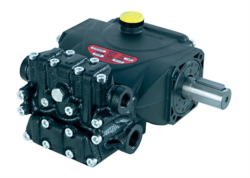
Interpump's industrial pump portfolio in Singapore clearly illustrates these speed-driven performance distinctions. The Interpump E3B2515I R operates at 3400 rpm and delivers 15 L/min at a maximum pressure of 250 bar (25 MPa / 3625 psi), consuming 7.13 kW of input power. This compact unit weighs just 9.5 kg and occupies minimal footprint—a critical advantage in space-constrained Singapore manufacturing floors. The high rotational speed enables aggressive flow delivery and ultra-high pressure capability from a physically small displacement pump, ideal for hydraulic applications, precision machinery, and systems demanding compact component integration.
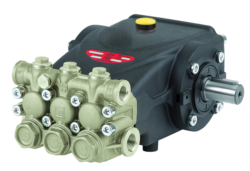
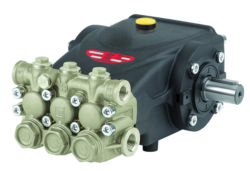
By contrast, the Interpump E3C1021 DX*V.DX*NO.C/J operates at 1750 rpm (50% lower speed) and produces 21 L/min at 100 bar (10 MPa / 1450 psi) while consuming only 4.04 kW—43% less power input than its high-speed counterpart. Although maximum pressure is lower, the volumetric flow output exceeds the E3B series, demonstrating the trade-off: lower speed permits larger displacement, yielding higher volume but reduced pressure capability. Similarly, the Interpump E3C1515 L runs at 1750 rpm, delivers 15 L/min at 150 bar with 4.26 kW input—making it 40% more power-efficient than the high-speed alternative for moderate-pressure applications.
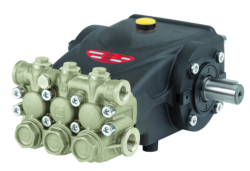
The E3B2515 L and E3B1515 DX configurations maintain identical 3400 rpm performance characteristics, ensuring consistent high-pressure delivery across Interpump's ultra-high-pressure product family. When your application demands 250 bar pressure—such as industrial cleaning systems, injection molding, or precision hydraulic control—high-speed designs are non-negotiable. When moderate pressures (100–150 bar) suffice, standard-speed units reduce operational energy footprint significantly, translating to measurable cost savings across annual operating budgets in Singapore's energy-conscious industrial environment.
Real-World Application Scenarios for Singapore Operations
Consider a food processing facility in Singapore's Jurong industrial zone requiring a pump for high-pressure cleaning and sanitization systems. Pressures typically demand 200+ bar; production schedules require 8–12 hour daily operation. The Interpump E3B2515I R high-speed design meets these demands in a compact footprint suitable for integrated equipment mounting. The 250 bar capability provides safety margin; the 3400 rpm speed delivers responsive flow control critical for precision cleaning nozzles. Over a 5-year operating lifecycle, the higher power consumption per operating hour is justified by application-specific performance requirements.
Alternatively, a HVAC retrofit project across Singapore's Central Business District demands reliable, efficient condensate transfer from multiple rooftop units to ground-level drainage. Pressures rarely exceed 150 bar; volumetric consistency matters more than peak pressure. The Interpump E3C1515 L at 1750 rpm consumes 4.26 kW versus 7.13 kW for high-speed equivalents—a 40% reduction directly visible on monthly electrical invoices across dozens of building management systems. The lower operational speed also reduces bearing stress and seal degradation, extending maintenance intervals in Singapore's humid environment where moisture ingress and thermal cycling stress pump longevity.
Manufacturing facilities running 24/7 production cycles experience cumulative energy impacts. A single high-speed pump consuming an additional 3 kW per hour translates to 72 kWh daily, or ~26,000 kWh annually—approximately SGD 3,500–4,500 in electricity costs at Singapore's industrial rates. When application requirements permit standard-speed operation, this calculation becomes a primary procurement driver for plant operations managing tight energy budgets.
Technical Comparison: High-Speed vs. Standard-Speed Performance Data
| Specification | E3B2515I R (High-Speed) | E3C1515 L (Standard-Speed) | E3C1021 (Standard-Speed) |
|---|---|---|---|
| Rotational Speed (rpm) | 3400 | 1750 | 1750 |
| Flow Rate (L/min) | 15 | 15 | 21 |
| Flow Rate (US GPM) | 3.96 | 3.96 | 5.55 |
| Maximum Pressure (bar) | 250 | 150 | 100 |
| Maximum Pressure (MPa) | 25 | 15 | 10 |
| Power Input (kW) | 7.13 | 4.26 | 4.04 |
| Power Input (hp) | 9.7 | 5.8 | 5.5 |
| Weight (kg) | 9.5 | 9.5 | 9.5 |
| Footprint (mm) | 265 L | 265 L | 265 L |
| Efficiency (kW per L/min) | 0.475 | 0.284 | 0.192 |
| Primary Application | Ultra-High Pressure (Hydraulics) | Moderate Pressure (General Industrial) | Low-Pressure High-Volume |
Key Insight: The efficiency metric (kW per L/min output) reveals that standard-speed pumps deliver superior energy conversion at lower pressures. The E3C1021 operates at 0.192 kW per L/min—60% more efficient than the high-speed E3B2515I R at 0.475 kW per L/min. However, this advantage only applies when maximum pressure requirements remain below 100–150 bar. Above 250 bar, standard-speed designs cannot feasibly deliver; high-speed architecture becomes mandatory.
Selecting the Right Speed Category for Your Singapore Operation
The decision between high-speed and standard-speed pumps requires a three-part evaluation:
1. Pressure Requirements: Does your application genuinely demand 200+ bar? If maximum system pressure is 100–150 bar, standard-speed models eliminate unnecessary power consumption. Review your system schematic and pressure gauge data to confirm actual operating points, not worst-case theoretical limits.
2. Operating Duty Cycle: Extended runtime (16+ hours daily) amplifies energy cost differences. A 3 kW daily surplus becomes significant across 365 operating days. Conversely, intermittent or seasonal applications may justify higher instantaneous power if it enables smaller physical footprint or maintenance-free operation periods.
3. Maintenance & Longevity: In Singapore's tropical climate, lower rotational speeds reduce bearing stress and thermal cycling effects on seals. If your facility operates in high-ambient-temperature environments or experiences poor cooling airflow, standard-speed designs extend service intervals and reduce unplanned downtime risk.
The industrial pumps available in Singapore span both categories; reputable distributors such as 3G Electric maintain inventories supporting both high-speed precision applications and efficiency-focused standard-speed systems. Procurement decisions should reference this data systematically rather than defaulting to single-speed categories.
Conclusion: Data-Driven Pump Selection for Long-Term Operations Success
Rotational speed fundamentally shapes industrial pump performance, cost, and reliability outcomes. High-speed pumps (3400 rpm) deliver ultra-high pressure and compact integration—essential for hydraulic systems and precision applications but at elevated energy and wear costs. Standard-speed alternatives (1750 rpm) excel in moderate-pressure environments, offering superior energy efficiency and extended component life in Singapore's challenging tropical operating environment.
For Plant Managers and Operations Directors evaluating pumps and compressors, the key is matching speed specification to actual application pressure and flow requirements—not industry defaults or historical precedent. Using real performance data from Interpump's E3B and E3C series, you can model 5-year lifecycle costs, energy consumption, and maintenance intervals with confidence.
Ready to optimize your pump selection? Contact the team at 3G Electric, Singapore's trusted industrial equipment distributor since 1990. Our technical specialists can review your system requirements, compare speed-specific performance data, and recommend the most cost-effective solution for your operations. Explore our complete oil pump and industrial pump portfolio, or reach out directly for a personalized consultation.