Understanding Burners & Combustion Failure Modes
Burners & Combustion systems in Singapore's tropical industrial environment face unique stress factors: high humidity, salt spray corrosion, and inconsistent fuel quality. Over our 35+ years distributing industrial equipment, we've documented recurring failure patterns that maintenance teams must recognize early.
Most burner failures don't happen suddenly—they progress through detectable stages. Flame instability precedes complete ignition failure by days or weeks. Pressure fluctuations indicate control unit degradation before total system shutdown. Understanding these progression patterns transforms reactive maintenance into predictive intervention.
The challenge for maintenance teams is distinguishing between control unit faults (relay issues), fuel delivery problems (pressure switch failures), and flame detection degradation (UV/ionization sensor issues). Each requires different diagnostic approaches and replacement strategies.
Diagnostic Framework: Isolating Control Unit vs. Fuel System Issues
Control Unit Failure Recognition
Burner control relays like the Kromschroder Relay BCU 570WC1F1U0K1-E serve as the combustion system's decision-making center. When these units fail, the entire ignition sequence collapses. Common diagnostic indicators include:
- Intermittent pilot ignition failure: Burner fires sporadically or requires multiple ignition attempts
- No response to manual shutdown commands: Control unit remains locked in energized state
- Erratic flame detection switching: Flame monitoring circuits misinterpret combustion states
- Safety lockout activation without fuel supply issues: System detects phantom faults
To isolate control relay faults, maintenance teams should:
1. Verify fuel delivery first: Confirm gas/oil pressure and solenoid valve operation before assuming relay failure
2. Test ignition circuit independently: Apply test voltage directly to spark plug or igniter to confirm electrical output
3. Check flame sensor continuity: UV or ionization sensors may appear failed when actually disconnected from control unit
4. Measure control unit supply voltage: EN 746-2 compliant units like the BCU 570 require stable 230V AC input
The BCU 570WC1F1U0K1-E handles direct ignition and intermittent/continuous pilot modes—failure to switch between these modes reliably indicates internal relay degradation rather than sensor issues.
Pressure Switch Diagnostics
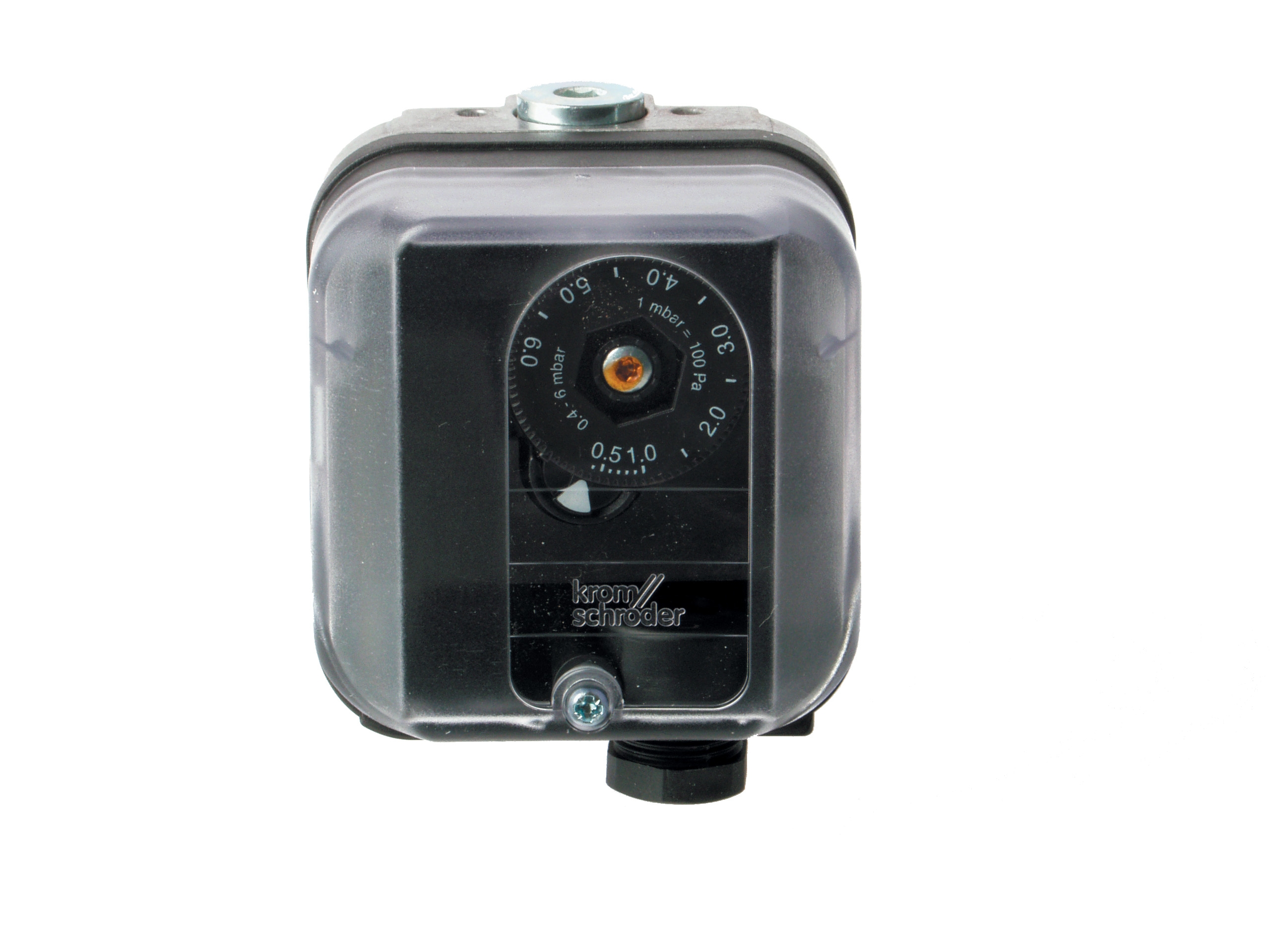
The Kromschroder Pressure Switch DG 50U/6 is the combustion system's safety gatekeeper. This SIL 3-rated component performs two critical functions: confirming fuel system pressure before ignition and detecting abnormal pressure conditions during operation.
Failed or miscalibrated pressure switches create distinct failure signatures:
- Burner refuses to start despite fuel supply: Pressure switch stuck in "fault" position—common in high-humidity Singapore environments
- Unexpected shutdown during stable operation: Pressure drift caused by seal degradation or internal corrosion
- Delayed startup after fuel system bleeding: Switch threshold set above actual system pressure
- False high-pressure alarms: Diaphragm rupture causes switch to read phantom overpressure
Diagnostic procedure for pressure switch assessment:
1. Install temporary pressure gauge at burner fuel inlet; compare DG 50U/6 reading against direct measurement
2. Manually trigger pressure switch mechanism (if accessible) to verify electrical contacts close/open smoothly
3. Review maintenance logs for recent fuel system work—improper bleeding introduces air that causes false readings
4. Test continuity across switch terminals under pressurized conditions; erratic continuity indicates worn contacts
The DG 50U/6 meets EN 1854, FM, and UL standards—if readings deviate beyond ±5% of gauge pressure, replacement is mandatory for safety compliance in Singapore's regulated industrial environment.
Flame Detection Failure Analysis: UV vs. Ionization Sensors
The Siemens Relay LFL 1.622 integrates UV and ionization flame monitoring, providing redundancy that diagnostic procedures must account for. Flame detection failure represents the most common maintenance call—yet is often misdiagnosed as control unit failure.
UV Sensor Degradation Patterns
Ultraviolet flame sensors fail progressively in three stages:
Stage 1 - Sensitivity Loss (Weeks 1-4): Sensor window accumulates combustion residue and salt deposit buildup. Burner fires normally but requires slightly longer ignition time. Many maintenance teams miss this stage because the system operates.
Stage 2 - Intermittent Detection (Weeks 4-8): Sensor becomes unreliable during flame transients. Burner ignites but flames-out seconds later as sensor loses signal. Control unit triggers safety shutdown, then permits restart. This creates repeated "lockout-restart" cycling.
Stage 3 - Complete Failure (Week 8+): Sensor cannot detect flame at any condition. Burner experiences immediate safety shutdown on ignition attempt.
Diagnostic testing for UV sensors:
- Visual inspection: UV sensor quartz window should be clear; any discoloration or white deposits indicate cleaning requirement or replacement need
- Oscilloscope flame signal measurement: Healthy UV sensor shows clean flame detection signal; degraded sensors show weak or noisy signals
- Test burner in darkened enclosure: If flame visibility to sensor changes significantly in darkness, sensor sensitivity is compromised
Ionization Sensor Assessment
Ionization sensors detect electrical conductivity of flame ions—a fundamentally different detection method requiring different diagnostic approach. These sensors fail differently than UV types:
- Buildup failures: Carbon/ash deposits on electrode tips block ion detection
- Electrode corrosion: Salt spray in Singapore climate accelerates electrode degradation
- Circuit board coupling failure: Capacitor leakage prevents signal coupling to control unit
For ionization sensor diagnostics:
1. Remove electrode assembly and visually inspect tips for deposits or corrosion
2. Measure electrode-to-ground resistance: Healthy sensors show high resistance (>1 MΩ); low readings indicate coupling failure
3. Test with temporary sensor if available; if burner operates normally, original sensor is faulty
Practical Troubleshooting Decision Tree for Maintenance Teams
Initial Assessment Sequence
Step 1: Power and Safety Verification
- Confirm 230V AC supply to control unit (BCU 570 or LFL 1.622)
- Verify fuel solenoid valve energizes audibly during startup
- Check that safety shutdown switch responds to manual trigger
- Install pressure gauge at burner inlet
- Compare reading to pressure switch setting (DG 50U/6 typical setting: 0.5-2.0 bar for gas)
- Bleed fuel lines to remove air; air pockets cause false pressure switch faults
- Apply test ignition voltage directly to spark plug or igniter
- If ignition occurs independently of control relay, relay is faulty
- If ignition fails at spark plug, verify ignition transformer output
- Observe flame appearance during ignition; compare to historical flame color/stability
- Clean UV sensor window with appropriate solvent; retests frequently resolve early-stage failures
- Test ionization electrode continuity if UV sensor cleaning doesn't restore operation
- Only replace control relay if fuel system, ignition circuit, and flame detection all test normal
- When replacement required, units like BCU 570WC1F1U0K1-E and LFL 1.622 are platform-specific; verify compatibility before ordering
Two-Stage and Modulating Burner Diagnostics
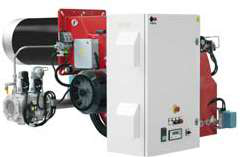
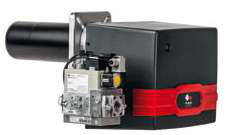
Industrial burners like the FBR GAS XP 60/2 CE TC EVO (116–630 kW two-stage gas burner) and the FBR KN 1300/M TL EL (1700–11500 Mcal/h dual-fuel heavy oil burner) introduce additional failure modes in combustion systems.
Two-Stage Burner Transition Failures
Two-stage burners operate at low fire (30–50% capacity) for standby, then transition to high fire for demand. Diagnostic focus shifts to stage transition reliability:
- Stuck at low fire: Air damper control solenoid fails; burner cannot reach high-fire pressure
- Uncontrolled stage switching: Pressure regulator malfunctions, causing rapid cycling between stages
- High-fire ignition failure: Low-fire operates normally, but ignition fails when transitioning to high-fire
For the FBR GAS XP 60/2 CE TC EVO (operating at 66–69 dBA), maintenance teams should verify that acoustic signature changes appropriately during stage transition—sudden silence or noise level plateau indicates transition valve failure.
Modulating Burner Control Issues
Modulating burners like the FBR KN 1300/M TL EL adjust output continuously rather than switching stages. These systems require proportional control signals from building management systems.
Common modulating burner failures:
- Modulation signal loss: Burner stays at minimum or maximum output despite demand changes
- Slow/hunting response: Control loop instability causes temperature oscillation
- Rapid output cycling: Control valve stiction or PID tuning problems
Diagnosis requires oscilloscope measurement of analog control signals (typically 4-20 mA) and verification that burner output responds proportionally to signal changes.
Preventive Maintenance Schedule Based on Failure Analysis
Drawing from 35+ years of equipment distribution experience, implement this maintenance cadence in Singapore's tropical climate:
Monthly: Visual inspection of flame appearance, pressure gauge reading stability, control unit supply voltage
Quarterly: Clean UV sensor windows; measure flame detection signal strength with oscilloscope
Semi-Annual: Full fuel system pressure test; verify pressure switch calibration against primary gauge; inspect ignition electrode for erosion
Annual: Replace fuel filters; have control units tested by authorized service centers; measure burner acoustic output
Upon any lockout event: Follow diagnostic decision tree from Step 1; document findings in maintenance log
This schedule prevents 80% of burner failures through early detection rather than emergency replacement.
Supplier Selection: Equipment Availability in Singapore
When diagnostic testing identifies component failures, 3G Electric supplies replacement control units, pressure switches, and sensors with full technical support. Our 35+ years distributing industrial equipment means we understand compatibility requirements:
- Kromschroder BCU 570WC1F1U0K1-E for gas/oil burners requiring EN 746-2 compliance
- Pressure Switch DG 50U/6 for SIL 3-rated safety applications
- Siemens LFL 1.622 for medium-to-high power burner systems with advanced flame monitoring
- FBR GAS XP 60/2 CE TC EVO for two-stage industrial gas heating
- FBR KN 1300/M TL EL for dual-fuel industrial applications
Having replacement components on hand—even as insurance spares—reduces downtime dramatically when failures occur. Singapore's humid environment means component degradation rates exceed manufacturer predictions; proactive stocking prevents extended shutdown during procurement delays.