Industrial Pump Displacement & Power Ratings: Engineering Selection for Global Operations
Pump displacement and power rating represent two of the most fundamental specifications in industrial pump selection, yet they are frequently misunderstood or oversimplified in procurement decisions. Displacement—measured in cubic centimeters per revolution (cc/rev) or liters per minute (L/min)—directly determines the volumetric capacity of a pump, while power rating, expressed in kilowatts (kW) or horsepower (hp), quantifies the energy input required to achieve that displacement under specified pressure conditions. For procurement and purchase engineers evaluating industrial pumps and compressors for global operations, understanding the relationship between these parameters and their implications for system design, efficiency, and cost is essential. This article provides a data-driven framework for interpreting pump specifications, comparing equipment across pressure and flow tiers, and making engineering-informed procurement decisions that align with operational requirements in diverse industrial environments.
Pump Displacement Fundamentals & Power Consumption Dynamics
Pump displacement defines the volume of fluid moved per complete revolution of the pump shaft, typically expressed in L/min (liters per minute) at a standardized rotation speed. For positive displacement pumps—which are the dominant category in industrial applications globally—displacement is a fixed geometric property determined by internal component geometry. A pump with a displacement rating of 15 L/min will deliver approximately 15 liters per minute of flow at its rated speed, regardless of pressure, provided cavitation and mechanical losses remain within acceptable limits.
Power rating, conversely, represents the mechanical input energy required to drive the pump and overcome system resistance. This relationship is governed by the fundamental equation: Power (kW) = (Pressure × Flow) / 600, where pressure is expressed in bar and flow in L/min. This relationship reveals a critical insight for procurement engineers: a pump with identical displacement can require vastly different power inputs depending on operating pressure. A pump delivering 15 L/min at 100 bar requires approximately 2.5 kW, while the same 15 L/min displacement at 250 bar demands roughly 6.25 kW—a 2.5× increase in power consumption for identical volumetric capacity.
This power-pressure relationship has profound implications for motor selection, electrical infrastructure, cooling system design, and operational cost modeling. In global industrial operations spanning facilities with varying electrical standards—from 50 Hz European grids to 60 Hz North American systems—matching pump power ratings to available motor specifications becomes a critical procurement constraint. Additionally, power consumption directly correlates with heat generation within the pump and fluid circuit. High-pressure, lower-displacement systems often exhibit superior efficiency characteristics in space-constrained applications, while moderate-pressure, higher-displacement configurations may prove more cost-effective in applications tolerant of larger footprints.
Technical Specifications Across Industrial Pressure Tiers
Industrial pump applications globally distribute across distinct pressure tiers, each with characteristic displacement-to-power ratios and operational suitability. Examining real-world product specifications reveals these relationships with precision.
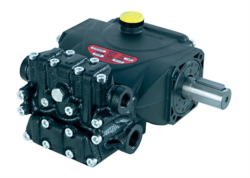
The Interpump E3C1021 exemplifies the moderate-pressure, higher-displacement category common in general industrial applications. This unit delivers 21 L/min at 100 bar with power consumption of 4.04 kW (5.5 hp), operating at 1750 rpm. The power-to-displacement ratio calculates to 0.192 kW per L/min—a baseline efficiency metric useful for benchmarking. The pump's relatively compact dimensions (265 × 223 × 140 mm) and 9.5 kg weight make it suitable for applications where space and weight constraints exist, such as mobile equipment or modular systems common in agricultural and small-scale industrial sectors globally.
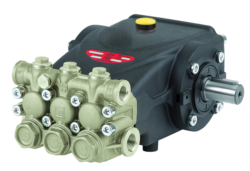
Mid-range pressure applications are represented by the Interpump E3C1515, which delivers 15 L/min at 150 bar with 4.26 kW (5.8 hp) power consumption at 1750 rpm. This specification profile (0.284 kW per L/min) reflects the efficiency penalty of higher pressure operation. The identical footprint to the E3C1021 (265 × 223 × 140 mm) demonstrates mechanical platform standardization—a procurement advantage enabling standardized mounting, cooling, and integration approaches across multiple pressure ratings within a product family.
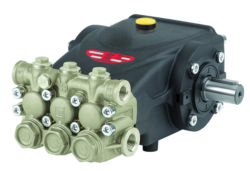
High-pressure applications leverage models such as the Interpump E3B2515, which operates across two configurations: the E3B2515I delivering 15 L/min at 250 bar and the E3B2515 L (same displacement, same pressure rating). Both require 7.13 kW (9.7 hp) power input at 1450 rpm operating speed. The power-to-displacement ratio (0.475 kW per L/min) illustrates the efficiency curve of high-pressure displacement: more energy input per unit flow, but substantially higher pressure capacity enabling smaller cylinders and more compact downstream equipment. For applications including industrial cleaning systems, high-pressure forming equipment, and specialized manufacturing processes demanding pressure above 200 bar, this efficiency trade-off often delivers net system advantages.
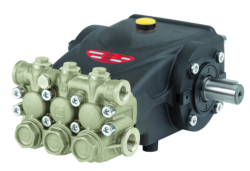
For integrated solutions requiring valve and gearbox functionality, the Interpump E3B1515 with integrated valve and RS500H gearbox maintains identical displacement (15 L/min) and pressure (250 bar) specifications while incorporating directional control and speed reduction within a single mechanical package. This integrated approach reduces component count, simplifies fluid circuit design, and often provides cost advantages in production applications where standardized component sets can be deployed across multiple equipment lines.
Real-World Application Scenarios & Displacement Matching
Understanding pump displacement and power specifications becomes actionable when mapped against specific industrial requirements. Consider a global manufacturing facility requiring hydraulic actuation for a metal forming press. The application demands 20 L/min flow delivery at 150 bar system pressure sustained for 8-hour operational shifts. Displacement selection would naturally fall to the E3C1515 (15 L/min at 150 bar), requiring either two units in parallel or a single larger-displacement model—a procurement decision involving cost, space, and redundancy considerations.
Alternatively, a cleaning equipment manufacturer serving global markets may require multiple pressure tiers for different customer segments: gentle surface cleaning at 100 bar for delicate substrates (E3C1021), medium-intensity cleaning at 150 bar (E3C1515), and high-pressure industrial cleaning at 250 bar (E3B2515). Standardizing on compatible Interpump products enables streamlined procurement, simplified spare parts inventory, and technician training efficiency across product lines—substantial advantages in global distribution scenarios where supply chain complexity directly impacts operational margins.
Mobile equipment applications—common in agricultural, forestry, and construction sectors globally—present unique displacement-matching challenges. Limited engine power budgets demand maximum hydraulic output per kilowatt of power consumption. The E3C1021's 0.192 kW/L/min efficiency profile outperforms higher-pressure units, making it optimal for applications like tractor hydraulic systems where displacement volumes of 15–25 L/min operate across 80–120 bar ranges. Conversely, compact equipment with rigid space constraints often benefits from higher-pressure, lower-displacement solutions despite efficiency penalties, because system component sizes scale directly with pressure rather than displacement.
Procurement Selection Methodology & Best Practices
Effective pump procurement requires systematic evaluation of displacement and power against operational parameters. Begin by defining system requirements: required flow rate (L/min), operating pressure (bar), duty cycle (intermittent vs. continuous), and environmental constraints (temperature, contamination, duty cycle).
Calculate theoretical power consumption using the formula: Power = (Pressure × Flow) / 600. Compare this to available motor specifications and electrical infrastructure at deployment locations. In global operations, accounting for regional voltage standards (220V single-phase through 480V three-phase) and frequency differences (50 Hz vs. 60 Hz) prevents costly equipment modifications or operational limitations.
Evaluate displacement efficiency ratios (kW per L/min) across candidate products. Lower ratios indicate superior efficiency at given pressure, but must be weighted against cost, availability, and space constraints. Standardizing on products from compatible families (such as Interpump's modular line) simplifies maintenance, spare parts provisioning, and operator training—particularly valuable in decentralized global operations.
Account for duty cycle implications. Intermittent-use applications tolerate lower efficiency (higher power consumption) provided thermal management remains adequate. Continuous-duty systems demand higher efficiency ratings to manage heat generation and control operating costs. Pressure margin analysis—specifying equipment rated 20–30% above nominal system pressure—provides safety buffers for transient pressure spikes common in industrial hydraulics globally.
Conclusion & Engineering Guidance
Pump displacement and power ratings represent interdependent specifications whose relationship directly shapes industrial equipment selection, system design, and operational performance. Understanding these fundamentals—and interpreting real product specifications against application requirements—enables procurement engineers to make informed decisions delivering optimal cost, reliability, and performance across global industrial operations.
The Interpump product families discussed throughout this article exemplify how standardized displacement platforms (15 L/min, 21 L/min) combined with modular pressure ratings (100, 150, 250 bar) and integrated valve/gearbox options enable comprehensive system solutions. Whether your organization operates a single facility or manages distributed equipment globally, evaluating pump specifications against documented technical parameters ensures alignment with engineering requirements and operational budgets.
Ready to specify the right pump for your industrial application? Contact 3G Electric's technical team for detailed consultation on pump displacement selection, power rating analysis, and equipment matching for your specific operational requirements. Our equipment specialists can review your system specifications and recommend products from our comprehensive pumps and compressors inventory, supporting industrial operations globally with expert procurement guidance.