Understanding Pumps & Compressors Control Systems in Industrial Settings
Pumps & Compressors control systems are the nervous system of modern industrial operations. While mechanical components like impellers, rotors, and bearings receive substantial maintenance attention, the electrical control infrastructure—variable frequency drives (VFDs), programmable logic controllers (PLCs), solenoid valves, pressure transducers, and motor starters—often operates invisibly until catastrophic failure occurs.
In Singapore's manufacturing and water treatment sectors, control system failures represent 35-40% of unplanned equipment shutdowns. Unlike bearing wear or cavitation (which develop gradually), electrical failures frequently manifest as sudden, complete system loss. Over 35 years of distributing industrial equipment, 3G Electric has documented recurring control system failure patterns that allow technicians to diagnose and resolve issues systematically.
This guide provides industrial professionals with structured troubleshooting protocols for the most common control system failures affecting pumps and compressors, including diagnostic procedures, root cause identification, and repair recommendations.
Section 1: Variable Frequency Drive (VFD) Malfunctions and Diagnostics
Common VFD Failure Modes
Variable frequency drives control motor speed and torque, optimizing energy consumption and process performance. VFD failures typically manifest as:
- No output voltage — drive powers on but produces zero output to motor
- Nuisance tripping — drive shuts down repeatedly without load-side fault
- Partial voltage output — motor receives reduced voltage, causing underspeed operation
- Overheating and thermal shutdowns — internal component temperatures exceed safe limits
- Communication loss — networked VFD loses contact with supervisory system
Diagnostic Procedure for VFD Failures
Step 1: Verify Input Power Supply
Before assuming VFD failure, confirm that three-phase power delivery meets specifications:
- Measure voltage at VFD input terminals using a digital multimeter (should read 400V ±10% for Singapore industrial supply)
- Check for voltage imbalance: calculate (Max Phase Voltage - Min Phase Voltage) ÷ Average Voltage × 100%. Values exceeding 3% indicate utility or wiring problems
- Verify phase rotation using a rotation meter—incorrect rotation causes immediate drive shutdown on some models
- Inspect all input fuses and circuit breakers; a single blown fuse prevents three-phase operation
Most drives display fault codes on integrated keypads:
- Record the exact error code and note any secondary codes displayed
- Consult the drive manufacturer's manual—each code points to specific circuit sections
- Common codes include: E.FLT (electronics fault), E.OCP (overcurrent protection), E.OVV (overvoltage), E.THM (thermal shutdown)
- Note the time of fault occurrence relative to load demand (failures at startup vs. runtime suggest different root causes)
Using an oscilloscope or true-RMS multimeter:
- Measure voltage between each output phase pair (U-V, V-W, W-U)
- All three readings should be equal within ±2%. Significant deviation indicates internal transistor failure
- On oscilloscope, verify pulse-width-modulated (PWM) waveform appears at 5-20 kHz frequency
- Distorted or missing PWM signals indicate gate driver circuit failure
Disconnect motor leads from drive output terminals and measure resistance using an ohmmeter:
- Three-phase motor resistance between any two phases should be identical (within 5%)
- Very low or zero resistance indicates motor phase-to-ground short
- Infinite resistance suggests open winding—motor requires replacement
- If motor tests normal, VFD output failure is confirmed
VFD Remediation Strategies
For input power problems: Contact facility electrical maintenance to verify utility supply and correct any wiring faults. Install a line reactor if voltage spikes exceed ±15%.
For thermal shutdowns: Ensure cooling fan intake is not blocked. VFDs generate 15-25% heat loss; confirm ambient temperature remains below 40°C. If facility ambient exceeds 35°C, install a separate cooling fan across the drive heatsink.
For persistent error codes: Power-cycle the drive (turn off main disconnect, wait 2 minutes for capacitor discharge, then restart). Momentary spikes often trigger nuisance faults that clear automatically. If faults recur, contact 3G Electric with the error code and load specifications—replacement drives can be arranged quickly for Singapore operations.
Section 2: Solenoid Valve Control Failures and Troubleshooting
Understanding Solenoid Valve Operation in Pump Systems
Solenoid valves regulate pump outlet flow, modulate pressure, or enable/disable system operation. They contain electromagnetic coils that pull armature plungers when energized, opening internal ports. Solenoid failures prevent proper system response and can cause:
- Continuous pump discharge without on-demand regulation
- Inability to shut down pump circuits
- Intermittent operation during startup
- Pressure overshoot beyond relief valve setpoints
Diagnostic Testing for Solenoid Coils
Resistance Testing (Ohm Check)
Using an ohmmeter:
- Disconnect solenoid coil electrical leads
- Measure resistance across the coil terminals
- Standard industrial solenoids read 10-50 ohms at room temperature (varies by model)
- Zero ohms indicates internal short; infinite ohms indicates open winding
- Resistance significantly higher than specification suggests moisture ingress or age-related degradation
With solenoid energized:
- Measure voltage at solenoid terminals using a digital multimeter
- Industrial solenoids typically require 24 VDC or 110/220 VAC
- Voltage below 90% of nominal prevents sufficient magnetic force for armature pull
- Use a clamp meter to measure coil current; compare to nameplate rating
- Current 25% below specification suggests partial de-energization; current exceeding specification indicates imminent coil burnout
- With solenoid energized, listen for audible "click" sound indicating armature movement
- Absence of click suggests coil has lost magnetic field strength
- Feel for vibration near solenoid body during energization—strong vibration is normal
- Manually attempt to pull armature plunger (power off); excessive resistance indicates mechanical sticking from contamination
Solenoid Failure Root Causes and Solutions
Coil Burnout (Open Winding)
Cause: Extended power application during stuck-valve condition, or electrical surge from improper VFD grounding.
Solution: Install protective diodes (flyback diodes) across coil terminals to suppress voltage spikes. Replace coil or entire solenoid assembly. Verify downstream valve is not mechanically stuck before restart.
Stuck Armature (No Movement)
Cause: Contamination from system fluid degradation or corrosion, preventing plunger travel.
Solution: Power-cycle solenoid 5-10 times with 2-second intervals to dislodge particles. If armature remains stuck, remove solenoid and soak in appropriate solvent (mineral oil for hydraulic systems, water-based cleaner for water systems) for 4-6 hours. Manually work plunger up and down 20-30 times. If sticking recurs within days, system fluid requires full change and filter upgrade.
Insufficient Voltage Supply
Cause: Control circuit voltage regulation failure, long wire runs with excessive resistance, or shared power supply overload.
Solution: Install a dedicated 24 VDC power supply for critical solenoid circuits. Upgrade wire gauge to reduce voltage drop below 2% at maximum current load. For existing installations, add a local DC power supply adjacent to solenoid location.
Section 3: PLC and Automation Logic Failures
Identifying Logic-Based Control Failures
Programmable logic controllers (PLCs) execute the control sequence for pump start/stop, pressure regulation, and system protection. Logic failures differ from electrical failures—power supply and indicators function normally, but the pump does not respond to commands. Common symptoms include:
- Pump remains off despite activation signal
- Pump operates in wrong sequence (continues running after stop command)
- Pressure regulation oscillates or drifts from setpoint
- Safety interlocks fail to activate
- Communication with remote supervisory system drops intermittently
Diagnostic Approach for Logic Failures
Step 1: Trace Input Signals
Using a multimeter and PLC diagnostics display:
- Verify pressure transmitters and flow sensors transmit correct 4-20 mA analog signals to PLC input modules
- Check digital input signals (start/stop buttons, limit switches): should read 0V for off-state, 24V for on-state
- Confirm all signal wires are connected to correct PLC terminals (cross-reference wiring diagram)
- Test sensor outputs independently using a variable power supply to confirm sensors respond correctly
- Access PLC programming software on connected laptop or engineering workstation
- Verify the pump start command logic is enabled and conditions are satisfied
- Check for disabled rungs or commented-out logic that may prevent operation
- Review PLC scan time (typical: 50-200 milliseconds); excessive scan times cause delayed response
- Look for watchdog timer resets that interrupt normal operation
- Measure voltage at PLC output terminals driving motor starter or VFD enable input
- Output should read 24V for on-state and 0V for off-state
- If PLC output reads correct voltage but solenoid/motor does not respond, fault lies downstream in power distribution
- If PLC output reads incorrect voltage (floating or stuck at 0V), PLC output module requires replacement
PLC Troubleshooting Strategies
For Communication Failures (Network Drop)
Industrial Ethernet or serial communication between PLC and remote SCADA system:
- Verify network cable connections are fully seated and shielded from high-voltage wiring (minimum 300 mm separation)
- Check for broken wire pairs inside Ethernet connectors using a cable tester
- Confirm PLC and SCADA system use identical communication protocol (Modbus RTU, Profibus, EtherCAT, etc.)
- Reset Ethernet port by power-cycling PLC for 30 seconds
- If communication restores intermittently, replace PLC communication module
When pump starts correctly but solenoid valve does not modulate pressure:
- Cross-reference pressure setpoint value stored in PLC program memory
- Verify analog output from PLC (0-10V or 4-20 mA) that controls proportional solenoid matches signal range calibrated at solenoid installation
- Use oscilloscope to measure PLC analog output waveform quality; distorted signals indicate output module failure
- If setpoint appears reasonable but valve position does not follow, proportional solenoid response may be degraded—test solenoid separately or arrange replacement through 3G Electric
Intermittent failures suggest electrical noise or marginal component performance:
- Install ferrite clamps on all power and signal cables entering PLC enclosure
- Verify all PLC and field device grounds connect to single point on facility ground buss
- Check for loose terminal connections inside control panel; vibration from running pumps can loosen terminals
- If failures continue, suspect capacitor aging in PLC power supply—replacement power supply modules are inexpensive and resolve most intermittent issues
Section 4: Practical Troubleshooting Decision Tree and Remote Support
Diagnostic Decision Tree for Control System Failures
Symptom: Pump does not start on command
1. Verify motor starter coil energized (listen for relay click, measure 24V coil voltage) → If coil not energized, check PLC output signal. If signal absent, proceed to logic diagnostics
2. If coil energized but motor does not turn, measure VFD output voltage. If zero, proceed to VFD diagnostics
3. If VFD output normal, check motor isolation and phase rotation. If motor tests normal, physical blockage preventing rotation (cavitation lock, bearings seized)
Symptom: Pump operates but pressure does not build
1. Verify pump inlet pressure reading on gauge. If inlet gauge reads zero, air leak or empty supply tank
2. If inlet pressure normal, measure pump outlet pressure. If below setpoint, adjust relief valve incrementally (1/4 turn at a time) while observing pressure gauge
3. If relief valve adjustment does not increase pressure, solenoid valve may be stuck open. Isolate solenoid and test coil resistance
4. If pressure still does not build, pump mechanical failure (worn impeller or internal leakage) requires service
Symptom: Excessive pressure spikes above relief setpoint
1. Measure relief valve pilot pressure signal (solenoid coil voltage and current)
2. If pilot signal is normal but pressure overshoots, relief valve internal spool stuck partially closed—requires disassembly and cleaning
3. If pilot signal is abnormal, solenoid coil degraded or control PLC output signal erratic
Selecting the Right Pump for Replacement
When control system diagnostics identify pump mechanical failure or when control system incompatibility arises, selecting appropriate replacement equipment ensures compatibility:
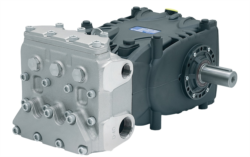
For moderate-flow applications (100-150 L/min at 160-200 bar), the Pratissoli KF30 high-performance industrial pump delivers 106 L/min at 200 bar with 40 kW power input—ideal for compact installations requiring Italian engineering reliability. The KF30 integrates easily with existing PLC control systems supporting 4-20 mA analog feedback.
For higher-capacity operations (200+ L/min), the Pratissoli MW40 industrial pump provides 211 L/min at 210 bar pressure with 85 kW power, suitable for large-scale manufacturing and water circulation systems. The MW40 includes integrated pressure transducer ports for closed-loop PLC control.
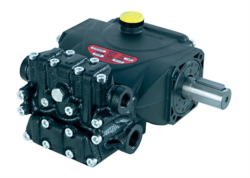
For compact high-pressure circuits requiring minimal footprint, Interpump E1D1808 L gear pump delivers 8 L/min at 180 bar with only 2.72 kW input—ideal for auxiliary and pilot pump applications where space and energy efficiency matter.
For proportional valve control requiring precise flow regulation, Interpump ET1C1612 SX*D20 pump operates at 1750 rpm with 12 L/min output and 3.68 kW power—designed for smooth solenoid valve modulation without flow pulsation.
3G Electric's technical team can verify pump control system compatibility before purchase, ensuring your replacement equipment integrates seamlessly with existing PLC programming and electrical infrastructure.
When to Engage Professional Support
Diagnostic procedures identify most common faults within 15-30 minutes. However, contact 3G Electric if:
- Multimeter and oscilloscope testing reveal uncertain results
- Error codes do not correspond to documented failure modes
- VFD or PLC replacement is required (technical specifications must match original equipment)
- Pressure relief valve internal service or proportional solenoid replacement is needed
- Pump replacement is being considered and control system compatibility requires verification
Singapore-based industrial professionals can reach 3G Electric's technical support team with photographs, error codes, and test measurements. With 35+ years of equipment distribution experience, our team provides rapid guidance to minimize downtime and optimize long-term system reliability.