Introduction: The Silent Threats in Pumps & Compressors Operations
Bearing wear and mechanical seal degradation represent the most insidious failure modes in Pumps & Compressors systems. Unlike cavitation or thermal runaway, these mechanisms develop silently over weeks or months, making early detection the critical difference between planned maintenance and emergency shutdown.
With 35+ years of global industrial equipment experience, 3G Electric has observed that maintenance teams often detect bearing wear only after audible noise emerges or seal leakage becomes visible—both indicators of advanced degradation. This guide provides actionable diagnostic protocols that identify mechanical degradation at early stages, enabling predictive intervention rather than reactive replacement.
Section 1: Bearing Wear Detection and Diagnostic Methodology
Understanding Bearing Degradation Patterns
Bearings in Pumps & Compressors experience three distinct wear phases:
Phase 1: Incipient Wear (0-15% capacity loss)
- Spalling initiates on raceway surfaces
- Vibration frequency shifts slightly
- Temperature remains near baseline
- Detection requires vibration analysis or ultrasonic inspection
- Audible grinding or rumbling sounds emerge
- Vibration amplitude increases measurably
- Operating temperature rises 5-15°C above baseline
- Loose metal particles contaminate internal fluid circuits
- Bearing play becomes visible
- Catastrophic failure imminent within days
- Pump discharge pressure fluctuates unpredictably
- Risk of complete component seizure
Field Diagnostic Protocol
Vibration Analysis Method:
Use a handheld vibration meter (ISO 20816-3 compliant) at three measurement points: axial (top), horizontal (side), and vertical (bottom) on the pump housing. Record baseline readings during commissioning phase.
- Normal bearing condition: 2.3-4.5 mm/s RMS
- Warning threshold: 4.5-7.1 mm/s RMS (schedule maintenance within 2-4 weeks)
- Alert threshold: 7.1-11.0 mm/s RMS (schedule maintenance within 1-2 weeks)
- Alarm threshold: >11.0 mm/s RMS (operate only to nearest shutdown window)
Frequency analysis through FFT (Fast Fourier Transform) reveals bearing-specific fault signatures. Ball pass frequency outer race (BPFO) and ball pass frequency inner race (BPFI) spikes indicate advanced spalling.
Ultrasonic Bearing Inspection:
Ultrasonic devices detect high-frequency stress waves (20-40 kHz) generated by friction and microslip in bearing raceways. This method identifies wear 3-4 weeks earlier than vibration analysis.
- Baseline: 3-6 dB above ambient electrical noise
- Minor wear: 8-15 dB elevation (plan maintenance in 3-4 weeks)
- Moderate wear: 15-25 dB elevation (plan maintenance in 1-2 weeks)
- Severe wear: >25 dB elevation (immediate intervention required)
Install thermocouples on bearing housings and track daily temperatures. A sustained rise of 8-12°C above baseline over 1-2 weeks indicates bearing friction increase. Sudden spikes (>15°C above baseline) suggest developing spalling.
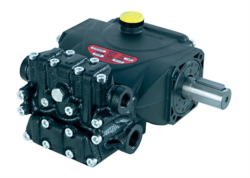
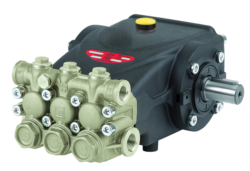
For Interpump equipment like the PUMP E3B2515I R, monitor bearing temperature via infrared camera at the gearbox interface and pump inlet housing.
Section 2: Mechanical Seal Integrity Assessment and Failure Prevention
Seal Failure Mechanisms in Pumps & Compressors
Mechanical seals fail through four primary mechanisms:
1. Face Wear (Most Common)
- Stationary and rotating seal faces experience micro-abrasion
- Caused by particulate contamination in pumped fluid
- Manifests as increased leakage rate (drips to steady flow)
- Typical lifespan reduction: 30-50% with high particulate presence
- Seal elastomers swell or shrink in incompatible fluids
- Springs corrode in chemically aggressive media
- Carbon face becomes brittle in oxidizing environments
- Common in oils exceeding 65°C without proper inhibitor packages
- Differential thermal expansion creates face separation
- Occurs when cooling water circuits fail or bypass
- Dry-running conditions cause immediate thermal spike (100°C+ at faces)
- Results in rapid face wear and leakage
- Bubble collapse near seal faces creates pitting
- Associated with low inlet pressure or high viscosity fluids
- Appears as microscopic surface cratering under inspection
- Reduces seal life by 40-60%
Diagnostic Inspection Protocol
Visual Inspection Checklist:
- Observe dripping rate at seal cavity drain: 0-1 drop/minute is acceptable; >1 drop/minute indicates face wear
- Check drain line for color changes (darkening indicates thermal degradation)
- Inspect seal cavity for crystalline deposits (chemical incompatibility indicator)
- Look for oil vapor discoloration on external pump housing (sign of elevated internal temperature)
Extract 100 mL fluid sample from pump outlet. Perform ISO 4406 particle count analysis.
- ISO 16/14/11 or better: Acceptable seal life (normal wear)
- ISO 17/15/12 to ISO 18/16/13: Reduced seal life (40-60% nominal)
- ISO 19/17/14 or worse: Rapid seal failure (10-30% nominal life)
Particulate contamination accelerates face wear exponentially. For sealed systems using Interpump equipment like PUMP E3B1515 DX*VALV.DX + GEARBOX RS500H, maintain fluid condition at ISO 16/14/11 through inline 3-micron filtration.
Thermal Signature Analysis:
Compare seal cavity temperature to pump inlet temperature:
- Normal operation: Seal cavity 8-15°C above inlet
- Elevated friction: Seal cavity 20-30°C above inlet (plan seal replacement in 4-6 weeks)
- Critical condition: Seal cavity >40°C above inlet (replace seal immediately)
Use infrared thermography on the gearbox mounting face and stuffing box area to detect localized hot spots indicating pressure or thermal concentration.
Acoustic Signature Monitoring:
Abnormal seal cavitation produces distinctive high-frequency clicking sounds (2-5 kHz band). Record baseline operating audio signature during commissioning. Compare periodic recordings to detect acoustic drift indicating seal degradation.
Section 3: Predictive Maintenance Strategy and Implementation Framework
Building a Data-Driven Maintenance Calendar
3G Electric's 35+ years of equipment support experience demonstrates that maintenance teams operating Pumps & Compressors achieve 60% reduction in unplanned downtime through systematic monitoring of five key parameters:
1. Vibration Trending (Weekly)
- Take measurements at same location, same time, same equipment state
- Plot on control chart with upper control limit (UCL) and lower control limit (LCL)
- Trend allows early detection of gradual degradation
- Sudden jumps (>1.5 mm/s in one week) trigger immediate investigation
- Automated data collection via thermocouple and data logger is most reliable
- Manual IR imaging acceptable for smaller pump populations
- Set alert threshold at 85% of maximum design temperature
- Establish baseline during first 2 weeks of operation
- ISO particle count analysis
- Water content analysis (Karl Fischer method)
- Acid number (TAN) testing for oil degradation
- Viscosity confirmation at operating temperature
For PUMP E3C1515 L and similar equipment in continuous duty, increase fluid analysis to bi-monthly schedule.
4. Seal Leakage Quantification (Weekly)
- Measure drain flow rate in graduated cylinder over 60 seconds
- Document in maintenance log with operational hours and temperature
- Establish rate-of-change analysis: increasing trend indicates developing face wear
- Leakage rate doubling within 4 weeks warrants seal replacement scheduling
- Record 30-second audio sample at consistent equipment state
- Store digitally with date and operating parameters
- Compare qualitatively for emergence of grinding, clicking, or whistling sounds
- Frequency analysis via smartphone app (free FFT apps available) identifies bearing BPFO/BPFI spikes
Maintenance Action Matrix
Bearing Wear Intervention Schedule:
| Vibration Level | Ultrasonic dB | Temperature Rise | Recommended Action | Timeline |
|---|---|---|---|---|
| 2.3-4.5 mm/s | <15 dB | 0-8°C | Continue monitoring | Routine schedule |
| 4.5-7.1 mm/s | 15-20 dB | 8-12°C | Schedule bearing replacement | 4-6 weeks |
| 7.1-11.0 mm/s | 20-25 dB | 12-18°C | Expedite bearing replacement | 2 weeks |
| >11.0 mm/s | >25 dB | >18°C | Replace before next operation | Immediate |
Mechanical Seal Intervention Schedule:
| Drain Flow Rate | Fluid ISO Code | Seal Cavity Temp | Recommended Action | Timeline |
|---|---|---|---|---|
| <1 drop/min | 16/14/11 or better | <90°C | Continue operation | Routine schedule |
| 1-2 drops/min | 17/15/12 | 90-100°C | Schedule seal replacement | 6-8 weeks |
| 2-5 drops/min | 18/16/13 | 100-110°C | Expedite seal replacement | 2-3 weeks |
| >5 drops/min | 19/17/14+ | >110°C | Replace before next operation | Immediate |
Section 4: Spare Parts Strategy and Equipment Specifications
Critical Spare Parts Inventory for Global Operations
Maintenance teams supporting Pumps & Compressors across multiple locations should maintain strategic spare parts inventory to reduce response time:
Tier 1 (Stock at facility)
- Bearing sets matched to installed equipment (maintain 2 per pump)
- Mechanical seal cartridges with elastomer options for operating fluid compatibility (1 per pump)
- Seal cavity gaskets and O-rings (5 units each)
- Coupling alignment tools and spare flex elements
- Complete gearbox assemblies
- Shaft sleeves and wear rings
- Thermal gasket sets
- Inlet valve cartridges
- Complete pump casings
- Rotor assemblies
- Motor-pump flange kits
For organizations operating Interpump equipment such as PUMP E3B2515 L or PUMP E3C1021 DXV.DXNO.C/J, 3G Electric provides rapid-access spare parts catalogs and cross-reference materials to accelerate procurement.
Performance Specifications for Diagnostic Validation
When diagnosing Pumps & Compressors performance issues, reference original equipment specifications:
Typical Performance Baselines (Interpump Series):
- Rated flow accuracy: ±5% at design speed
- Pressure ripple: <3% at rated pressure
- Bearing radial play: 0.05-0.15 mm (new); >0.25 mm indicates replacement threshold
- Seal leakage: <5 mL/hour at rated pressure (new); >15 mL/hour indicates face wear
- Inlet temperature rise: <15°C above ambient
- Vibration: <4.5 mm/s RMS at rated speed
Maintenance teams should obtain original equipment baseline documentation during commissioning and store in digital maintenance management system for reference during diagnostic troubleshooting.
Conclusion: Building Sustainable Maintenance Excellence
Successful Pumps & Compressors maintenance programs rely on early detection of bearing wear and mechanical seal degradation through systematic diagnostic protocols. By implementing the field-tested methods outlined in this guide—vibration analysis, ultrasonic inspection, temperature trending, fluid condition monitoring, and acoustic signature tracking—maintenance teams transform reactive maintenance into predictive intervention.
3G Electric's three decades of global equipment support demonstrate that facilities investing in structured bearing and seal diagnostics achieve 40-60% reduction in emergency downtime, extend equipment life by 25-35%, and reduce total maintenance costs through optimized spare parts planning.
The diagnostic matrix and maintenance action schedules provided serve as implementation templates adaptable to facility-specific equipment configurations. Integration with computerized maintenance management systems (CMMS) enables data accumulation, trend analysis, and predictive modeling for continuous improvement of maintenance strategies.