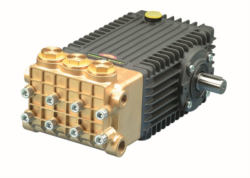
Selecting the Right Industrial Pump for High-Pressure Applications in Singapore
Choosing the correct industrial pump for your application requires understanding pressure classifications, flow rate requirements, and operational constraints specific to your industry. Whether you're operating a manufacturing facility, maintaining industrial cleaning systems, or managing hydraulic networks across Singapore, pump selection directly impacts efficiency, longevity, and operational costs. High-pressure applications demand particular attention to technical specifications, as undersized or incorrectly specified pumps lead to equipment failure, downtime, and safety risks. This guide examines critical selection parameters and introduces proven pump solutions suitable for diverse industrial scenarios.
Understanding Pressure Classifications and Pump Categories
Industrial pumps are classified primarily by maximum operating pressure, measured in bar, MPa, or PSI. Pressure classification determines the pump's structural integrity, material requirements, and suitability for specific applications. Low-pressure pumps typically operate below 100 bar (10 MPa / 1,450 PSI), while medium-pressure systems range from 100–250 bar, and high-pressure systems exceed 250 bar, reaching upward of 500 bar in specialized applications.
Pressure-rated pumps must maintain structural safety margins well above their intended operating pressure. A pump rated for 150 bar should not continuously operate at that maximum; instead, it functions optimally in the 80–120 bar range, preserving component lifespan and preventing seal degradation. This safety margin is critical in Singapore's demanding industrial environments, where equipment reliability directly affects production schedules and regulatory compliance.
Beyond pressure rating, pump selection depends on volumetric flow rate (measured in liters per minute or US gallons per minute), rotational speed (RPM), and power requirements (horsepower or kilowatts). The relationship between pressure and flow defines the pump's output power: higher pressures with lower flow rates suit precision applications, while higher flow rates at moderate pressures serve volume-intensive processes. Understanding this relationship prevents over-specification and cost waste while ensuring adequate performance margins.
Pump construction materials also vary by pressure class. Low and medium-pressure pumps often use aluminum or cast iron housings, while high-pressure units employ hardened steel and specialized seal materials to withstand extreme stress. For hazardous environments—such as ATEX-classified zones in petrochemical facilities—pump certification becomes mandatory, requiring specialized designs with explosion-proof construction.
Technical Specifications for Industrial Pump Applications
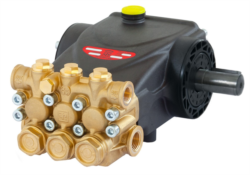
Examining specific industrial pump models illustrates how pressure, flow, and power specifications align with real-world requirements. The Interpump WW90 R + FLANGE B3B14 represents a compact, entry-level solution for moderate-pressure applications. Rated at 90 bar (9 MPa / 1,300 PSI) with a flow capacity of 8 liters per minute (2.11 US GPM), this 2 kW (2 hp) pump weighs only 5.2 kg and operates at 2,800 RPM. Its compact footprint—177 x 175 x 130 mm—makes it ideal for space-constrained installations, such as mobile cleaning equipment or integrated production lines.
For applications demanding higher flow rates at moderate pressures, the Interpump TSX 10.130 220/50 MULTIREG+ROTOTEK*TOTALSTOP delivers 9.5 liters per minute (2.5 US GPM) at 130 bar (13 MPa / 1,885 PSI), with a maximum pressure rating of 160 bar (16 MPa / 2,300 PSI). Weighing 44.5 kg, this unit incorporates pressure regulation and total-stop valve functionality, providing enhanced control in applications where pressure fluctuations could damage downstream equipment or compromise process precision. The integrated ROTOTEK governor ensures consistent pressure delivery, critical for hydraulic systems requiring stability.
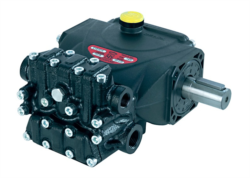
At the opposite end of the spectrum, the Interpump PUMP 5015 R ATEX exemplifies ultra-high-pressure engineering. This 14.7 kW (20 hp) pump operates at 500 bar (50 MPa / 7,250 PSI)—an extreme pressure suitable for specialized industrial cleaning, hydraulic presses, and petrochemical applications. Despite its power output, it maintains a relatively compact weight of 19.5 kg and produces 15 liters per minute (3.96 US GPM) at 1,450 RPM. Its ATEX certification signifies compliance with European hazardous-area directives, essential for installations in explosive atmospheres found in refineries and chemical processing facilities throughout Singapore's industrial zones.
The Interpump TSX 15.150 415/50 MULTIREG99*TOTAL STOP bridges medium and high-pressure applications, delivering 15 liters per minute (4 US GPM) at 150 bar (15 MPa / 2,175 PSI) with a maximum rating of 180 bar (18 MPa / 2,610 PSI). This configuration suits systems requiring consistent, high-flow output with integrated pressure management—typical of automated production lines, hydraulic power units, and integrated cooling systems across Singapore's manufacturing sector.
Real-World Application Examples
Industrial cleaning operations in Singapore frequently employ high-pressure pumps for surface preparation, equipment maintenance, and process cleaning. A facility managing petrochemical equipment might specify the Interpump PUMP 5015 R ATEX, whose 500 bar rating effectively removes heavy deposits, corrosion, and process residues without damaging underlying substrates. The pump's compact weight allows integration into mobile or semi-portable cleaning rigs, while ATEX certification ensures safe operation in classified areas where explosive vapors may be present.
Manufacturing operations utilizing hydraulic power systems benefit from pumps with integrated pressure regulation, such as the TSX series. A precision machinery manufacturer might deploy the TSX 15.150 415/50 to power hydraulic clamps, positioning systems, and load-bearing circuits. The integrated MULTIREG99 governor maintains consistent pressure across production cycles, reducing component stress and extending service life. The TOTAL STOP valve prevents drift when the system is idle, protecting machining tolerances and reducing energy consumption during extended shutdowns.
Smaller manufacturing facilities and contract services benefit from versatile, compact solutions like the WW90 R + FLANGE B3B14. This pump suits mobile equipment, portable pressure washing units, and modular pump stations where space limitations and weight restrictions apply. Its 90 bar capability accommodates a broad range of industrial applications while maintaining simplicity and reliability in field conditions across diverse Singapore industrial settings.
Critical Selection Criteria and Best Practices
When selecting an industrial pump, establish your actual operating requirements rather than maximum theoretical needs. Document the required flow rate at a specific operating pressure, not simply the highest pressure the application might encounter. Most systems operate well below maximum ratings; specifying pumps for average conditions—not worst-case scenarios—improves efficiency and reduces capital expenditure.
Consider duty cycle and operational continuity. Continuous-duty applications demand robust construction and superior cooling; intermittent operations allow lighter-duty, more economical designs. Environmental factors matter significantly in Singapore's tropical climate: humidity, corrosion potential, and temperature fluctuations influence seal longevity and material selection.
Evaluate total lifecycle cost, not just acquisition price. A slightly higher-specification pump with superior seals and materials may outperform budget options over 5–10 years through reduced maintenance and longer service intervals. Ensure your pump integrates with existing hydraulic systems, pressure sensors, and control schemes; compatibility prevents costly retrofitting and minimizes downtime during implementation.
Finally, verify certifications appropriate to your operating environment. ATEX certification is non-negotiable in hazardous areas; ISO and CE markings ensure quality standards; and material certifications confirm suitability for specific fluids (hydraulic oil, water, specialty coolants). Engage with established equipment distributors in Singapore who understand local regulatory requirements and can provide technical support throughout installation and operation.
Selecting the correct industrial pump demands balancing pressure, flow, power, environmental compatibility, and lifecycle value. Whether your operation requires compact low-pressure solutions or extreme high-pressure systems for hazardous environments, careful specification ensures reliable performance and operational efficiency. 3G Electric has served Singapore's industrial sector since 1990, providing expert guidance on pump selection, integration, and support. Contact our technical team to discuss your application requirements and identify the optimal pump solution for your operation.