Gas Burner Nozzle Size & Power Output Matching: A Practical Selection Guide for Singapore Industrial Applications
Selecting the correct gas burner for your industrial combustion system requires more than choosing the largest available unit. The relationship between nozzle diameter, power output, and electrical supply configuration directly impacts flame stability, fuel efficiency, and operational safety. Many maintenance teams in Singapore's manufacturing, food processing, and chemical industries face challenges when upgrading or replacing burners without understanding how nozzle geometry correlates to actual thermal output. This guide provides industrial professionals with the technical framework to make informed burner selections based on real-world performance data and practical application requirements.
Understanding Nozzle Size and Its Impact on Burner Performance
Automatic forced-draught burners for gaseous fuels shall demonstrate stable combustion across their full declared modulation range, with no flame failure or CO emission excursions exceeding the limits in §6.2 during the test cycle.
— Paraphrased from UNI EN 676:2008+A2:2013, the European standard governing automatic forced-draught burners using gaseous fuels
The nozzle is the critical interface where fuel atomization occurs in a gas burner system. Nozzle diameter, measured in millimeters, determines the spray pattern, fuel distribution, and maximum throughput capacity. In industrial combustion, a larger nozzle doesn't automatically mean better performance—it must be matched precisely to your thermal load requirements and furnace chamber dimensions.
Gas burner nozzles operate within defined pressure and flow rate parameters. A nozzle that is undersized creates backpressure and incomplete combustion, while an oversized nozzle produces unstable flames and poor fuel atomization. The nozzle diameter establishes the burner's operating window, which is expressed as a power range measured in kilowatts (kW). This range represents the minimum and maximum thermal output the burner can deliver while maintaining acceptable flame quality and combustion efficiency (per UNI EN 676 §6.2 stable-combustion requirement).
For example, a compact industrial burner with a 90 mm nozzle typically delivers 17.4 to 93 kW, while a larger 385 mm nozzle unit can operate between 130 and 850 kW. The wider operating window of larger nozzles makes them suitable for applications requiring variable load conditions or seasonal demand fluctuations. Conversely, smaller nozzles provide finer control for precision heating applications where thermal output needs to remain within tight bands (typically ±5% of setpoint for laboratory-grade thermal control).
Flame stability depends on the relationship between fuel velocity, air velocity, and combustion chamber geometry. When selecting a burner, the minimum power output (minimum kW) is particularly important—operating below this threshold causes flame dropout, which the flame supervision relay must detect within 3 seconds and lock out per EN 298:2012. The maximum power output indicates the burner's capacity ceiling and determines the largest furnace or boiler it can effectively heat. Industrial facilities in Singapore that operate multiple thermal loads should inventory burners across different nozzle sizes to maintain operational flexibility without compromising combustion quality.
Technical Specifications: Matching Nozzle Diameter to Your Thermal Requirements
3G Electric supplies several industrial-grade gas burner models specifically engineered for demanding applications across Singapore's manufacturing sector. Understanding the specification hierarchy—nozzle size, power output range, and electrical supply—is essential for correct equipment selection.
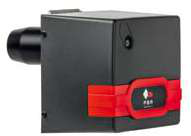
The FBR X GAS XP 60 CE TC EVO burner (_41) represents a mid-range solution with a 250 mm nozzle, delivering 232–630 kW output on a three-phase electrical supply. This specification profile suits medium-scale industrial heating applications, such as metal annealing furnaces, ceramic kilns, or large commercial boilers. The 398 kW operating window provides a 2.7:1 turndown ratio—adequate for facilities with moderate thermal-demand variation across production cycles, though shy of the 4:1 modulating-burner threshold typical for continuously varying loads.
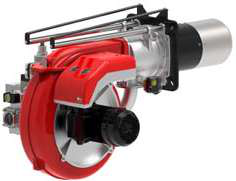
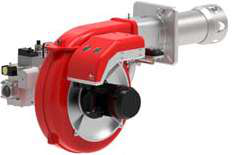
For higher-capacity applications, the FBR GAS XP 80/2 CE-LX4 TL Cl. 4 burner (_41) and its companion model FBR GAS XP 80/M CE-LX4 TL Cl. 4 (_41) both feature 385 mm nozzles capable of 850 kW maximum output. The key difference lies in their minimum power thresholds: the XP 80/2 operates from 170 kW minimum (5:1 turndown), while the XP 80/M starts at 130 kW (6.5:1 turndown). This distinction is critical when your furnace operates at low load for extended periods. Facilities requiring better low-load performance should prioritize the XP 80/M variant (per FBR X-series technical bulletin).
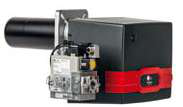
For smaller, precision-heating applications, the FBR GAS X2/M CE-LX4 TC Cl. 4 (_31) and FBR GAS X2/M CE TC (_31) provide 90 mm nozzles with 93 kW maximum output. The X2/M CE-LX4 variant extends the low-end capability to 23.7 kW (3.9:1 turndown), making it suitable for applications with significant load variation, while the CE TC model starts at 17.4 kW (5.3:1 turndown) for ultra-precise thermal control in laboratory furnaces or small batch-processing equipment.
The electrical supply specification (single-phase versus three-phase) affects installation infrastructure and operational costs. All high-capacity burners reviewed here require three-phase 400 V / 50 Hz supply (per IEC 60204-1 industrial machinery electrical equipment), which is standard throughout Singapore's industrial facilities. Single-phase 230 V models are reserved for lower-output units (under 100 kW) where three-phase infrastructure may not be economically justified.
Real-World Application Examples: Nozzle Selection in Practice
Consider a Singapore-based food processing facility operating a large-capacity steam boiler requiring 500 kW continuous thermal input with occasional peaks to 750 kW. The FBR X GAS XP 60 CE TC EVO (250 mm nozzle, 232–630 kW) would be undersized—peak demand exceeds its maximum capacity by 19%. Instead, the FBR GAS XP 80/M CE-LX4 TL Cl. 4 (385 mm nozzle, 130–850 kW) provides 13% headroom over peak and can modulate smoothly between 500 kW steady-state operation and 750 kW peak demand without thermal cycling or flame instability.
Alternatively, a textile dyeing facility requiring precise temperature control for wash water heating at 50–75 kW represents an undersized application for the large XP 80 series. Here, the FBR GAS X2/M CE-LX4 TC Cl. 4 (90 mm nozzle, 23.7–93 kW) becomes the optimal choice. Its 3.9:1 turndown range and 23.7 kW minimum operating point ensure stable, consistent heating without energy waste or frequent on-off cycling that degrades burner life and increases maintenance frequency (typical cycling-induced wear shortens electrode and ionisation-probe life by 40–60% versus modulated operation).
A metal fabrication shop operating an induction furnace with auxiliary heating for tool preconditioning faces a different scenario: thermal load varies between 60–200 kW depending on production schedules. A single burner selection becomes problematic—the XP 60 (232–630 kW) has an unacceptably high minimum, while the X2/M (23.7–93 kW) lacks sufficient maximum capacity. The solution involves either installing the XP 60 with a gas train equipped with proportional valve control (typically a Honeywell V4400 or Siemens SKP series modulating actuator), or operating multiple smaller burners sequentially. This real-world complexity underscores why consultation with equipment specialists is critical during the specification phase.
Selection Criteria and Best Practices for Industrial Burner Specifications
Load Profile Assessment: Before selecting a burner model, document your facility's thermal requirements across operating scenarios—continuous operation, peak demand, and minimum idle load. The selected burner's minimum power output must not exceed your lowest operating requirement by more than 20%, and maximum output should exceed peak demand by a similar margin (10–20%) for safety and control headroom.
Turndown Ratio Considerations: The ratio between maximum and minimum power output determines modulation flexibility. Higher turndown ratios (wider operating windows) reduce the need for multiple burner models but may sacrifice precise control at lower loads. FBR's engineered specifications generally offer 3–5:1 turndown ratios (per FBR X-series technical bulletin), balancing flexibility with stability; specialised configurations reach 6.5:1 (XP 80/M).
Nozzle Size and Furnace Geometry: Nozzle diameter must align with your combustion chamber dimensions. Oversized nozzles can cause flame impingement on refractory walls (typically when flame length exceeds 60% of chamber depth); undersized nozzles may produce insufficient atomization in large chambers. Consult with equipment manufacturers when adapting burners to existing furnaces.
Control Integration: Verify that selected burners integrate with your existing or planned control system. CBM relay controls such as the TMG 740-3 provide flame safety and modulation management for pressurized-air and mixed-fuel burner configurations, with response time conformant to EN 298:2012 (≤3 s flame failure detection, ≤1 s safety shutoff). Ensure electrical supply specifications align with your facility's infrastructure.
Maintenance Access: Nozzle replacement and cleaning are routine maintenance tasks. Ensure your installation design permits safe, accessible nozzle removal without requiring furnace disassembly or extended downtime. Maintain spare nozzles for each burner model in your facility's inventory; typical service interval for industrial gas-burner nozzles is 4,000–6,000 operating hours, halved in dusty or high-particulate environments.
Conclusion and Next Steps
Proper gas burner nozzle and power output selection prevents operational inefficiencies, reduces unplanned maintenance, and ensures combustion safety across your industrial facility. The relationship between nozzle diameter and thermal output range is non-negotiable—undersized or oversized burners create operational problems that no amount of field adjustment can fully resolve.
Singapore's industrial professionals face diverse thermal requirements across manufacturing, food processing, chemical production, and facility management applications. The FBR gas burner lineup and supporting CBM control components provide proven solutions across the full spectrum of nozzle sizes (90–520 mm) and power outputs (17.4–5,232 kW), with all units conforming to UNI EN 676 and EN 298 safety requirements.
If you're upgrading existing combustion equipment or specifying new installations, 3G Electric's team has served Singapore's industrial sector since 1990. We provide technical consultation, equipment selection guidance, and supply genuine FBR burners and CBM controls with full technical documentation and local support. Contact 3G Electric today to discuss your specific thermal load requirements and receive a customized burner specification matched to your operational profile. Our technical specialists are available to review your combustion system design and recommend the optimal equipment configuration for performance, efficiency, and safety.