Introduction: Pumps & Compressors in Modern HVAC Thermal Management
Pumps and compressors form the backbone of sophisticated HVAC systems, managing heat transfer and fluid circulation across commercial and industrial facilities. For HVAC contractors operating in Singapore's hot, humid climate, understanding how to select and integrate these components directly impacts system reliability, energy efficiency, and client satisfaction.
With over 35 years of experience as a global distributor of industrial equipment, 3G Electric has worked with contractors across Southeast Asia to optimize thermal management solutions. The difference between a well-functioning cooling system and one prone to breakdowns often comes down to proper pump and compressor specification, installation technique, and ongoing maintenance protocols.
This guide focuses on the practical thermal management applications of pumps and compressors, offering HVAC contractors actionable insights for designing systems that perform reliably in Singapore's demanding climate conditions.
Section 1: Understanding Pump & Compressor Roles in HVAC Cooling Circuits
Pumps: The Circulation Backbone
In HVAC systems, pumps serve as the circulation engine, moving chilled water or refrigerant through cooling coils, heat exchangers, and distribution networks. The pump's primary job is to overcome system resistance and maintain consistent flow velocity—critical for heat transfer efficiency.
The flow rate and pressure capabilities of your pump directly determine:
- Heat removal capacity: Higher flow rates allow more thermal energy to be transferred per minute
- Coil performance: Insufficient flow creates thermal layering and reduces effective cooling capacity
- System responsiveness: Proper flow ensures temperature setpoints are maintained consistently across all zones
- Valve operation: Many control valves require minimum velocity to function correctly
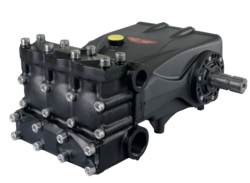
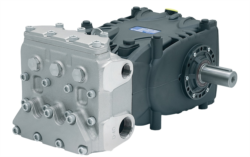
For example, the Pratissoli KF30 delivers 106 L/min at 200 bar with 40 kW input—suitable for mid-range commercial cooling systems serving multiple floors or zones. For larger installations, the Pratissoli MW40 provides 211 L/min at 210 bar, doubling the circulation capacity for high-demand facilities.
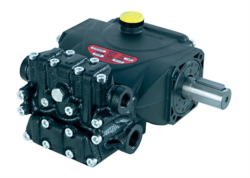
Smaller, precision applications benefit from compact solutions like the Interpump E1D1808 L, which delivers 8 L/min at 180 bar—ideal for point-of-use cooling or secondary circulation loops in larger systems.
Compressors: The Refrigerant Engine
Compressors move refrigerant through the vapor-compression cycle, raising pressure and temperature to enable heat rejection at the condenser. The compressor's displacement, speed, and efficiency rating determine how much cooling capacity your system can deliver and how much electrical energy it consumes.
Key compressor considerations for HVAC contractors:
- Displacement matching: Must align with condenser and evaporator capacity to prevent short-cycling or inadequate cooling
- Speed control: Variable-speed compressors adapt to partial-load conditions, improving efficiency and reducing energy waste
- Lubrication requirements: Proper oil circulation prevents wear and extends component life in Singapore's humid environment
- Pressure ratios: High ambient temperatures common in Singapore increase discharge pressures—verify compressor ratings for tropical conditions
Section 2: System Design Principles for Singapore Climate Conditions
Heat Load Calculation and Pump Sizing
Singapore's equatorial climate—consistently hot (27-35°C), humid (70-90%), and with high solar radiation—demands careful load analysis. A typical commercial building cooling load ranges from 150-300 W/m², significantly higher than temperate climates.
The proper sizing formula:
Required Pump Flow (L/min) = (Total Cooling Load in kW × 1000) / (Specific Heat × Temperature Difference × Density)
For practical application:
- Assume 4.18 kJ/kg·K for water (or chilled water properties)
- Typical ΔT across cooling coils: 5-7°C
- Most commercial systems target 5°C for balance between efficiency and pump power
- Facility cooling load: 500 kW
- Desired temperature drop: 6°C
- Required flow: (500 × 1000) / (4.18 × 6 × 1000) ≈ 20 L/s or 1,200 L/min
This would require multiple MW40 pumps in parallel or a larger centralized system. Undersizing creates inadequate cooling and hot spots; oversizing increases energy costs and creates excessive pressure drops.
Compressor Capacity and Refrigerant Selection
For HVAC systems in Singapore:
1. High-efficiency refrigerants: R-410A and R-32 are standard; verify local regulations as Singapore follows EPA guidelines
2. Compressor displacement: Should match condenser capacity at design ambient temperature (typically 35°C design for Singapore)
3. Capacity modulation: Variable-displacement or multi-stage compressors prevent excessive cycling during shoulder seasons (March-April, October-November)
High ambient temperatures increase refrigerant pressure and reduce compressor efficiency—a 40°C ambient (common during peak tropical heat) can reduce capacity by 15-20% compared to 35°C design conditions. Account for this de-rating when selecting equipment.
Piping Layout and Velocity Targets
Proper piping design ensures pumps operate efficiently:
- Liquid line velocity: 1.0-2.0 m/s (prevents noise, erosion, and excessive pressure drop)
- Suction line velocity: 0.6-1.2 m/s (prevents cavitation and maintains pump inlet conditions)
- Discharge line velocity: 2.0-4.0 m/s (balances pressure drop and cost)
In Singapore's high-humidity environment, use insulated piping to prevent condensation on chilled water lines. Uninsulated pipes can lose 10-15% of cooling capacity through convection and create building moisture problems.
Section 3: Installation and Configuration Best Practices
Pump Installation for Reliability
Suction-side design:
- Install a suction strainer upstream of the pump to protect against debris
- Provide a foot valve with check capability to prevent backflow
- Ensure suction line is shorter than discharge line to reduce resistance
- Use KF-series pumps with ISO 4400 suction side cleanliness to prevent failure
- Install a check valve immediately after the pump discharge to prevent backflow during shutdown
- Use a relief valve set 10-15% above system operating pressure to protect against overpressurization
- Include isolation ball valves to allow pump service without system shutdown
- For systems like the Pratissoli SS71153 (122 L/min at 160 bar), verify all downstream components are rated for 160 bar minimum
- Mount pumps on resilient isolators to absorb vibration—critical in office buildings where pump noise travels through structure
- Use flexible discharge piping (minimum 1 meter of hose or expansion loops) to decouple pump vibration from rigid piping
- Avoid rigid pipe clamps within 1 meter of pump discharge
Compressor Installation Considerations
Refrigerant charging:
- Overcharging increases discharge pressure and reduces efficiency—use electronic scales, never charge by temperature
- Undercharging reduces capacity and risks liquid slugging (compressor damage)
- In Singapore's heat, charge on the conservative side to prevent excessive pressure during peak ambient
- Verify proper oil type compatible with selected refrigerant
- Maintain oil sight glass at 40-60% to ensure adequate lubrication and cooling
- Check oil condition quarterly in tropical climates due to moisture absorption
- Single-phase power is common in Singapore; verify supply voltage stability (±10% variation)
- Larger compressors (MW40 or larger) typically require three-phase supply
- Install soft-start devices or variable frequency drives (VFDs) to reduce inrush current and mechanical stress
Integration with Controls
Modern HVAC systems require coordinated pump and compressor control:
- Variable-speed pumps: Use 0-10V signals or Modbus communication to modulate flow based on building demand
- Compressor staging: Multi-compressor systems should use capacity control algorithms to maintain 60-80% compressor load—optimal efficiency range
- Pressure transducers: Install on pump discharge and compressor suction/discharge to monitor system health
- Flow meters: Verify actual flow matches design assumptions; common issues include undersized piping or clogged strainers
Section 4: Commissioning, Optimization, and Troubleshooting
System Commissioning Protocol
Start-up sequence (in order):
1. Verify all isolation valves are open; check valve functions properly
2. Prime pump using suction isolation valve (for KF30 or similar) before full system operation
3. Start pump at lowest speed; listen for cavitation (high-pitched noise indicating air in suction line)
4. Gradually increase pump speed to operating RPM while monitoring discharge pressure
5. Check all piping and connections for leaks
6. Verify relief valve opens at set pressure by slowly closing a discharge valve
7. Start compressor and monitor refrigerant pressures; verify suction and discharge align with saturation temperatures
8. Measure chilled water temperature drop across evaporator—should match design ΔT (typically 5-7°C)
Performance Optimization in Tropical Conditions
Singapore-specific tuning:
- High ambient season (April-September): Monitor discharge pressure hourly; if exceeding design by >10%, reduce system load or increase condenser fan speed
- Humidity management: Ensure evaporator coils drain freely; standing water creates microbial growth and odor issues
- Seasonal capacity: During cooler months (November-February), reduce compressor displacement or unload cylinders to maintain 60-80% load factor
- Peak shaving: Implement thermal storage (ice or chilled water tanks) to flatten peak loads during 2-4 PM period when solar heat is maximum
Common Issues and Troubleshooting
Symptom: Inadequate cooling capacity
- Check pump discharge pressure against design specification (e.g., Interpump E1D1808 should deliver 8 L/min at 180 bar)
- Measure chilled water temperature and flow rate; if ΔT is <3°C, pump may be cavitating or suction strainer is clogged
- Verify compressor discharge temperature; if >60°C, system may be overcharged or condenser fouled
- Listen for cavitation (high-pitched, grinding sound)—indicates low suction pressure or air in line
- Check suction strainer; if pressure drop >0.2 bar, clean or replace element
- Verify pump mounting isolators are not hardened or missing
- Measure pump inlet pressure; should be 0.3-0.5 bar above atmospheric at pump inlet
- Verify pump flow matches system demand; if oversized, compressor may cycle frequently
- Check for thermal overload trips on compressor motor; if recurring, reduce ambient temperature load or add thermal storage
- Inspect discharge line insulation; in Singapore humidity, condensation on discharge lines reduces overall system efficiency
- Measure actual pump and compressor power input against nameplate ratings
- For MW40 (85 kW rated): actual power should be 70-90 kW under design load; if >95 kW, check for cavitation or oversizing
- Verify compressor suction temperature; for R-410A, should be 5-15°C below saturation at suction pressure
Conclusion
Pumps and compressors are engineered components requiring precise specification, careful installation, and thoughtful optimization to deliver reliable cooling in Singapore's demanding climate. HVAC contractors who master these fundamentals—understanding load calculations, designing for tropical conditions, installing with proper controls, and commissioning systematically—will build a reputation for systems that perform consistently and efficiently.
3G Electric's 35+ years as a distributor have shown us that most cooling system failures aren't due to equipment defects but rather specification errors, installation shortcuts, or inadequate commissioning. By following the practical guidance in this article, contractors can avoid these common pitfalls and deliver systems that exceed client expectations.
For technical support selecting the right pump or compressor for specific applications—whether the compact Interpump E1D1808 for precision cooling or the high-flow Pratissoli MW40 for large commercial facilities—consult 3G Electric's technical team. Our inventory of Italian-engineered Pratissoli and Interpump components, combined with local Singapore expertise, ensures you get both the right equipment and the support to install it correctly.