Understanding Pumps & Compressors as Critical Infrastructure
Pumps & Compressors form the cardiovascular system of industrial facilities across Singapore. Unlike passive equipment, these dynamic machines operate continuously under extreme pressure, temperature, and flow conditions. For plant managers, understanding the distinction between reliability (ability to function without failure) and maintainability (ability to repair quickly) determines whether your facility operates profitably or faces cascading production losses.
With over 35 years of experience distributing industrial equipment throughout Asia-Pacific, 3G Electric has observed a critical pattern: plants that adopt reliability-centered maintenance reduce unplanned downtime by 40-60% compared to reactive maintenance approaches. The difference lies not in equipment cost, but in engineering discipline and component selection aligned with actual operational demands.
The Singapore industrial sector, characterized by high-speed manufacturing, food processing, and petrochemical operations, demands equipment engineered for continuous duty cycles with minimal tolerance for failure. This guide addresses the technical requirements plant managers must understand to prevent catastrophic failures before they occur.
Failure Mode Analysis: Why Pumps & Compressors Fail Prematurely
Hydraulic Pump Failure Mechanisms
Pumps fail through five dominant mechanisms, each preventable through proper engineering:
Cavitation Damage occurs when pressure drops below vapor pressure at the pump inlet, creating vapor bubbles that implode violently against surfaces. This causes pitting, material erosion, and catastrophic performance degradation. Prevention requires maintaining inlet pressure above 0.3 bar absolute and ensuring suction lines remain fully submerged with minimal resistance.
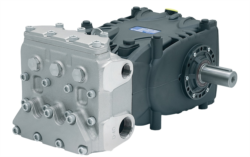
The Pratissoli KF30 industrial pump (106 L/min, 200 bar rating) demonstrates proper cavitation resistance through dual-stage design and optimized inlet geometry. For Singapore's tropical conditions with elevated fluid temperatures, this pump maintains stable performance where standard equipment fails within 2,000 operating hours.
Contamination-Induced Wear represents 80% of pump failures in industrial environments. Particles exceeding 25 microns penetrate clearances between rotating components, creating scoring and accelerating wear. A single grain of sand (approximately 100 microns) entering a high-pressure pump can reduce component lifespan from 10,000 hours to 500 hours.
Plant managers must implement ISO 18/16/13 filtration standards minimum—requiring oil with fewer than 320 particles per milliliter exceeding 4 microns. For critical applications, ISO 17/15/12 (fewer than 80 particles per milliliter at 4 microns) extends pump life to 20,000+ operating hours.
Thermal Degradation accelerates viscosity breakdown and seal deterioration. When pump outlet temperatures exceed 60°C (140°F), oil molecular bonds begin breaking. Singapore's ambient temperatures already stress cooling systems; inadequate heat rejection reduces oil life from 5 years to 18 months. The Pratissoli MW40 (211 L/min, 210 bar) requires dedicated cooling in tropical climates—a cost many plant managers underestimate until expensive failures occur.
Pressure Spikes from sudden load changes or system shocks generate transient pressures 2-3× the pump's rated pressure. Reciprocating compressors and quick-closing valves generate these destructive peaks. The Interpump ET1C1612 SX*D20 (12 L/min, 160 bar, PTFE construction) incorporates pressure-spike tolerant geometry rated for systems with hydraulic shock potential, yet many installations overlook this critical selection parameter.
Viscosity Incompatibility creates catastrophic wear when incorrect fluid types mix. Mixing mineral oil with synthetic fluids, or using fluid with viscosity outside ±10% of pump specification, reduces component life exponentially. Plant managers implementing multi-pump systems must verify fluid compatibility before commissioning.
Compressor Failure Pathways
Compressors fail through different mechanisms than pumps, requiring distinct prevention strategies:
Liquid Slugging occurs when liquid enters the compressor cylinder instead of vapor. A single slug of liquid occupying 2-3% of cylinder volume generates forces exceeding rated pressure by 300-400%, causing catastrophic damage to valves, pistons, and connecting rods. Prevention requires proper receiver sizing (minimum 3 minutes rated flow capacity) and effective moisture removal equipment sized for ambient humidity—critical in Singapore's 80-90% relative humidity environment.
Thermal Runaway develops when discharge temperatures exceed safe limits. Intercooler fouling (common in coastal Singapore facilities due to salt-laden intake air) reduces cooling effectiveness and temperature control. Compressors rated 100°C discharge temperature fail within 6 months when fouling causes actual discharge temperatures of 130°C.
Valve Failure results from inadequate maintenance intervals. Discharge valves operate under extreme stress—lifting and closing 600 times per minute at 200+ bar pressure. Particulate contamination as small as 10 microns wedges valves open, causing unloaded running and loss of flow capacity within 48 hours.
Reliability-Centered Component Selection Strategy
Right-Sizing Beyond Nominal Specifications
Most equipment failures stem from oversizing or undersizing equipment relative to actual duty cycles. A pump rated 100 L/min operating continuously at 90 L/min fails faster than a pump rated 120 L/min operating at 90 L/min. Continuous operation at 85-90% of rated capacity reduces bearing wear and heat generation significantly.
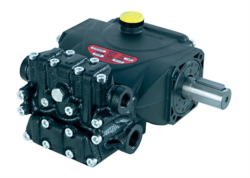
For high-pressure applications, the Interpump E1D1808 L (8 L/min, 180 bar, 2800 rpm) suits applications requiring exact flow matching. Its compact 5 kg design enables precision sizing without oversizing penalties. Many plant managers select equipment based on peak flow demand rather than average continuous duty—a critical error causing accelerated wear and fuel consumption penalties.
Material Selection for Tropical Environments
Singapore's maritime environment accelerates corrosion and seal degradation. Standard cast iron pump bodies corrode internally within 18 months in facilities near coastal areas or exposed to salt spray. The Pratissoli SS71153 (122 L/min, 160 bar) utilizes ductile iron construction with superior corrosion resistance for tropical service, extending intervals between major overhauls from 5,000 to 8,000 operating hours.
Seal materials require equal attention. PTFE (polytetrafluoroethylene) construction in the Interpump ET1C1612 SX*D20 pump provides superior chemical compatibility and maintains sealing integrity across wider temperature ranges than standard elastomers. For applications involving non-standard fluids or extreme temperature swings, PTFE seals reduce leakage and contamination ingress by 70-80%.
Bearing Life Calculation and Component Renewal
Bearing life follows L₁₀ (10% failure rate) methodology: B₁₀ = [(C/P)³] × 10⁶ revolutions, where C represents basic load rating and P represents actual load. For high-pressure pumps like the Pratissoli KF30, bearing life reaches 8,000-12,000 operating hours at rated conditions—but drops to 800-1,200 hours when system pressure exceeds specification by just 20%.
Plant managers must calculate actual bearing life based on measured operating conditions, not nominal ratings. Installing pressure gauges at pump inlet and outlet provides continuous feedback on bearing stress levels. When calculated bearing life indicates replacement requirements within 6 months, component renewal scheduling must be priority-planned to prevent catastrophic failures during production runs.
Preventive Engineering: Implementation Roadmap
Filtration System Design
Implement multi-stage filtration: 100-micron mesh at reservoir breathers (preventing ambient dust ingress), 25-micron pressure-line filters (protecting pump internals), and 3-micron return-line filters (removing wear debris). This configuration maintains ISO 18/16/13 contamination control and extends pump life from 5,000 to 15,000+ operating hours.
For systems utilizing the Pratissoli MW40 or larger equipment, invest in offline kidney-loop filtration circulating 5-10% of pump flow continuously through 2-micron filters. This removes wear particles before they recirculate through the pump, extending component life exponentially.
Temperature Management Protocol
Maintain oil temperature between 40°C and 50°C (104-122°F) for optimal performance. Install dual-element thermostats allowing 45°C setpoint with 5°C deadband—preventing thermal cycling that accelerates seal degradation. For tropical climates, oversized coolers represent the most cost-effective reliability investment: a cooler sized for 130% of calculated heat rejection cost $3,000-5,000 but prevents $150,000+ pump replacement failures.
Pressure Profile Mapping
Establish baseline pressure profiles under known-good conditions at pump inlet, outlet, and critical load points. Repeat measurements quarterly. When pressures deviate >10% from baseline, investigate root causes before failures cascade:
- Inlet pressure dropping >0.5 bar suggests suction-line restriction or reservoir depletion—both precursors to cavitation damage
- Outlet pressure increasing >10% indicates system congestion or load growth requiring engineering review
- Return-line backpressure exceeding 2 bar reveals filter saturation or valve stiction
Vibration Analysis and Bearing Condition Monitoring
High-frequency acceleration (HFA) measurements detect bearing degradation 6-12 weeks before catastrophic failure. Establish baseline vibration signatures for each pump at startup. When HFA increases 5-10 dB above baseline, schedule bearing replacement within 30 days. This precision approach prevents sudden failures that disrupt production schedules.
For critical equipment like the Pratissoli KF30 supporting continuous production, permanent condition monitoring systems ($2,000-4,000) enable early-warning maintenance reducing total cost of ownership by 30-40% through elimination of emergency repairs and production losses.
Practical Implementation for Singapore Plant Managers
Reliability engineering transforms equipment from cost centers to strategic assets. By combining proper component selection (utilizing precision-engineered equipment like Pratissoli and Interpump products), contamination control, temperature management, and condition monitoring, Singapore plant managers achieve:
- 60-70% reduction in unplanned downtime
- 40-50% extension of equipment service life
- 25-35% improvement in overall equipment effectiveness (OEE)
- Predictable maintenance budgeting replacing emergency expenditures
3G Electric's 35+ years distributing industrial equipment throughout Asia-Pacific provide access to reliability-engineered components specifically suited for tropical operating conditions. Rather than procuring based on lowest initial cost, plant managers should evaluate total cost of ownership including failure risks, downtime impacts, and service life extension. Equipment engineered for reliability costs 10-15% more initially but delivers 3-5× better financial performance across a 10-year planning horizon.