Pump Power & Displacement Trade-offs: Selecting Industrial Pumps by Power Output and Displacement Efficiency
When procurement engineers specify industrial pumps for global operations, pressure and flow rate dominate selection criteria—but power consumption and displacement efficiency often receive insufficient attention. Yet these parameters directly impact operational cost, motor selection, and long-term asset management across your facility. A pump's power output (measured in horsepower or kilowatts) and its displacement geometry determine not just how much work the equipment can perform, but how efficiently it converts electrical input into productive hydraulic output. Understanding the relationship between power and displacement helps procurement teams avoid over-specification, reduce energy waste, and match equipment to available motor infrastructure. This article examines power and displacement as distinct selection variables, explains their technical interdependencies, and provides practical frameworks for evaluating industrial pump options across diverse global applications.
Understanding Power Output and Displacement Geometry in Industrial Pumps
Power consumption in industrial pumps reflects the energy required to move fluid at a given pressure and flow rate. The fundamental relationship follows this equation: Power (kW) = (Pressure × Flow) / 600, where pressure is expressed in bar and flow in liters per minute. However, real-world power demand exceeds this theoretical minimum because of mechanical and volumetric losses inherent to pump design. Displacement, measured in cubic centimeters per revolution (cc/rev), represents the volume of fluid a pump delivers with each complete rotation of its shaft. A pump with larger displacement delivers more fluid per revolution, which means it can achieve the same flow rate at lower rotational speeds—or deliver higher flow at the same speed.
These parameters interact in critical ways. A high-displacement pump operating at moderate speed generates significant flow with moderate power draw, whereas a low-displacement pump must spin faster to achieve equivalent flow, potentially requiring higher power input and generating greater noise and wear. Conversely, achieving high pressure with low displacement demands extreme rotational speeds, which increases mechanical stress and limits practical motor compatibility. The optimal pairing of power, displacement, and rotational speed depends entirely on the duty cycle: continuous-duty HVAC circulation systems favor low-speed, high-displacement designs; industrial cleaning and surface preparation demand high-pressure, lower-displacement configurations that tolerate intermittent duty cycles.
Procurement engineers must recognize that power rating is not a measure of capability—it is a measure of energy consumption under specified conditions. A 7.1 kW pump is not inherently "stronger" than a 4.0 kW pump; rather, it consumes more electrical energy to deliver its rated flow and pressure combination. Selection therefore requires matching the pump's power profile to both your application's performance demands and your facility's available electrical infrastructure. Undersizing power capacity creates bottlenecks; oversizing wastes energy and inflates operational cost.
Power and Displacement Profiles Across Interpump Industrial Pump Families
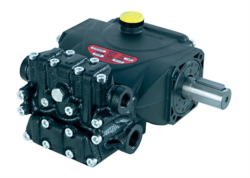
Interpump's E3B and E3C series illustrate contrasting design philosophies regarding power and displacement trade-offs. The Interpump E3B2515I operates at 1,450 rpm and delivers 15 L/min at 250 bar while consuming 7.13 kW. This represents a high-pressure, lower-displacement design optimized for systems requiring sustained elevated pressure with moderate volumetric delivery. The pump's power-to-flow ratio is approximately 0.48 kW per L/min—relatively high because the dominant energy requirement is maintaining pressure against system resistance rather than moving large fluid volumes. This architecture suits industrial cleaning equipment, material testing systems, and injection molding machinery where pressure dominates the specification.
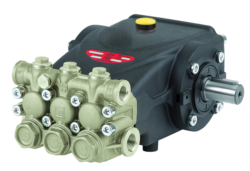
By contrast, the Interpump E3C1021 operates at 1,750 rpm and delivers 21 L/min at only 100 bar while consuming just 4.04 kW. This lower-pressure, higher-displacement design yields a power-to-flow ratio of approximately 0.19 kW per L/min—nearly 2.5 times more efficient in terms of power per unit flow. The pump's larger displacement (relative to the E3B series) allows lower rotational speeds and reduced mechanical stress, making it suitable for circulation applications, cooling systems, and transfer duties where moderate pressure suffices.
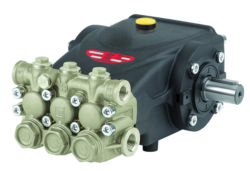
The Interpump E3C1515 L occupies a middle ground: 15 L/min at 150 bar, 4.26 kW, and 1,750 rpm operation. Its power-to-flow ratio of 0.28 kW per L/min suggests moderate efficiency and broad applicability. These three products illustrate a fundamental principle: as pressure requirements increase relative to flow, power consumption per unit volume rises sharply. The E3B2515I's 250 bar rating demands 1.67 times more power than the E3C1021's 100 bar rating to deliver only 28% less flow—a significant energy penalty for sustained high-pressure duty.
Procurement teams evaluating these families must ask: does my application truly require the E3B's pressure capability, or can a lower-pressure E3C family pump meet performance needs at substantially lower power draw? This distinction becomes critical in facilities operating dozens of pumps or managing multi-site global operations where even modest per-unit power reductions compound into measurable cost savings over equipment lifetimes measured in decades.
Real-World Application Examples: Power-Displacement Alignment
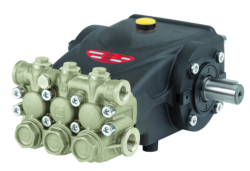
Consider a Singapore manufacturing facility operating a central cooling loop for precision machining centers. The system requires continuous circulation of 18 L/min at 120 bar pressure. A procurement engineer might initially select the Interpump E3B2515I because it handles 250 bar—safely above the 120 bar requirement. However, this selection forces the pump to operate at only 48% of its rated pressure while consuming 7.13 kW continuously. Over a 24/7 operational calendar, this over-specification wastes approximately 3 kW continuously compared to the Interpump E3C1218 L, which delivers 18 L/min at exactly 120 bar while consuming 4.12 kW—a 42% reduction in electrical demand. Annualized energy cost savings alone could justify a complete equipment replacement.
Alternatively, a high-pressure surface preparation operation in a global contract-manufacturing network might require 15 L/min at 250 bar for 2-hour work shifts, three times daily. The Interpump E3B2515I becomes the correct choice despite its 7.13 kW rating because the duty cycle is intermittent—the pump operates only 6 hours daily, making total energy consumption manageable despite the high power draw. An E3C family pump rated at only 150 bar would be unsuitable regardless of cost savings, because it cannot meet the pressure specification and would require parallel pumps or oversized motors to compensate, ultimately proving more expensive and complex.
These scenarios demonstrate that power and displacement selection cannot be decoupled from duty cycle analysis. Continuous-duty applications strongly favor lower-pressure, higher-displacement designs that minimize power draw. Intermittent high-pressure applications justify higher power consumption because duty-cycle economics override hourly operating cost. Global procurement teams managing diverse facility types must evaluate each application independently rather than standardizing on a single pump family across all operations.
Power Efficiency and Displacement: Selection Best Practices for Procurement Engineers
1. Calculate Power-to-Flow Ratios
For every pump under consideration, divide rated power (kW) by rated flow (L/min) to establish a baseline efficiency metric. Lower ratios indicate better volumetric delivery per unit power consumed. Use this metric to screen pump families before detailed evaluation, allowing rapid identification of candidates that align with your facility's electrical capacity and energy budgets.
2. Match Duty Cycle to Design Philosophy
Obtain duty-cycle data from equipment operators: hours per day, pressure cycling frequency, sustained vs. intermittent operation. High-displacement, low-speed pumps excel in continuous-duty environments but may be unnecessarily expensive for intermittent use. High-pressure, lower-displacement pumps are appropriate for short-duration, high-intensity work cycles.
3. Validate Motor Availability
Confirm that your facility's electrical infrastructure can support the pump's power requirement at the specified operating voltage and phase configuration. Over-specification creates unnecessary motor-upgrade costs; under-specification in global multi-site operations complicates spare-parts standardization and increases logistics complexity.
4. Consider Long-Term Operating Cost
Calculate total cost of ownership including equipment purchase, installation, and annualized energy consumption. Even a 10% reduction in power draw across continuous-duty pumps typically justifies equipment cost premiums within 2-3 years of operation, particularly in high-electricity-cost markets across global operations.
Conclusion: Power and Displacement as Strategic Selection Variables
Power output and displacement geometry remain undervalued variables in industrial pump procurement, overshadowed by pressure and flow specifications that dominate initial evaluation. Yet these parameters directly influence equipment cost, electrical infrastructure requirements, and long-term operational expense. By evaluating power-to-flow ratios, aligning pump design philosophy to duty-cycle realities, and calculating total cost of ownership, procurement engineers can specify equipment that performs reliably while minimizing energy waste and supporting global asset-management strategies.
3G Electric's technical team maintains expertise in power and displacement optimization across industrial pump families. Whether you are consolidating pump specifications across multiple global facilities or specifying equipment for a single critical application, our engineers can help you evaluate power efficiency, validate motor compatibility, and select pumps that balance performance, cost, and long-term operational sustainability. Contact us today for a technical consultation—let's ensure your pump selection delivers both the performance you need and the efficiency your budget demands.