Pump Displacement & Flow Capacity: Selecting Industrial Pumps by Delivery Rate for Global Applications
Pump displacement and flow capacity represent one of the most fundamental yet frequently misunderstood selection criteria in industrial equipment procurement. While pressure ratings dominate specification discussions, flow rate—the volume of fluid delivered per unit time—directly determines whether a pump can satisfy the operational demands of your system. For procurement and purchase engineers evaluating equipment for global industrial applications, understanding displacement fundamentals and how they translate into real-world delivery performance is essential for avoiding costly specification errors, system undersizing, and operational inefficiency. This technical guide examines volumetric displacement principles, compares displacement across industrial pump families, and provides practical selection frameworks tied to actual equipment available through 3G Electric's distribution network.
Understanding Pump Displacement and Volumetric Flow Rate
Pump displacement refers to the volume of fluid a pump moves with each complete rotation or cycle. Measured in cubic centimeters per revolution (cc/rev) or liters per minute (L/min) at a given rotational speed, displacement is a fixed geometric property of the pump design—it cannot be changed without physically modifying the pump internals. Volumetric flow rate, by contrast, is the actual volume of fluid delivered to the system per unit time and depends on both displacement and rotational speed (RPM).
The relationship is straightforward: Flow Rate (L/min) = Displacement (cc/rev) × RPM ÷ 1000. This means that for a pump with fixed displacement, increasing rotational speed increases flow output linearly. Conversely, two pumps with different displacements operating at the same speed will deliver proportionally different flow rates.
This distinction matters critically in equipment selection. A pump specified for a 15 L/min requirement operating at 1450 RPM requires less displacement per revolution than a pump delivering 21 L/min at the same speed. Understanding this relationship prevents procurement teams from oversizing equipment (increasing capital cost and energy consumption) or undersizing it (resulting in system starvation and operational failure).
In global industrial applications—from HVAC systems to hydraulic circuits to fluid transfer operations—matching pump displacement to system demand is non-negotiable. Undersized pumps create bottlenecks; oversized pumps waste energy and accelerate component wear through excessive pressure relief valve cycling. The precision required in this selection process demands that engineers have access to detailed displacement and flow specifications across comparable equipment options.
Displacement Comparison Across Interpump Industrial Pump Series
3G Electric's inventory includes multiple Interpump pump families, each engineered for distinct displacement and flow scenarios. Examining these options reveals how displacement design philosophies differ and how they translate into practical application fit.
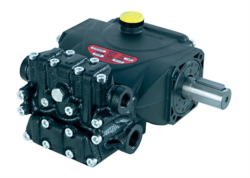
The Interpump E3B2515I pump exemplifies a high-displacement, high-pressure design intended for demanding applications. Delivering 15 L/min at 1450 RPM with pressure ratings reaching 250 bar (3625 PSI), this pump operates at relatively moderate speed with compact geometry (265 mm length). The combination of moderate displacement with very high pressure capability makes this pump ideal for systems requiring precision control and sustained pressure delivery—such as precision cleaning equipment, compact hydraulic systems, and applications where space is constrained but pressure demands are significant.
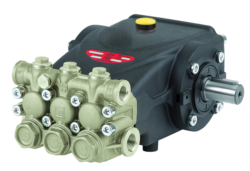
In contrast, the Interpump E3C1021 pump operates at the same 1750 RPM rotational speed but delivers 21 L/min—40% greater flow capacity than the E3B2515I. Despite higher flow output, the E3C1021 is rated for only 100 bar (1450 PSI), reflecting a fundamentally different design philosophy. This pump targets volume-intensive applications: cooling circuits, low-pressure fluid transfer, process circulation, and HVAC distribution systems where continuous flow volume matters more than extreme pressure capability.
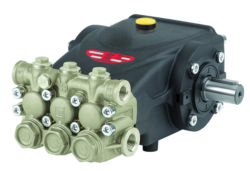
The Interpump E3C1515 pump occupies the middle ground: 15 L/min flow delivery at 1750 RPM with 150 bar (2175 PSI) pressure rating. This balanced design serves applications requiring moderate flow with medium pressure—general hydraulic systems, machinery lubrication circuits, and composite applications spanning multiple duty cycles.
These variations demonstrate a critical principle: displacement selection represents a trade-off between flow volume and pressure capacity. Higher displacement designs sacrifice maximum pressure capability; lower displacement designs limit flow but enable higher pressure ratings. Neither approach is inherently superior—specification depends entirely on application requirements. A procurement team must first establish whether the limiting constraint is flow volume or pressure magnitude, then select displacement accordingly.
Real-World Application Scenarios: Displacement-Driven Selection
Scenario 1: Closed-Loop HVAC System Expansion
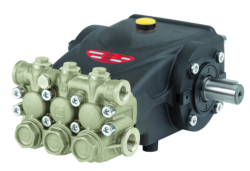
A global manufacturing facility in Southeast Asia requires a supplementary circulation pump for its existing HVAC system. The system engineer specifies 18 L/min continuous delivery at low pressure (120 bar maximum). The facility's procurement team evaluates the Interpump E3C1218 pump, which delivers exactly 18 L/min at 1750 RPM with 120 bar pressure rating. This displacement match is precise: neither oversized (avoiding energy waste) nor undersized (meeting the system's volume demand). The pump integrates seamlessly without requiring system reconfiguration.
Scenario 2: High-Pressure Compact Hydraulic System
A precision equipment manufacturer operating facilities across multiple continents requires a pump for a compact hydraulic assembly where mounting space is severely limited and system pressure reaches 250 bar during peak operation. Flow requirements are modest—only 15 L/min. The Interpump E3B2515 pump offers the necessary high pressure rating while maintaining compact physical dimensions. The lower displacement (relative to E3C series pumps) ensures the pump can achieve the required pressure within the system architecture. Attempting to use a higher-displacement, lower-pressure pump in this application would require oversizing the motor and hydraulic reservoir, increasing capital cost and facility footprint.
Scenario 3: Process Circulation with Integrated Valve Control
An industrial facility requires a circulation pump for process cooling with integrated pressure relief valve, 21 L/min capacity, and simplified installation. The Interpump E3C1021 with integrated valve delivers the required displacement while eliminating separate valve procurement and installation complexity. The combination of adequate flow capacity and moderate pressure (100 bar) aligns with the application's thermal management profile.
Selection Criteria: Matching Displacement to Application Requirements
Step 1: Establish System Flow Demand Determine the minimum volumetric flow rate required for your application. This is non-negotiable—undersizing creates system failure. Consider peak demand plus margin (typically 10-15%) to account for filter loading and component aging.
Step 2: Identify Operating Speed Constraints Determine the available motor speed (typically 1450, 1750, or 3400 RPM for industrial electric motors). This constrains which pump displacement options are viable. A system requiring 15 L/min at 1450 RPM demands different displacement than 15 L/min at 1750 RPM.
Step 3: Cross-Check Pressure Compatibility Verify that the candidate pump's pressure rating accommodates your system's sustained and peak pressure demands. Do not confuse flow capacity with pressure capability—a high-flow pump rated for only 100 bar cannot serve a 250 bar system regardless of displacement match.
Step 4: Evaluate Total Cost of Ownership Compare capital cost, energy consumption (reflected in power ratings), weight (affecting mounting and support costs), and long-term reliability across candidate options. A slightly larger displacement may reduce motor strain and extend component life, offsetting higher initial cost.
Step 5: Consider Serviceability and Spare Parts Availability Ensure that replacement components and expertise are available globally, particularly if your operations span multiple regions. Established industrial brands typically offer better parts availability and technical support.
Closing Recommendation
Pump displacement and flow capacity selection requires precision, data-driven analysis, and access to comparable technical specifications across multiple equipment families. Oversimplifying this decision by selecting "the highest-rated pump" or defaulting to previous specifications often results in suboptimal performance, wasted capital, and operational inefficiency.
3G Electric has served global industrial customers since 1990 with authoritative expertise in pumps, compressors, and industrial equipment distribution. Our technical team can evaluate your specific flow and pressure requirements and match you with the optimal displacement configuration from our comprehensive Interpump inventory. Whether you require high-flow, low-pressure circulation; compact, high-pressure systems; or balanced medium-capacity designs, we can provide detailed comparative analysis tied to your application profile. Contact 3G Electric today to discuss your pump displacement requirements and access technical specifications for equipment designed to match your operational demands precisely.